
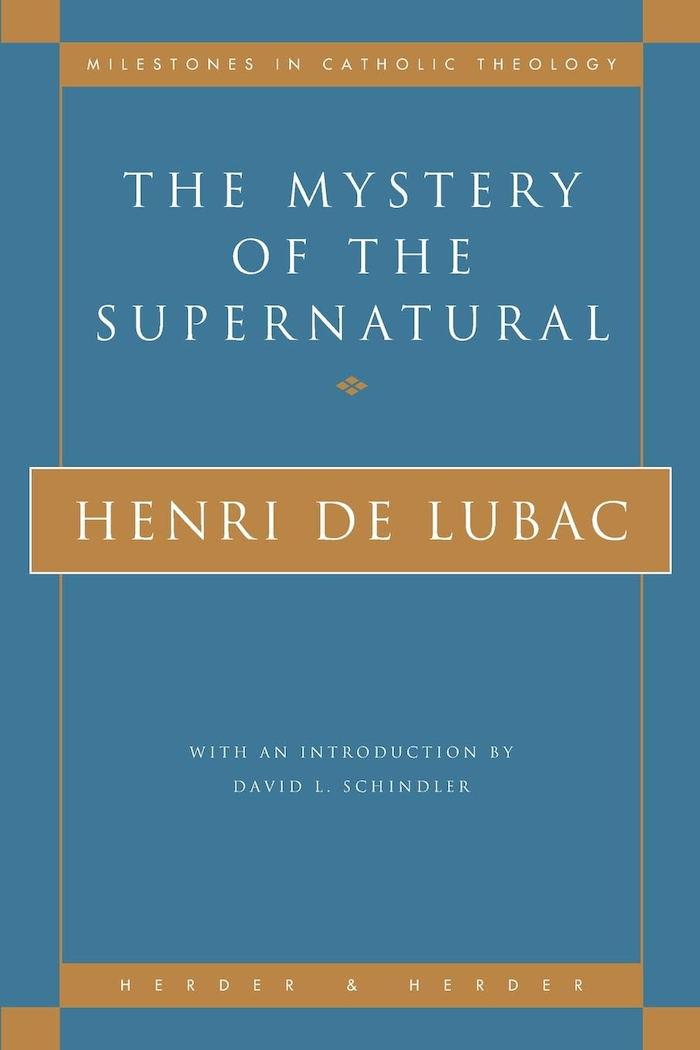
One of the organizing themes in the work of theologian Henri de Lubac (1896–1991) was that the division between what we call the “natural” and the “supernatural” was a relatively late twist taken in theology. In his Introduction to a 1998 edition of de Lubac’s The Mystery of the Supernatural, David L. Schindler wrote: “Neither the Fathers nor the great scholastics had ever envisioned the possibility of a purely natural end for human persons attainable by their own intrinsic powers of cognition and volition, some natural beatitude of an order inferior to the intuitive vision of God. For these earlier thinkers, there was only one concrete order of history, that in which God had made humanity for himself, and in which human nature had thus been created only for a single destiny, which was supernatural.”
Early in his career, De Lubac was attacked for his repudiation of the deep dualism that had afflicted modern theology (and hence, modern culture). Gratefully, toward the end of his life, he believed that a critical mass of theological reflection had come to recognize the mistake of establishing a boundary between “nature” and “supernature,” a boundary which ontologically alienated Creation from God. But sadly, a great deal of damage had been done in the secularizing centuries that reinforced this boundary. So, in the 1965 Preface to The Mystery of the Supernatural, de Lubac wrote:
[T]hough the dualist — or, perhaps better, separatist — thesis has finished its course, it may be only just beginning to bear its bitterest fruit. As fast as professional theology moves away from it, it becomes so much more widespread in the sphere of practical action. While wishing to protect the supernatural from any contamination, people had in fact exiled it altogether — both from intellectual and from social life — leaving the field free to be taken over by secularism. Today, that secularism, following its course, is beginning to enter the minds even of Christians. They too seek to find a harmony with all things based upon an idea of nature which might be acceptable to a deist or an atheist: everything that comes from Christ, everything that should lead to him, is pushed so far into the background as to look like disappearing for good. The last word in Christian progress and the entry into adulthood would then appear to consist in a total secularization which would expel God not merely from the life of society, but from culture and even from personal relationships.
Theologian Peter Leithart — president of the Theopolis Institute — is one of many Protestant thinkers who have appreciated de Lubac’s diagnosis of some of the theological roots of radical secularism. In the video embedded below, Leithart summarizes de Lubac’s claims about the supernatural.
Leithart further expounds on this key theme in de Lubac’s thought in an essay titled “Natural and Supernatural,” published by the Theopolis Institute.
Click on the tags below for listings of related readings or audio features.