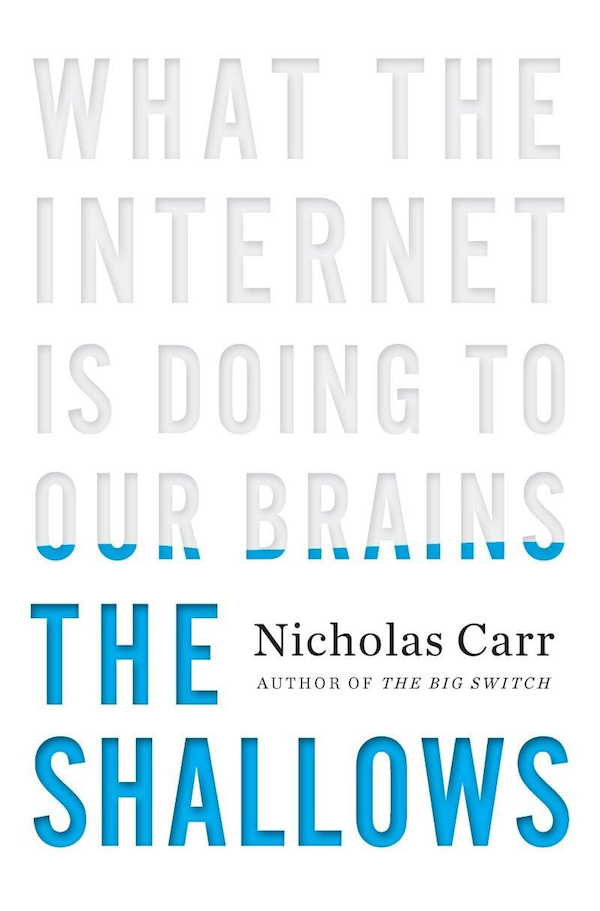
“Marshall McLuhan . . . elucidated the ways our technologies at once strengthen and sap us. In one of the most perceptive, if least remarked, passages in Understanding Media, McLuhan wrote that our tools end up ‘numbing’ whatever part of our body they ‘amplify.’ When we extend some part of ourselves artificially, we also distance ourselves from the amplified part and its natural functions. When the power loom was invented, weavers could manufacture far more cloth during the course of a workday than they’d been able to make by hand, but they sacrificed some of their manual dexterity, not to mention some of their ‘feel’ for fabric. Their fingers, in McLuhan’s terms, became numb. Farmers, similarly, lost some of their feel for the soil when they began using mechanical harrows and plows. Today’s industrial farm worker, sitting in his air-conditioned cage atop a gargantuan tractor, rarely touches the soil at all — though in a single day he can till a field that his hoe-wielding forebear could not have turned in a month. When we’re behind the wheel of our car, we can go a far greater distance than we could cover on foot, but we lose the walker’s intimate connection to the land.
“As McLuhan acknowledged, he was far from the first to observe technology’s numbing effect. It’s an ancient idea, one that was given perhaps its most eloquent and ominous expression by the Old Testament psalmist:
Their idols are silver and gold, The work of men’s hands. They have mouths, but they speak not; Eyes have they, but they see not; They have ears, but they hear not; Noses have they, but they smell not; They have hands, but they handle not; Feet have they, but they walk not; Neither speak they through their throat. They that make them are like unto them; So is every one that trusteth in them.
“The price we pay to assume technology’s power is alienation. The toll can be particularly high with our intellectual technologies. The tools of the mind amplify and in turn numb the most intimate, the most human, of our natural capacities — those for reason, perception, memory, emotion. The mechanical clock, for all the blessings it bestowed, removed us from the natural flow of time. When Lewis Mumford described how modern clocks helped ‘create the belief in an independent world of mathematically measurable sequences,” he also stressed that, as a consequence, clocks ‘disassociated time from human events.’ [Joseph] Weizenbaum, building on Mumford’s point, argued that the conception of the world that emerged from timekeeping instruments ‘was and remains an impoverished version of the older one, for it rests on a rejection of those direct experiences that formed the basis for, and indeed constituted, the old reality.’ In deciding when to eat, to work, to sleep, to wake up, we stopped listening to our senses and started obeying the clock. We became a lot more scientific, but we became a bit more mechanical as well.
“Even a tool as seemingly simple and benign as the map had a numbing effect. Our ancestors’ navigational skills were amplified enormously by the cartographer’s art. For the first time, people could confidently traverse lands and seas they’d never seen before — an advance that spurred a history-making expansion of exploration, trade, and warfare. But their native ability to comprehend a landscape, to create a richly detailed mental map of their surroundings, weakened. The map’s abstract, two-dimensional representation of space interposed itself between the map reader and his perception of the actual land. As we can infer from recent studies of the brain, the loss must have had a physical component. When people came to rely on maps rather than their own bearings, they would have experienced a diminishment of the area of their hippocampus devoted to spatial representation. The numbing would have occurred deep in their neurons.
“We’re likely going through another such adaptation today as we come to depend on computerized GPS devices to shepherd us around. Eleanor Maguire, the neuroscientist who led the study of the brains of London taxi drivers, worries that satellite navigation could have ‘a big effect’ on cabbies’ neurons. ‘We very much hope they don’t start using it,’ she says, speaking on behalf of her team of researchers. ‘We believe [the hippocampal] area of the brain increased in grey matter volume because of the huge amount of data [the drivers] have to memorize. If they all start using GPS, that knowledge base will be less and possibly affect the brain changes we are seeing.’ The cabbies would be freed from the hard work of learning the city’s roads, but they would also lose the distinctive mental benefits of that training. Their brains would become less interesting.
“In explaining how technologies numb the very faculties they amplify, to the point even of ‘autoamputation,’ McLuhan was not trying to romanticize society as it existed before the invention of maps or clocks or power looms. Alienation, he understood, is an inevitable by-product of the use of technology. Whenever we use a tool to exert greater control over the outside world, we change our relationship with that world. Control can be wielded only from a psychological distance. In some cases, alienation is precisely what gives a tool its value. We build houses and sew Gore-Tex jackets because we want to be alienated from the wind and the rain and the cold. We build public sewers because we want to maintain a healthy distance from our own filth. Nature isn’t our enemy, but neither is it our friend. McLuhan’s point was that an honest appraisal of any new technology, or of progress in general, requires a sensitivity to what’s lost as well as what’s gained. We shouldn’t allow the glories of technology to blind our inner watchdog to the possibility that we’ve numbed an essential part of our self.”
— from Nicholas Carr, The Shallows: What the Internet Is Doing to Our Brains (W. W. Norton, 2010)
Machines and misanthropy — Nicholas Carr on how technology has transformed our understanding of progress (and people)
Disengagement from the world — Nicholas Carr encourages us to consider how automation technologies impact our ability to engage with the world and whether — like a good tool — they present a more inviting world or close us off from that world. (30 minutes)
Life more abundantly — Jeanne Schindler advocates for a return to an understanding and prioritizing of sensory experience — real engagement with the real world — as foundational to learning and living. (35 minutes)
Literary and media scholar Grant Wythoff talks about the “father of science fiction,” Hugo Gernsback. (26 minutes)
Utopian dreams and cynicism — John Durham Peters discusses the history of the idea of communication, saying that our hopes are too high when we believe that the solution to social discord is just better communication. (49 minutes)
Mark Bauerlein talks about the ways of learning and living practiced by contemporary youth, how they impact the acquisition and use of knowledge and form intellectual habits, and what this means for the future of our society. (16 minutes)
Helping boys become virtuous men — Teacher and chaplain Mark Perkins describes forms of formation that take the body seriously 50 minutes
Clips from five extended interviews — We are pleased to share clips from five interviews that we’ve recently produced as full-length Conversations. (30 minutes)
In the Image of Our Devices — Nicholas Carr considers how automation technologies impact our ability to engage with the world. (66 minutes)
The recovery of an integrated ecology — In this essay, Michael Hanby unpacks the summons of Laudato si’ to an ecological way of life based on a proper understanding of creation in its fullness and integrity. (57 minutes)
The downward spiral of all technocracies — Andrew Willard Jones explains the two paths that exist with the development of new technologies: one which leads to an expansion of the humane world and one which exploits and truncates both Creation and humanity. (65 minutes)
How social media truncates relationships — In this lecture, Felicia Wu Song explains how social media industrializes and monetizes our relationships, forming us in modes of relationships and identity that are detrimental to ourselves and to society. (41 minutes)
On the Degeneration of Attentiveness — Critic Nicholas Carr talks about how technology-driven trends affect our cultural and personal lives. (56 minutes)
Gratitude, vitalism, and the timid rationalist — In this lecture, Matthew Crawford draws a distinction between an orientation toward receiving life as gift and a timid and cramped rationalism that views man as an object to be synthetically remade. (52 minutes)
Humans as biological hardware — In this essay, Brad Littlejohn and Clare Morell decry how modern technology tends to hack the human person in pursuit of profit. (55 minutes)
Robert Kanigel describes the transformation of work due to Frederick Winslow Taylor’s concept of scientific management. (11 minutes)
Choices about the uses of technology — This Feature presents interviews with David Nye and Brian Brock related to how we evaluate adoption of new technology and how technology influences our thinking. (31 minutes)
Sociologist Craig Gay argues that in order to address the challenges of a technological approach to the world, we need to recover the Christian tradition’s robust theology of personhood. (24 minutes)
Education that counters alienation — In this lecture, Jeanne Schindler explores how digital technologies warp not only education but our experience of being human. (30 minutes)
Paradoxical attitudes toward plastic — Jeffrey Meikle traces the technological, economic, and cultural development of plastic and relates it to the American value of authenticity. (15 minutes)
Albert Borgmann (1937–2023) believes Christians have an obligation to discuss and discern the kind of world that technology creates and encourages. (12 minutes)
The gift of meaningful work — In this lecture, D. C. Schindler argues that genuine work is inherently meaningful and facilitates an encounter with reality and therefore, ultimately, with God. (36 minutes)
Philosopher and mechanic Matthew Crawford laments the losses of human skill that correspond with gains in mechanical automation. (21 minutes)
A fearful darkness in mind, heart, and spirit — Roberta Bayer draws on the work of George Parkin Grant (1918–1988) to argue that our “culture of death” must be countered with an understanding of reality based in love, redemptive suffering, and a recognition of limitations to individual control. (33 minutes)
Questioning “conservatives” — John Lukacs asserts that believers in unending technological ‘progress’ can’t really be conservatives.
Life, liberty, and the defense of dignity — In a 2003 interview, Leon Kass discussed his book Life, Liberty, and the Defense of Dignity: The Challenge for Bioethics. The unifying theme in the book’s essays is the threat of dehumanization in one form or another. (36 minutes)
Neal Postman discuses the ways in which how we think about the world has been influenced by communications technology, even in its earliest forms. (11 minutes)
A.I., power, control, & knowledge — Ken Myers shares some paragraphs from Langdon Winner‘s seminal book, Autonomous Technology: Technics-out-of-Control as a Theme in Political Thought (1977) and from Roger Shattuck‘s Forbidden Knowledge: From Prometheus to Pornography (1996). An interview with Shattuck is also presented. (31 minutes)
Technology and social imaginaries — In this interview from 1999, cultural historian David Nye insists that societies have choices about how they use technologies, but that once choices are made and established, a definite momentum is established. (19 minutes)
Living into focus — As our lives are increasingly shaped by technologically defined ways of living, Arthur Boers discusses how we might choose focal practices that counter distraction and isolation. (32 minutes)
Albert Borgmann, R.I.P. — Albert Borgmann argues that, despite its promise to the contrary, technology fails to provide meaning, significance, and coherence to our lives. (47 minutes)