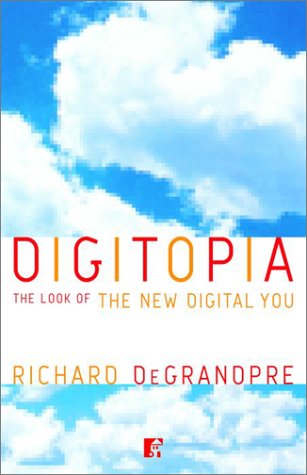
I first ran across the work of Richard DeGrandpre in an article he wrote for the magazine, AdBusters. That magazine’s original editorial vision (which they seem to have forgotten in recent years) was to examine the ways in which the version of reality encouraged by advertising (and by other technnlogically mediated forms of communication) promotes habits of profoundly distorted perception.
The article I read by DeGrandpre was called “The Great Escape” (published in the March/April 2001 issue), in which DeGrandpre described experiments done in the 1930s by perception psychologist James Gibson. People were given glasses that distorted their vision, making straight lines seem curved. The subjects gradually compensated for the distortion of the lenses, and eventually, the curved lines seemed to be straight ones. When the glasses were removed, straight lines were perceived to be curving in the other direction.
DeGrandpre related this to the so-called beauty myth. Young women, he observed, have millions of exemplars from which to judge the sizes and shapes of the female body, yet this vast pool of reality is somehow overridden by a narrow band of hyper-reality. It’s a perfect match with the finding of Gibson’s classic study. Many young women, presented with their own image, fail to ‘see’ what appears on their retinas. Instead, as researchers have now documented, they often perceive a distorted, ‘fatter’ version of themselves. Again, their sense of reality derives from cumulative experience with the goal of adapting to whatever reality appears to be most pressing, or ‘valuable.’ Unfortunately, for many women, this ‘valued’ reality happens to make them sick.
DeGrandpre’s discussion was a helpful reminder of how much our perception of reality is conditioned by our cultural setting. This leads some postmodernists to insist that there is no reality, only socially constructed perceptions. An alternative reading, one which has many resonances in Scripture and the Christian tradition, is that there is a reality, and our cultural situatedness can either help us see it or deter us from seeing it. The glasses I am wearing right now enable me to see what the trees outside my window and the birds at my feeder actually do look like; they do not enable an arbitrary and entirely idiosyncratic view of the world. They put me in greater touch with reality.
Richard DeGrandpre was concerned in that article about the way in which virtual reality was becoming more attractive to people than real reality, a theme he pursued well in his 2001 book Digitopia: The Look of the New Digital You (Random House). As he wrote in his AdBusters article,
The mind isn’t some kind of computer that remains unchanged as cultural software runs through its cerebral circuits. Conscious reality changes as the software of everyday life changes, and remains changed thereafter. Whether it’s watching the tube, surfing the web, or viewing the latest special-effects flick, chronic exposure to simulated ideas, moods, and images conditions your sensibilities, albeit to different degrees, for how the real world should look, how fast it should go, and how you should feel when living in it. When a thousand points of light shine upon you in a commercial war for your thoughts, feelings, and wants, your mind adapts, accepts, and then, to feel stimulated, needs more. Kids twenty-five years ago forfeited their quarters to a video game called Pong. Pong is to Sony PlayStation 2 what a firecracker is to the atomic bomb. Virtual reality wires us for a virtual world. . . . As you adapt to the latest digital experiences, straying farther and farther from your home world of the here and now, that home world becomes less satisfying each time you return to it. Simply, the virtual becomes the only reality that counts.
Related reading and listening
- The destructive perils of speech without a real partner — Josef Pieper and Marc Barnes on how chatbots pervert the nature of conversation
- Machines and misanthropy — Nicholas Carr on how technology has transformed our understanding of progress (and people)
- Alienation and autoamputation: the price of power — Nicholas Carr on the numbing effect of technology
- Disengagement from the world — Nicholas Carr encourages us to consider how automation technologies impact our ability to engage with the world and whether — like a good tool — they present a more inviting world or close us off from that world. (30 minutes)
- Life more abundantly — Jeanne Schindler advocates for a return to an understanding and prioritizing of sensory experience — real engagement with the real world — as foundational to learning and living. (35 minutes)
- Technophiliac obsessions — FROM VOL. 141 Literary and media scholar Grant Wythoff talks about the “father of science fiction,” Hugo Gernsback. (26 minutes)
- Utopian dreams and cynicism — John Durham Peters discusses the history of the idea of communication, saying that our hopes are too high when we believe that the solution to social discord is just better communication. (49 minutes)
- What adolescence misses — FROM VOL. 94 Mark Bauerlein talks about the ways of learning and living practiced by contemporary youth, how they impact the acquisition and use of knowledge and form intellectual habits, and what this means for the future of our society. (16 minutes)
- Helping boys become virtuous men — Teacher and chaplain Mark Perkins describes forms of formation that take the body seriously 50 minutes
- The temptations of talismanic technologies — Jeffrey Bilbro on the persistence of techno-utopianism
- Living in a tool-i-fied world — Joseph Minich on how the ubiquity of technology makes atheism entirely plausible
- In the Image of Our Devices — Nicholas Carr considers how automation technologies impact our ability to engage with the world. (66 minutes)
- The recovery of an integrated ecology — In this essay, Michael Hanby unpacks the summons of Laudato si’ to an ecological way of life based on a proper understanding of creation in its fullness and integrity. (57 minutes)
- The downward spiral of all technocracies — Andrew Willard Jones explains the two paths that exist with the development of new technologies: one which leads to an expansion of the humane world and one which exploits and truncates both Creation and humanity. (65 minutes)
- How social media truncates relationships — In this lecture, Felicia Wu Song explains how social media industrializes and monetizes our relationships, forming us in modes of relationships and identity that are detrimental to ourselves and to society. (41 minutes)
- In technology, we live and move and have our knowing — George Parkin Grant on technology’s establishment of a framework for thinking about technology
- On the Degeneration of Attentiveness — Critic Nicholas Carr talks about how technology-driven trends affect our cultural and personal lives. (56 minutes)
- Gratitude, vitalism, and the timid rationalist — In this lecture, Matthew Crawford draws a distinction between an orientation toward receiving life as gift and a timid and cramped rationalism that views man as an object to be synthetically remade. (52 minutes)
- Humans as biological hardware — In this essay, Brad Littlejohn and Clare Morell decry how modern technology tends to hack the human person in pursuit of profit. (55 minutes)
- “The system will be first” — FROM VOL. 27 Robert Kanigel describes the transformation of work due to Frederick Winslow Taylor’s concept of scientific management. (11 minutes)
- Choices about the uses of technology — This Feature presents interviews with David Nye and Brian Brock related to how we evaluate adoption of new technology and how technology influences our thinking. (31 minutes)
- What it means to be a person — FROM VOL. 147 Sociologist Craig Gay argues that in order to address the challenges of a technological approach to the world, we need to recover the Christian tradition’s robust theology of personhood. (24 minutes)
- The problem with dynamism without direction — Paulina Borsook on the biological paradigm of technolibertarianism’s love of spontaneous dynamism, whatever the costs
- The libertarian spawning-ground of tech bros — Paulina Borsook on high tech’s long-standing animosity toward government and regulation
- Tech bros and public power — Paulina Borsook discusses the “bizarrely narcissistic” and ultra-libertarian culture of Silicon Valley. (22 minutes)
- Voluntarily silencing ourselves — FROM VOL. 39 John L. Locke discusses the value of personal communication and how technology is displacing it. (12 minutes)
- Souls in cyberspace — FROM VOL. 25 Douglas Groothuis examines the worldview and mythology behind the creation and marketing of the Internet. (13 minutes)
- Life in a frictionless, synthetic world — FROM VOL. 17 Mark Slouka explores the worldview of techno-visionaries who aim to create a new era of human evolution. (11 minutes)
- The digital revolution and community — FROM VOL. 7 Ken Myers talks with Jane Metcalfe, the founder of WIRED Magazine, about technology and community. (8 minutes)
- Metaphysical impulses beneath techno-utopianism — FROM VOL. 38 Erik Davis describes his research on how humans’ fascination with technology is permeated with “mythic energy” and gnostic aspirations. (11 minutes)
- Post-Christian America and the “unlimited technological future” — George Parkin Grant on technology and the Puritan legacy of “unflinching wills”
- Education that counters alienation — In this lecture, Jeanne Schindler explores how digital technologies warp not only education but our experience of being human. (30 minutes)
- What is lost with labor-saving devices — Romano Guardini on what is lost when cultural pursuits eclipse natural order
- Cosmetic surgery and human perfectibility — Elizabeth Haiken examines the shift that occurred in 20th century America from a focus on developing character to a focus on developing “personality” and achieving physical perfection. (19 minutes)
- Beauty, the body, and the “true self” — FROM VOL. 62 Lilian Calles Barger shows the necessity and beauty of healthy embodiment and challenges gnostic ideas found in the church that particularly distort the experiences of women. (15 minutes)
- Paradoxical attitudes toward plastic — Jeffrey Meikle traces the technological, economic, and cultural development of plastic and relates it to the American value of authenticity. (15 minutes)
- Technology and the kingdom of God — FROM VOL. 63 Albert Borgmann (1937–2023) believes Christians have an obligation to discuss and discern the kind of world that technology creates and encourages. (12 minutes)
- The gift of meaningful work — In this lecture, D. C. Schindler argues that genuine work is inherently meaningful and facilitates an encounter with reality and therefore, ultimately, with God. (36 minutes)
- Diverting language from its richest possibilities — FROM VOL. 75 Steve Talbott discusses the rich capacities of language and how technology diminishes them. (18 minutes)
- The relationship between prudence and reality — In this lecture, Ken Myers explains how the virtue of prudence is fundamentally connected with a deep and anchored understanding of reality. (54 minutes)
- The recovery of true authority for societal flourishing — Michael Hanby addresses a confusion at the heart of our current cultural crisis: a conflation of the concepts of authority and power. (52 minutes)
- Automation and human agency — FROM VOL. 150 Philosopher and mechanic Matthew Crawford laments the losses of human skill that correspond with gains in mechanical automation. (21 minutes)
- A fearful darkness in mind, heart, and spirit — Roberta Bayer draws on the work of George Parkin Grant (1918–1988) to argue that our “culture of death” must be countered with an understanding of reality based in love, redemptive suffering, and a recognition of limitations to individual control. (33 minutes)
- Questioning “conservatives” — John Lukacs asserts that believers in unending technological ‘progress’ can’t really be conservatives.
- Seeking control, in white magic and The Green Book — Alan Jacobs on C. S. Lewis’s critique of the modern pursuit of god-like control
- Life, liberty, and the defense of dignity — In a 2003 interview, Leon Kass discussed his book Life, Liberty, and the Defense of Dignity: The Challenge for Bioethics. The unifying theme in the book’s essays is the threat of dehumanization in one form or another. (36 minutes)
- The surrender of culture to technology — FROM VOL. 6Neal Postman discuses the ways in which how we think about the world has been influenced by communications technology, even in its earliest forms. (11 minutes)
- A.I., power, control, & knowledge — Ken Myers shares some paragraphs from Langdon Winner‘s seminal book, Autonomous Technology: Technics-out-of-Control as a Theme in Political Thought (1977) and from Roger Shattuck‘s Forbidden Knowledge: From Prometheus to Pornography (1996). An interview with Shattuck is also presented. (31 minutes)
- Technology and social imaginaries — In this interview from 1999, cultural historian David Nye insists that societies have choices about how they use technologies, but that once choices are made and established, a definite momentum is established. (19 minutes)
- Living into focus — As our lives are increasingly shaped by technologically defined ways of living, Arthur Boers discusses how we might choose focal practices that counter distraction and isolation. (32 minutes)