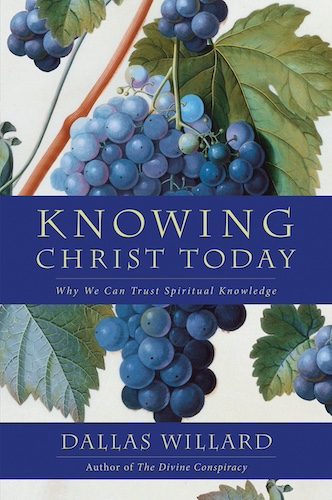
“Serious and thoughtful Christians today find themselves in a quandary about knowledge, on the one hand, and religious belief and practice, on the other. It is a socially imposed quandary. In the context of modern life and thought, they are urged to treat their central beliefs as something other than knowledge — something, in fact, far short of knowledge. Those beliefs are to be relegated to the categories of sincere opinion, emotion, blind commitment, or behavior traditional for their social group. And yet they cannot escape the awareness that those beliefs do most certainly come into conflict with what is regarded as knowledge in educational and professional circles of public life. This conflict has profound effects upon how they hold and practice religious beliefs and how they present them to others.
“Those effects are most clearly seen, on the public stage, in the repositioning of Christian teachers and leaders during the last century. They have been left to preside over the rituals of one or another cultural subgroup that, from the viewpoint of received knowledge, is nothing more than a sociological phenomenon — an ‘opiate’ of certain people-having nothing to do with knowledge of a reality with which all human beings must come to terms. This means that Christian teachers are left in the position of trying to coax and wheedle people into professing things and doing things by some means other than providing them knowledge of reality — hoping, perhaps, for ‘divine lightning’ to strike their souls and bring them around.
“The perceived gap between what is counted as knowledge and the offerings of Christian teachers is a reflection of the worldwide acceptance of the science and technology of the Western world, but not of the Christian framework of knowledge that gave rise to it. As Anglican theologian Lesslie Newbigin remarks, however: ‘No faith can command a man’s final and absolute allegiance, that is to say no faith can be a man’s real religion, if he knows that it is only true for certain places and certain people. In a world which knows that there is only one physics and one mathematics, religion cannot do less than claim for its affirmations a like universal validity.’
“A natural outcome of this felt tension between the central things Christians believe and what is accepted as knowledge of reality is the destabilization of belief and practice. Belief as mere belief — ‘my personal opinion,’ as we now ritually say — is already unstable in its own right. As Plato noted long ago, it tends to waver, to come and go, especially when concerned with the more abstract and ultimate issues of life. And that in turn makes character and action based on those beliefs hesitant and variable at best, unsuiting us for steady engagement with the realities (and disengagement from the nonrealities) that we have to deal with. Steadiness in belief and practice then comes to depend upon mere willpower, often taking the form of encrusted close-mindedness or harsh dogmatism. Belief and practice are sustained at great price, if at all. The isolation of faith from knowledge is, accordingly, one major source of the painful difference between what people profess and how they act that is so frequently seen in Christian circles — but, to be accurate, also in humanity at large. This is often thought of as a failure of will or sincerity, but in fact it goes much deeper — it is a matter of whether will and choice are founded on knowledge or the lack of it.
“This difficulty is not to be overcome by cultivating or manipulating feeling and emotions, by the practice of ritual or art, or by trying harder to believe and act as we think we should. ‘Just put your hands over your eyes and believe,’ as some have said. Nor is it overcome by miraculous injections of divine inspiration and upholding from time to time. All of these may have some place. But the problems created by belief without knowledge, or belief in opposition to knowledge cannot be dealt with in such ways. Belief cannot reliably govern life and action except in its proper connection with knowledge and with the truth and evidence knowledge involves.
“The relationship of religion to knowledge has become severely misunderstood and distorted over the last two centuries. In particular, it has become the accepted view that religion stands free of knowledge, that it requires only faith or commitment. In some quarters great faith has become equated with a belief or commitment that manages to sustain itself, with great effort, against knowledge — or at least with no support from knowledge. Faith is then regarded as essentially a kind of struggle. Some speak of the ‘lonely person of faith’ as an admirable but odd manifestation of heroic willpower.
“In fact, such an interpretation of faith is only one part of the larger contemporary picture in which life and action are seen as fundamentally irrational — totally governed by feelings, traditions, force, ‘willpower,’ and blind commitment. The significance of this picture for our contemporary life as a whole is profound. Like gravity in the physical realm, that picture pervasively influences and guides our thinking and acting — even without any specific awareness of it. In religion its effect upon practice is to restrict the foundation of devotion to will and feelings, with no thought that it is based, wholly or in part, upon knowledge of how things really are. In the social context it leads to mutual incomprehension between disagreeing parties, the inability to seek or find common ground, and suspicion, fear, contempt, and hostility. These are now the persistent undertone of our society and especially of its political discourse, frequently involving religion.”
— from Dallas Willard, Knowing Christ Today: Why We Can Trust Spiritual Knowledge (HarperOne, 2009)
Related reading and listening
- Disengagement from the world — Nicholas Carr encourages us to consider how automation technologies impact our ability to engage with the world and whether — like a good tool — they present a more inviting world or close us off from that world. (30 minutes)
- A sampling of newly published lectures — Ken Myers introduces listeners to four recently released lectures, courtesy of our Partners. The lecturers are Jennifer Frey, Gary Saul Morson, N. T. Wright, and Andrew Kern. (27 minutes)
- “If there is no God, all is permitted” — Gary Saul Morson explores the consequences of belief and disbelief in God through Russian literature. (51 minutes)
- The implausibility of belief — FROM VOL. 123 James K. A. Smith discusses the evangelical and ecclesial ramifications for Christians living within Charles Taylor’s third wave of secularism. (25 minutes)
- The “sovereign uselessness of moral reflection” — Calling on the wisdom of St. Augustine, Oliver O’Donovan reminds his listeners that all knowledge participates in the eternal Logos of God and is rooted in love, not disinterested moral judgement.(Lecture 1 of 3; 52 minutes)
- Beyond a reasonable doubt — From a 1980 interview with Ken Myers, Mortimer J. Adler discusses his argument that belief in the existence of God is rational. (14 minutes)
- Heaven and earth are full of His glory — Gerald R. McDermott examines the typological tradition of the Church, particularly through Jonathan Edwards’s thought, and he argues for a recovery of the Christian understanding of the universe as an “immense Trinitarian symbol.” (61 minutes)
- A false dichotomy — In this conversation from 2009, Dallas Willard (1934–2013) discusses the truth of spiritual knowledge and its epistemological validity. (63 minutes)
- All trees, no forest — Richard Weaver on the attenuating of knowledge
- Humility and moral knowledge — FROM VOL. 149 Steven L. Porter discusses The Disappearance of Moral Knowledge, an unfinished manuscript (which he helped to complete) by the late philosopher Dallas Willard. (22 minutes)
- Willard, Dallas — FROM THE GUEST PAGE: Dallas Willard (1935–2013) was a philosophy professor at the University of Southern California and an author of many books on Christianity and discipleship.
- Harbinger of disorder — Mark Mitchell on Michael Polanyi’s recognition of the dangerous dead-end of materialistic reductionism
- Universities as the hosts of reciprocating speech — Robert Jenson on how the Christian understanding of Truth in a personal Word shaped the Western university
- The vice of curiosity — Stanley Hauerwas on the warning from Paul Griffiths about desiring to own knowledge
- University or “utiliversity”? — In this essay, Reinhard Hütter examines in depth John Henry Newman’s The Idea of a University and argues that its insights and prescriptions are urgently relevant to the current status of higher education. (87 minutes)
- Thinking Together — Alan Jacobs discusses some principles he’s compiled to help us think well (and charitably) in our cultural context, and he warns us to be attentive to the ways technology displaces previously fixed communities. (53 minutes)
- Students as arbiters of knowledge — FROM VOL. 94 Tim Clydesdale discusses the experience of freshmen year at college, suggesting that by that time students have been effectively inoculated against a love of knowledge. (21 minutes)
- Mars Hill Audio Journal, Volume 165 — FEATURED GUESTS: Jeffrey Bilbro, Daniel McInerny, Joseph Minich, Carl Elliott, Nadya Williams, and Don W. King
- Pathways of the Mind: The Joy of the Essay — Alan Jacobs thinks Christians should embrace the potential in the literary form of the essay, because of the way it corresponds to the navigation and journey of a Christian life. (48 minutes)
- In the Image of Our Devices — Nicholas Carr considers how automation technologies impact our ability to engage with the world. (66 minutes)
- The law of faith and of love — Oliver O’Donovan compares St. Augustine’s interpretation of Psalm 119 with that of others, revealing Augustine’s more nuanced understanding of the complexities of the life of faith that the psalmist explores. (64 minutes)
- How paintings convey meaning — FROM VOL. 121 Theologian Walter Hansen and painter Bruce Herman question contemporary conceptions of meaning that confine it to the verbal or consider visual and verbal meaning to be completely exclusive. (20 minutes)
- Moral knowledge of reality — Oliver O’Donovan argues that admiration is the fundamental form of knowing the world, as we cannot know fully those elements of reality (“bare facts”) that contain no significance for us. (Lecture 2 of 3; 55 minutes)
- The recovery of an integrated ecology — In this essay, Michael Hanby unpacks the summons of Laudato si’ to an ecological way of life based on a proper understanding of creation in its fullness and integrity. (57 minutes)
- Sacramental Poetics — Poet and Eastern Orthodox believer Scott Cairns explains how a good poem functions like an icon: it assists the process of our becoming aware of what is real, and it is generative in the ways it keeps opening up new understandings. (56 minutes)
- Joy & sorrow, destitution & abundance — In this poetry reading and talk, poet Christian Wiman discusses his own faith journey and how his struggles worked themselves into his poems. (40 minutes)
- The personal element in all knowing — Mark Mitchell connects key aspects of Michael Polanyi’s conception of knowledge with Matthew Crawford’s insistence that real knowing involves more than technique. (34 minutes)
- Making contact with reality — FROM VOL. 139 Esther Lightcap Meek discusses the realism of philosopher and chemist Michael Polanyi. (23 minutes)
- Knowing the world through the body — FROM VOL. 76 Professor Martin X. Moleski explains why Michael Polanyi (1891-1976) left his career in science to become a philosopher. (16 minutes)
- Steward of knowledge vs. autonomous knower — FROM VOL. 66 Esther Lightcap Meek challenges the modernist view of knowledge, which prefers the figure of the autonomous knower to the figure of a steward of knowledge acquired in part from others. (15 minutes)
- The collaboration of bodies and minds — F. C. Copleston on Aquinas’s confidence in the embodied nature of knowledge
- Wonder, being, skepticism, and reason — FROM VOL. 135 Matthew Levering talks about the long and rich tradition of reasoning about God. (23 minutes)
- The need to recollect ourselves as whole persons — In this 2016 lecture, John F. Crosby explores key personalist insights found in the thinking of John Henry Newman and Romano Guardini. (60 minutes)
- “A sign of contradiction” — In this lecture, Daniel Gibbons compares and contrasts understandings of sacramental poetics proposed by Augustine, Aquinas, and Sydney. (36 minutes)
- Nature’s intelligibility — In this lecture, Christopher Blum argues that scientists need to regain a full appreciation of nature’s intelligibility, as they are apt to lose sight of reality due to the reductionism produced by their theories. (31 minutes)
- Submission to mathematical truth — In this lecture, Carlo Lancellotti argues that integration of the moral, cognitive, and aesthetic aspects of mathematics is needed in a robust liberal arts mathematics curriculum. (25 minutes)
- When philosophy loses its way — FROM VOL. 52 Ralph McInerny (1929–2010) speaks about themes from his 1999 Gifford Lectures, which relate how natural theology came to be regarded as pointless, resulting in a philosophical dead end.(24 minutes)
- The need for robust Christian intellectual life — In this lecture, Robert Benne surveys the contemporary landscape in which Christian scholars attempt to integrate their faith and their intellectual life. (43 minutes)
- Victorian ideas about belief and doubt — FROM VOL. 148 Timothy Larsen situates George MacDonald within a Victorian understanding of faith and doubt. (17 minutes)
- Mars Hill Audio Journal, Volume 163 — FEATURED GUESTS: Andrew Youngblood, R. J. Snell, Nicholas Denysenko, Nigel Biggar, Robert McNamara, and David Cayley
- Embodied knowledge — FROM VOL. 121 James K. A. Smith advocates for a return to some pre-modern conceptualizations of the human body. (18 minutes)
- Worldliness vs. otherworldliness — FROM VOL. 38 Sociologist Craig Gay speaks of the charge that Christianity is an otherworldly religion. (12 minutes)
- Touch’d with a coal from heav’n — Daniel Ritchie finds in the poetry of William Cowper (1731–1800) an anticipation of Michael Polanyi’s epistemology
- How we know the world — Daniel Ritchie argues that poet and hymnodist William Cowper was ahead of his time in critiquing the Enlightenment’s reductionist view of knowledge. (16 minutes)
- William Cowper: Reconciling the Heart with the Head — Daniel E. Ritchie discusses the life and work of poet William Cowper (1731–1800), comparing his commitment to understanding reality through personal knowledge, intuition, and rigorous contemplation with the thought of Michael Polanyi. (43 minutes)
- Approaches to knowing — FROM VOL. 104 Daniel Ritchie describes how many of the figures he studies in his new book emphasize the significance of human experience, enculturation, and contingency to human knowledge. (21 minutes)
- Faith as the pathway to knowledge — Lesslie Newbigin on authority and the Author of all being
- The integration of theoretical and mythic intelligence — FROM VOL. 156 William C. Hackett discusses the relationships between philosophy and theology, and of both to the meaning embedded in myth. (29 minutes)
- St. Irenaeus against the Gnostics — In this reading of an essay by theologian Khaled Anatolios, St. Irenaeus is remembered for his synthesis of faith and reason. (52 minutes)
- The ecstasy of the act of knowing — Theologian Paul Griffiths situates our creaturely knowing within the framework of the relation between God and Creation