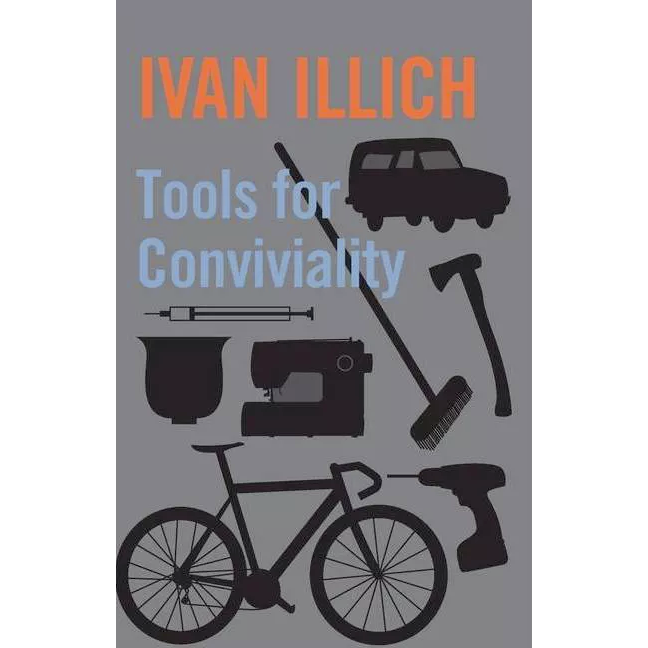
“For a hundred years we have tried to make machines work for men and to school men for life in their service. Now it turns out that machines do not ‘work’ and that people cannot be schooled for a life at the service of machines. The hypothesis on which the experiment was built must now be discarded. The hypothesis was that machines can replace slaves. The evidence shows that, used for this purpose, machines enslave men. Neither a dictatorial proletariat nor a leisure mass can escape the dominion of constantly expanding industrial tools.
“The crisis can be solved only if we learn to invert the present deep structure of tools; if we give people tools that guarantee their right to work with high, independent efficiency, thus simultaneously eliminating the need for either slaves or masters and enhancing each person’s range of freedom. People need new tools to work with rather than tools that ‘work’ for them. They need technology to make the most of the energy and imagination each has, rather than more well-programmed energy slaves.
“I believe that society must be reconstructed to enlarge the contribution of autonomous individuals and primary groups to the total effectiveness of a new system of production designed to satisfy the human needs which it also determines. In fact, the institutions of industrial society do just the opposite. As the power of machines increases, the role of persons more and more decreases to that of mere consumers.
“Individuals need tools to move and to dwell. They need remedies for their diseases and means to communicate with one another. People cannot make all these things for themselves. They depend on being supplied with objects and services which vary from culture to culture. Some people depend on the supply of food and other others on the supply of ball bearings.
“People not only need to obtain things, they need above all the freedom to make things among which they can live, to give shape to them according to their own tastes, and to put them to use in caring for and about others. Prisoners in rich countries often have access to more things and services than members of their families, but they have no say in how things are to be made and cannot decide what to do with them. Their punishment consists in being deprived of what I shall call ‘conviviality.’ They are degraded to the status of mere consumers.
“I choose the term ‘conviviality’ to designate the opposite of industrial productivity. I intend it to mean autonomous and creative intercourse among persons, and the intercourse of persons with their environment; and this in contrast with the conditioned response of persons to the demands made upon them by others, and by a man-made environment. I consider conviviality to be individual freedom realized in personal interdependence and, as such, an intrinsic ethical value. I believe that, in any society, as conviviality is reduced below a certain level, no amount of industrial productivity can effectively satisfy the needs it creates among society’s members.
“Present institutional purposes, which hallow industrial productivity at the expense of convivial effectiveness, are a major factor in the amorphousness and meaninglessness that plague contemporary society. The increasing demand for products has come to define society’s process.”
— From Ivan Illich, Tools for Conviviality (Harper & Row, 1973)
Related reading and listening
- Reason and the love of truth — FROM VOL. 97 James Peters discusses historical understandings of reason and rationality and how they differ from the modern notion of rationality. (21 minutes)
- The primacy of the Body of Christ — FROM VOL. 134 Philip Turner reflects on how Christian ethics is misplaced if it has as its central concern individual moral behavior or social justice. (28 minutes)
- How communities remember who they are — Oliver O’Donovan on the necessity of tradition in sustaining communal identity
- How common loves shape communities — Oliver O’Donovan discusses how communities mediate love and knowledge to their members and what challenges arise as a community’s traditions are confronted by sin, error, and plurality. (Lecture 2 of 3; 49 minutes)
- Money, status, and satisfaction — FROM VOL. 44 David Myers and Robert Frank discuss the tenuous relationship between wealth and happiness. (22 minutes)
- Landscape and living memory — FROM VOL. 44 Gayle Brandow Samuels examines the ways in which trees have served as anchor-points for memory and identity in American culture. (9 minutes)
- Thinking Together — Alan Jacobs discusses some principles he’s compiled to help us think well (and charitably) in our cultural context, and he warns us to be attentive to the ways technology displaces previously fixed communities. (53 minutes)
- Mars Hill Audio Journal, Volume 165 — FEATURED GUESTS: Jeffrey Bilbro, Daniel McInerny, Joseph Minich, Carl Elliott, Nadya Williams, and Don W. King
- The reciprocity of all things — FROM VOL. 148 Jeffrey Bilbro explores the importance of sustainability through the essays, poetry and fiction of Wendell Berry. (13 minutes)
- What are students for? — FROM VOL. 140 Drawing from Wendell Berry’s works, Jack Baker and Jeffrey Bilbro discuss a vision of higher education that respects a multidimensional notion of place. (23 minutes)
- Real Food, Real Communities — Corby Kummer extols the virtues of the Slow Food movement, which seeks to honor, protect, and sustain traditional foods and ingredients from specific cultures and regions. (48 minutes)
- Clips from five extended interviews — We are pleased to share clips from five interviews that we’ve recently produced as full-length Conversations. (30 minutes)
- Shared Practices, Strong Communities — Christine Pohl reflects on why a deliberate commitment to certain shared practices is necessary for the sustaining of community. (57 minutes)
- “The search for shared ends” — Oliver O’Donovan examines whether and to what extent there might be the possibility of a unifying Christian perspective on political doctrine or policy. (59 minutes)
- Antagonism or fruitfulness? — FROM VOL. 108 Jean Porter describes how natural law justifies legal and moral authority within the life of the human person. (17 minutes)
- The collapse of public life — FROM VOL. 154 D. C. Schindler explains how liberalism sought to make way for individuals to function together without any orientation to an explicit common good. (37 minutes)
- The personal element in all knowing — Mark Mitchell connects key aspects of Michael Polanyi’s conception of knowledge with Matthew Crawford’s insistence that real knowing involves more than technique. (34 minutes)
- Impact of “infotainment” on community — Neil Gabler and C. John Sommerville discuss how the mentalities conveyed by our experience with communications media work against the nurturing of community. (36 minutes)
- The digital revolution and community — FROM VOL. 7 Ken Myers talks with Jane Metcalfe, the founder of WIRED Magazine, about technology and community. (8 minutes)
- Education that counters alienation — In this lecture, Jeanne Schindler explores how digital technologies warp not only education but our experience of being human. (30 minutes)
- Mars Hill Audio Journal, Volume 163 — FEATURED GUESTS: Andrew Youngblood, R. J. Snell, Nicholas Denysenko, Nigel Biggar, Robert McNamara, and David Cayley
- Courtesy as a theological issue — FROM VOL. 37 Donald McCullough discusses his insights into the increasingly coarse nature of society and the theological foundations for courtesy. (12 minutes)
- The historian’s communal role as storyteller — FROM VOL. 127 Historian Christopher Shannon discusses how American academic historical writing presents a grand narrative of progressivism, which it defends by subscribing to an orthodoxy of objective Reason. (21 minutes)
- Friendship and life together — In a lecture at Providence College, Ken Myers explores how the concept of friendship, which used to be central to political philosophy, was banished from considerations of public life as the state was exalted over society. (53 minutes)
- Blest be the ties of language that bind us — Marion Montgomery on the precious gift of words
- The academy’s deconstruction of both person and community — Marion Montgomery on cultivating “a deportment of intellect governed by a continuing concern for the truth of things”
- Community, the giver of freedom — Thomas H. Naylor and William H. Willimon on why suspicion about big government shouldn’t take the form of autonomous individualism
- The family in modern context — Allan C. Carlson explores ways in which the family life has been reconfigured since the Industrial Revolution, with largely destructive effects. (29 minutes)
- Welcoming one another — Christine Pohl describes the practice of hospitality in Church history and the particular challenges to hospitality we face in our era. (30 minutes)
- On medicine and the meaning of suffering — Guests Susan Bergman and Christopher Shannon discuss the meaning of suffering and how we might suffer well with Christ. (19 minutes)
- We are not Cybermen — Essayist L. M. Sacasas discusses some of the ideas of Ivan Illich, whose work has influenced Sacasas’s own understanding of the anti-human dynamics of technological society. (21 minutes)
- Loving relationships in community — In conversation with moral philosopher Oliver O’Donovan, and with readings from his book, Entering into Rest, Ken Myers explores a central theme in O’Donovan’s work: that we are created to enjoy loving relationships in community. (27 minutes)
- Freed from the burden of choice — Writing in the mid-1990s, Alan Ehrenhalt reflects on the relationship between authority and community
- Why communities need authority — Alan Ehrenhalt argues that real community can only be sustained when three things are assumed: the goodness of limits, the necessity of authority, and the reality of personal sin. (13 minutes)
- The Bruderhof’s Christ-centered community — Clare Stober discusses the book she edited of stories of the Bruderhof, a network of 26 community settlements around the world. (30 minutes)
- Lessons from quarantine: Making do with tinned fruit — In this audio reprint of “Wendell Berry and Zoom,” Front Porch Republic editor Jeffrey Bilbro reflects on two metaphors that can help put our new-found “dependency” on web-based video conferencing into perspective: tinned fruit and a prosthetic limb. (17 minutes)
- A celebration of introverts — Adam McHugh and Susan Cain explain how an American culture that prizes gregariousness and “selling” oneself ends up marginalizing introverts and the gifts they have to offer, even in the Church. (36 minutes)
- Keeping “the good” in the common good — D. C. Schindler on the metaphysical character of real community
- The Good City: Community and Urban Order — Architects, historians, activists, and clergy discuss how loving our neighbors can and must take shape in how we order the material aspects of shared life. (100 minutes)
- Mars Hill Audio Journal, Volume 113 — FEATURED GUESTS: Steven Shapin, Arthur Boers, Christine Pohl, Norman Wirzba, Craig Bartholomew, and David I. Smith
- Mars Hill Audio Journal, Volume 108 — FEATURED GUESTS: Thomas Albert Howard, Jean Porter, Peter Augustine Lawler, Hans Boersma, Felicia Wu Song, and Elias Aboujaoude
- Mars Hill Audio Journal, Volume 93 — FEATURED GUESTS: Alan Jacobs, James A. Herrick, Robert C. Roberts, J. Daryl Charles, Allan C. Carlson, and Sheila O’Connor-Ambrose
- Joshua P. Hochschild: “Globalization: Ancient and Modern” — Joshua P. Hochschild examines the effects of globalization on local communities and argues for the need for reflection on the ends of politics given the ends of human beings. (36 minutes)
- Mars Hill Audio Journal, Volume 80 — FEATURED GUESTS: Stephen A. McKnight, Tim Morris, Don Petcher, Vigen Guroian, Paul Valliere, and Calvin Stapert
- Mars Hill Audio Journal, Volume 68 — FEATURED GUESTS: Murray Milner, Jr., Steven C. Vryhof, Douglas J. Schuurman, Robert Gagnon, Richard Stivers, and Quentin Schultze
- Mars Hill Audio Journal, Volume 67 — FEATURED GUESTS: Eric O. Jacobsen, Allan C. Carlson, Terence L. Nichols, R. R. Reno, David Bentley Hart, J. A. C. Redford, and Scott Cairns
- Mars Hill Audio Journal, Volume 62 — FEATURED GUESTS: Craig A. Bernthal, James Turner Johnson, Alissa Quart, Stephen M. Barr, Lilian Calles Barger, and Corby Kummer
- Mars Hill Audio Journal, Volume 59 — FEATURED GUESTS: Ron Hansen, Bernard Lewis, Alan Jacobs, Adrienne Chaplin, Todd Gitlin, and Quentin Schultze
- Mars Hill Audio Journal, Volume 45 — FEATURED GUESTS: Jeff Speck, Victor Davis Hanson, Allan C. Carlson, Paulina Borsook, John F. Kilner, Robert E. Webber, and Christoph Wolff
- Place, Community, and Memory — Several essayists and a novelist explore the important ways in which we (and the communities we inhabit) are shaped and sustained by the particular places in which we live. (100 minutes)