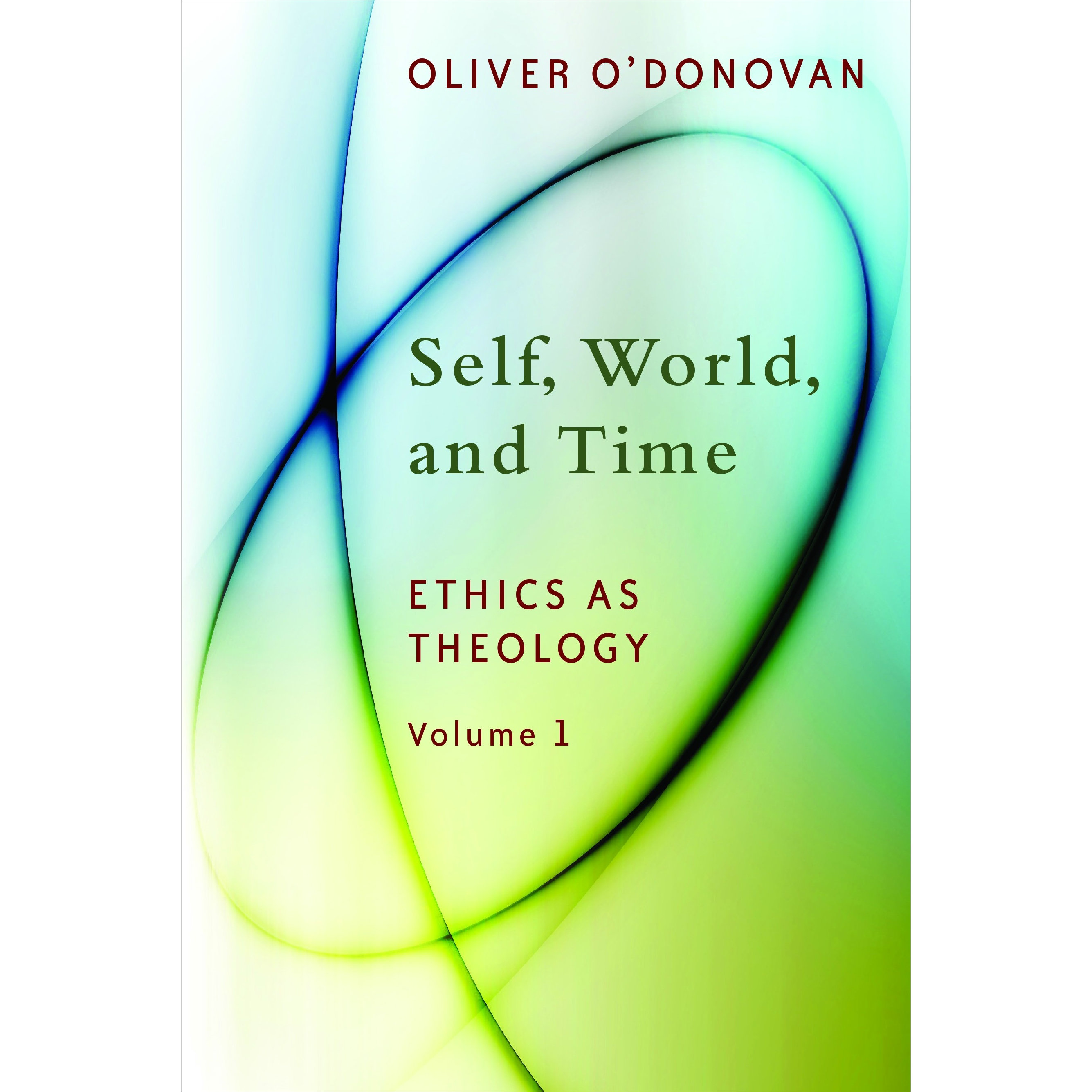
In preparing to interview moral philosopher Oliver O’Donovan about his most recent book, Entering into Rest, I have been re-reading the two earlier volumes with which the new book forms a trilogy. The series is called Ethics as Theology, and in these three books O’Donovan describes how Christian Ethics is “done” — how theologically informed thought becomes action.
In the first book, Self, World, and Time (which he designates as An Induction, paving the way for further explorations), O’Donovan examines the nature of moral agency (what it means to be an ethical self), the nature of the world in which we act morally, and the temporal trajectories (both past and future, involving memory and hope) in which ethical decisions made in our present moment are situated. In the book’s Preface, O’Donovan summarizes the challenges we face when we try (as we must) to understand the characteristics of our cultural moment. Given the editorial mission of Mars Hill Audio this paragraph especially caught my attention:
“That ‘late modernity’ in which we are given to live and act can never be taken as self-evident; it is a philosophical task in itself to understand it. There is a style of dealing with modernity all too knowingly. Modern ‘social conditions’ are comprised, we are told, of individualism, egalitarianism, technology, and capitalist enterprise; these are the terms on which mankind today lives, and we must either acknowledge them sensibly or be doomed to be forever criticizing them nostalgically — end of discussion! Alas, it is the doom of modernity to be bound up in an ever over-simple knowingness about itself! Our own age is the hardest of all ages to understand. It is composed of a mass of popular ideas and perceptions, often difficult to document though they are as familiar as the air we breathe, which acknowledge no duty to be consistent with each other. They may be derived from the thoughts of great thinkers, but when they are, they have lost most of what subtlety and discrimination they once had. They ration and restrict our access to thought about life and action in ways we must look hard in order to recognize. (It is not easy to think in a disciplined way through any social question outside the constraints of a would-be economic calculus which scarcely deserves the serious philosophical name of ‘utilitarianism.’) Even more cramping, they determine the way we describe the material objects of our thought, so that there are decent and gullible souls, for example, who think it ‘unscientific’ to refer to the child in the womb as ‘a person.’ Sophistry treads hard, as it has always trodden, on the heels of Ethics, but never harder than in a world of intense and overheated communications. The tramp of its boot must be heard before we can step to one side and free ourselves, recognizing where we have come and what decisions we must take. Such coming to recognition of our place and time is the condition for doing, or indeed being, anything.”
— From Oliver O’Donovan, Self, World, and Time: Ethics as Theology: An Induction (Eerdmans, 2013)
Related reading and listening
- War and loving our enemy-neighbor — Oliver O’Donovan on evaluating the conduct of war in light of the evangelical command of love
- “If there is no God, all is permitted” — Gary Saul Morson explores the consequences of belief and disbelief in God through Russian literature. (51 minutes)
- Ethics hidden in economics — FROM VOL. 134 William Cavanaugh explains why Christians should think about economics theologically, not just as a science or an ethical discipline. (25 minutes)
- A flood of images — Oliver O’Donovan describes the distinctive character of publicity in modernity, which drowns us in a flood of ever-changing representations that do not serve the common good. (37 minutes)
- How communities remember who they are — Oliver O’Donovan on the necessity of tradition in sustaining communal identity
- Publicity and representative images in society — Oliver O’Donovan describes the nature of publicity as the force that mediates our communication with one another, creating common interests and then rapidly subsuming them into newer ones.(Lecture 3 of 3; 57 minutes)
- How common loves shape communities — Oliver O’Donovan discusses how communities mediate love and knowledge to their members and what challenges arise as a community’s traditions are confronted by sin, error, and plurality. (Lecture 2 of 3; 49 minutes)
- The “sovereign uselessness of moral reflection” — Calling on the wisdom of St. Augustine, Oliver O’Donovan reminds his listeners that all knowledge participates in the eternal Logos of God and is rooted in love, not disinterested moral judgement.(Lecture 1 of 3; 52 minutes)
- Humility and moral knowledge — FROM VOL. 149 Steven L. Porter discusses The Disappearance of Moral Knowledge, an unfinished manuscript (which he helped to complete) by the late philosopher Dallas Willard. (22 minutes)
- How the Church promotes the cause of freedom — Oliver O’Donovan: “We discover we are free when we are commanded by that authority which commands us according to the law of our being, disclosing the secrets of the heart.”
- “The search for shared ends” — Oliver O’Donovan examines whether and to what extent there might be the possibility of a unifying Christian perspective on political doctrine or policy. (59 minutes)
- Thinking coherently about politics — Ken Myers gives an introduction to political theologian Oliver O’Donovan, whose work has been instrumental in teaching many how to think about social and political life in light of the gospel of Christ. (57 minutes)
- The law of faith and of love — Oliver O’Donovan compares St. Augustine’s interpretation of Psalm 119 with that of others, revealing Augustine’s more nuanced understanding of the complexities of the life of faith that the psalmist explores. (64 minutes)
- “Only a real world can save us” — Oliver O’Donovan explores how the “religion” of modernity lacks a coherent world in which one may participate with full human agency and moral purpose. (Lecture 3 of 3; 61 minutes)
- Christian unity and civil society — Oliver O’Donovan introduces listeners to Dutch lay theologian Hugo Grotius, arguing that the questions he tackled relate to perennial concerns about the relationship between divine and human agency, and between civil and ecclesiastical authority. (Lecture 2 of 3; 57 minutes)
- The demoralizing effect of pagan Roman religion — Oliver O’Donovan examines St. Augustine’s critique of pagan Roman religion in Book II of his treatise City of God and asks his audience to consider what insights Augustine’s critique has for us today. (Lecture 1 of 3; 51 minutes)
- Knowing and doing the good — Oliver O’Donovan raises several key questions and complications involved in the task of taking concrete and practical action toward a recognized moral good. (Lecture 3 of 3; 63 minutes)
- Moral knowledge of reality — Oliver O’Donovan argues that admiration is the fundamental form of knowing the world, as we cannot know fully those elements of reality (“bare facts”) that contain no significance for us. (Lecture 2 of 3; 55 minutes)
- Attentiveness to the world, the self, and time — Oliver O’Donovan uses the metaphor of waking to discuss the concept of moral sensibility as attention to the world, the self, and time. (Lecture 1 of 3; 60 minutes)
- Cultivating the Virtue of Reverence — Paul Woodruff (1943–2023) discusses the importance of reverence as a virtue that enriches relationships, elevates civic life, and helps leaders to wield power wisely. (53 minutes)
- Etiquette and ethics — In this essay, Judith Martin (a.k.a. Miss Manners) argues that etiquette is “civilization’s first necessity” and an indispensable societal virtue. (21 minutes)
- Against hacking babies — Oliver O’Donovan raises questions about IVF and the technologically ordered motive for efficiency
- Impact of “infotainment” on community — Neil Gabler and C. John Sommerville discuss how the mentalities conveyed by our experience with communications media work against the nurturing of community. (36 minutes)
- Eugenics and the rise of “evolutionary ethics” — FROM VOL. 70 Richard Weikart describes evolutionary ethics and examines the ties between national racism and the eugenics movements of the late nineteenth and early twentieth centuries. (16 minutes)
- The fatal polytheism of late liberalism — Oliver O’Donovan on the failure that leads to social collapse, marked by conflict, suspicion, and violence
- Insisting that political leaders are incapable of obeying Christ — Oliver O’Donovan on the unintended consequences of the First Amendment to the U.S. Constitution.
- The gift of objective reality — Moral philosopher Oliver O’Donovan makes an argument for the consistency of the idea of law when it is conceived in a theological context. (40 minutes)
- Freedom as conformity to reality — W. Bradford Littlejohn summarizes the definitions of liberty offered by Richard Bauckham and Oliver O’Donovan
- The sovereignty of love — In this 2022 lecture, Oliver O’Donovan explains the historical background — and present consequences — of the assertion by Jesus of two great commands. (67 minutes)
- O’Donovan, Oliver — FROM THE GUEST PAGE: Oliver O’Donovan held teaching posts at Wycliffe Hall, Oxford and Wycliffe College Toronto before becoming Regius Professor of Moral & Pastoral Theology and Canon of Christ Church at the University of Oxford in 1982.
- Why kings are compelling — Historian Francis Oakley describes how the modern idea of “secular” politics is a striking departure in human history. (32 minutes)
- Conscience seared with a red-hot iron — Oliver O’Donovan on the convicting role of a good conscience
- Culture in light of Easter — Oliver O’Donovan rejects a gnostic reading of redemption
- Religion within the bounds of citizenship — In a 2006 lecture, Oliver O’Donovan argues that the conventional way of describing Western civil society creates obstacles to the participation of believers (Muslim, Christian, and other). (68 minutes)
- The purpose of government and God’s eternal purpose — Philip Turner on understanding the state in light of the eschatological reality of the Church
- Politics in light of the Ascension — Oliver O’Donovan on the necessity of situating all political authority within redemptive history
- Thinking Christianly about the body — Theologian and ethicist Gilbert Meilaender discusses some of the themes he explores in two of his books: Body, Soul and Bioethics; and Bioethics: A Primer for Christians. (19 minutes)
- A foretaste of the kingdom of God — Oliver O’Donovan on the sovereignty of love
- Loving relationships in community — In conversation with moral philosopher Oliver O’Donovan, and with readings from his book, Entering into Rest, Ken Myers explores a central theme in O’Donovan’s work: that we are created to enjoy loving relationships in community. (27 minutes)
- The eclipsing of happiness — Reinhard Hütter on the Christian recognition that happiness is only intelligible in light of the end for which we were created
- Merciless moralism bereft of moral reasons — Dallas Willard explores how moral passions on campuses — and elsewhere — are now immune to rational examination or critique
- Mars Hill Audio Journal, Volume 149 — FEATURED GUESTS:
Dru Johnson, Steven L. Porter, Reinhard Hütter, Matthew Levering, David Lyle Jeffrey, and Christopher Phillips
- The first virtue of citizenship: Taking the law seriously — Oliver O’Donovan reflects on how the reality of the Kingship of Christ must be affirmed as a present reality
- Reasoning about values — Revisiting a 1974 text that examined the mutual animosities of the 1960s
- “Whose kingdom shall have no end” — Oliver O’Donovan and his mentor, George B. Caird, offer lessons from the book of Revelation for thinking about politics
- The social context of freedom — Brad Littlejohn talks about the necessity of a more expansive understanding of freedom, one which recognizes that we are really only free within the social experience of shared meaning and mutual recognition. (17 minutes)
- The Kingdom of God and the kings of the earth — In a 90-minute conversation with Matthew Lee Anderson and Ken Myers, Oliver O’Donovan explains some of the central themes of his work in political theology. (91 minutes)
- Learning about the meaning of government — In a telephone conversation during COVID-19 lockdowns, Oliver O’Donovan talks about lessons we can learn about the proper role of government from our experience of pandemics and quarantine. (51 minutes)
- Ethics as Theology, Part 2 — Drawing from St. Augustine and figures such as Aelred of Rievaulx, Oliver O’Donovan describes how the Church, communication, community, and friendship all significantly contribute to how we understand the role of love in both ethical and political reflection. (52 minutes)
- Ethics as Theology, Part 1 — Moral philosopher Oliver O’Donovan discusses the first two volumes of his three-volume set, Ethics as Theology. Among other topics, he reflects on the significance of the thinking moral subject as well as what form of moral inadequacy the “life of the flesh” suggests. (58 minutes)