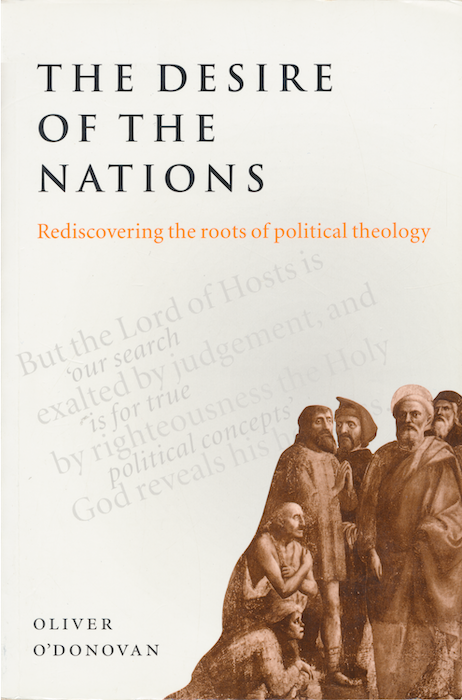
The final chapter in Oliver O’Donovan’s magisterial The Desire of the Nations: Rediscovering the Roots of Political Theology (Cambridge University Press, 1996) is titled “The Redemption of Society.” It begins with a discussion of the end of Christendom. The prevailing ethos of the post-Christendom West “is usually expressed in terms of the doctrine of ‘separation of church and state,’ an uncommunicative formula, to be sure, since those words assert nothing that could have perturbed the most traditional apologist for dual jurisdiction in Christendom. The intent of this doctrine, however, in its modern context, is to deny at least one element in the Christendom idea: that the state should offer deliberate assistance to the church’s mission. The development of the modern doctrine was associated with the special conviction of the Enlightenment that religious questions were not open to public arbitration.
“The First Amendment to the United States Constitution, prohibiting the ‘establishment’ and protecting the ‘free exercise’ of religion, is the paradigm assertion of this doctrine, and so can usefully be taken as the symbolic end of Christendom. There are, of course, many other events which could compete for that role. From the same period one might choose the French Revolution; from a much later one even the 1914–18 war suggests itself. But the American enactment is peculiarly suitable, since it propounds a doctrine meant to replace the church-state relations which Christendom had maintained, it was formulated largely by Christians who thought they had the interests of the church’s mission at heart, and it was argued for, as it still is, on ostensibly theological grounds. But it also bears the marks of the Age of Revolution, reflecting a conception of society constituted from below by its own internal dynamics; government does not form society, but puts itself at its disposal. The evangelical Christians who helped shape the new doctrine wished to deny government the right to interfere. In the name of King Jesus they proposed to instruct princes that they were dispensable to the Holy Spirit’s work, and to send them to the spectators’ seats. But what might have simply been a radicalised announcement of Christ’s triumph, though over-inclined to ‘realised eschatology’ perhaps, made common cause with anti-trinitarian heterodoxy which was permeated by rationalist conceptions of action and providence. So it ended up promoting a concept of the state’s role from which Christology was excluded, that of a state freed from all responsibility to recognize God’s self-disclosure in history.
“The paradox of the First Amendment is that a measure conceived as a liberation for authentic Christianity has become, in this century, a tool of anti-religious sentiment, weakening the participation of the church in society and depriving it of access to resources for its social role. . . .
“[T]here were features of the intellectual climate of the eighteenth century which weakened the Christian understanding of salvation-history, and replaced it with an open-ended concept of historical development, shaped by human action ventured, perhaps, in imitation of Christ but not in obedient faith directed back to his accomplished work. The shift from salvation-history to an unfolding providence undermined the intelligibility of Christian secular government, as it undermined the intelligibility of the doctrine of the Trinity itself, leaving it high and dry on the austere sands of the Quicunque vult without its necessary point of reference in the Paschal triumph. A Deist religion of divine fatherhood seemed sufficient to support the authority which government needed; while in evangelical religion worship of Christ could not unsuitably be seen as the prerogative of the converted view, the church within the church. Meanwhile the Puritan emphasis on the Holy Spirit had nourished a religion of private conscience. All these factors coincided to support the disestablishment thesis. Deists and evangelicals could agree that the state hardly knew enough about God to make a trinitarian Christianity normative. It suited them both to maintain revealed Christianity as a mystery for initiates.
“But this convergence only amounted to a negative strategy of denial. Much damage was to be done in the later nineteenth and early twentieth centuries by anti-ecumenical strategies of this type: social institutions, notably schools, were lost to Christian influence as minority Christian communities, which could not control them, preferred anything to their falling under the control of the larger churches; and so it was in this case, too. By denying any church established status in principle, the framers of the First Amendment gave away more than they knew. They effectively declared that political authorities were incapable of evangelical obedience. And with this the damage was done. It did not need the anti-religious line of interpretation pursued by twentieth-century courts to make this formula, from a theological point of view, quite strictly heretical. The creed asserts: cuius regni non erit finis, and the apostle, that ‘at the name of Jesus every knee shall bow’ (Phil. 2:10). The First Amendment presumes to add: ‘except . . .’
“Excluding government from evangelical obedience has had repercussions for the way society itself is conceived. Since the political formation of society lies in its conscious self-ordering under God’s government, a society conceived in abstraction is unformed by moral self-awareness, driven by internal dynamics rather than led by moral purposes. To deny political authority obedience to Christ is implicitly to deny that obedience to society, too. Precisely such a conception arose from the sociology which emerged in the eighteenth and came to maturity in the nineteenth century. Society was an acephalous organism, driven by unconscious forces from within, an object of study and, to the skilful, of manipulation, but in no sense a subject of responsible action. With this conception late-modernity, as we now experience it, stands on the threshold. This, after all, is society as it has been thought about in capitalist economic theory and in revolutionary socialism: it is liberal technological society, which functions like a computer constantly to extend the scope of its own operations in obedience to no rational purpose. The social sciences are the heartlands of this conception, but, to the extent that they have been methodically self-critical and understood their own abstractions for what they are, thought-experiments designed to isolate and examine certain types of relation, they have also pointed to how it may be transcended.
“Society so conceived presents itself as a ‘secular’ reality. Within the traditional meaning of the term, of course, society as a whole could never be secular. [O’Donovan had earlier pointed out that “the corresponding term to ‘secular’ is not ‘sacred’, nor ‘spiritual’, but ‘eternal’,” and they are corresponding terms, not opposites, “secular” referring to this passing age.] Secularity pertained only to certain functions within society which had their raison d’être in relation to this age (saeculum), not the next. The distinction of spiritual and secular was a distinction of two kinds of government within the one society. When in pre-modern Christianity two societies were distinguished as ‘two realms’ or ‘two cities’, they were polarized as moral and eschatological alternatives. There were not a spiritual society and a secular society, only a society of the saved and a society of the damned. . . . The appearance of a social secularity could, however, be created by understanding society as a quasi-mechanical system, incapable of moral and spiritual acts. Such a social organism may, it has been urged, make no moral or religious decisions on its own part, but leave the whole range of such decisions open for its members to make. But this is an abstract conception, not a sustainable proposal. Imagine the questions that such a society would have to avoid deciding: Are sacred ancestral lands protected against plans for mining or other development? Is drug-taking, or sex with child prostitutes, a valid religious activity? Can racial discrimination be practiced to preserve the elect people of God or to safeguard religious caste? May women be priests? Must those in quest of unemployment benefit be prepared to accept work on Sundays or Saturdays? Every actual society reaches answers to these questions which it treats as normative, and so makes definite religious judgments about the proper content of religious belief and practice. The false self-consciousness of the would-be secular society lies in its determination to conceal the religious judgments that it has made.”
— from Oliver O’Donovan, The Desire of the Nations: Rediscovering the Roots of Political Theology
(Cambridge University Press, 1996)
Related reading and listening
- War and loving our enemy-neighbor — Oliver O’Donovan on evaluating the conduct of war in light of the evangelical command of love
- “Subtraction stories” and a longing for transcendence — In this lecture, James K. A. Smith explores key elements of Charles Taylor’s understanding of what it means to live in a secular age. (43 minutes)
- The experience of a “real presence” in sacred music — FROM VOL. 126 Jonathan Arnold explores why people of no religious commitment pay money to hear specifically sacred music. (22 minutes)
- A flood of images — Oliver O’Donovan describes the distinctive character of publicity in modernity, which drowns us in a flood of ever-changing representations that do not serve the common good. (37 minutes)
- How communities remember who they are — Oliver O’Donovan on the necessity of tradition in sustaining communal identity
- Publicity and representative images in society — Oliver O’Donovan describes the nature of publicity as the force that mediates our communication with one another, creating common interests and then rapidly subsuming them into newer ones.(Lecture 3 of 3; 57 minutes)
- How common loves shape communities — Oliver O’Donovan discusses how communities mediate love and knowledge to their members and what challenges arise as a community’s traditions are confronted by sin, error, and plurality. (Lecture 2 of 3; 49 minutes)
- The “sovereign uselessness of moral reflection” — Calling on the wisdom of St. Augustine, Oliver O’Donovan reminds his listeners that all knowledge participates in the eternal Logos of God and is rooted in love, not disinterested moral judgement.(Lecture 1 of 3; 52 minutes)
- The establishment of nonbelief — FROM VOL. 10 George Marsden explains how and why American universities became places where religious concerns are excluded. (10 minutes)
- Secularization and anarchy — Joseph Cardinal Ratzinger on the necessary connection between law, ethics, and worship
- How the Church promotes the cause of freedom — Oliver O’Donovan: “We discover we are free when we are commanded by that authority which commands us according to the law of our being, disclosing the secrets of the heart.”
- “The search for shared ends” — Oliver O’Donovan examines whether and to what extent there might be the possibility of a unifying Christian perspective on political doctrine or policy. (59 minutes)
- Thinking coherently about politics — Ken Myers gives an introduction to political theologian Oliver O’Donovan, whose work has been instrumental in teaching many how to think about social and political life in light of the gospel of Christ. (57 minutes)
- The law of faith and of love — Oliver O’Donovan compares St. Augustine’s interpretation of Psalm 119 with that of others, revealing Augustine’s more nuanced understanding of the complexities of the life of faith that the psalmist explores. (64 minutes)
- “Only a real world can save us” — Oliver O’Donovan explores how the “religion” of modernity lacks a coherent world in which one may participate with full human agency and moral purpose. (Lecture 3 of 3; 61 minutes)
- Christian unity and civil society — Oliver O’Donovan introduces listeners to Dutch lay theologian Hugo Grotius, arguing that the questions he tackled relate to perennial concerns about the relationship between divine and human agency, and between civil and ecclesiastical authority. (Lecture 2 of 3; 57 minutes)
- The demoralizing effect of pagan Roman religion — Oliver O’Donovan examines St. Augustine’s critique of pagan Roman religion in Book II of his treatise City of God and asks his audience to consider what insights Augustine’s critique has for us today. (Lecture 1 of 3; 51 minutes)
- Knowing and doing the good — Oliver O’Donovan raises several key questions and complications involved in the task of taking concrete and practical action toward a recognized moral good. (Lecture 3 of 3; 63 minutes)
- Moral knowledge of reality — Oliver O’Donovan argues that admiration is the fundamental form of knowing the world, as we cannot know fully those elements of reality (“bare facts”) that contain no significance for us. (Lecture 2 of 3; 55 minutes)
- Attentiveness to the world, the self, and time — Oliver O’Donovan uses the metaphor of waking to discuss the concept of moral sensibility as attention to the world, the self, and time. (Lecture 1 of 3; 60 minutes)
- A more robust account of political life — FROM VOL. 138 John Milbank and Adrian Pabst on why politics needs to recognize the human soul in its depth (and what happens when it doesn’t). (51 minutes)
- Against hacking babies — Oliver O’Donovan raises questions about IVF and the technologically ordered motive for efficiency
- Impact of “infotainment” on community — Neil Gabler and C. John Sommerville discuss how the mentalities conveyed by our experience with communications media work against the nurturing of community. (36 minutes)
- Recognizing the Puritan flavor of “America” — George McKenna on the originally theocentric vision for the American vocation
- Critiquing “empire criticism” — Allan Bevere and Peter Leithart evaluate “empire criticism,” a way of reading the New Testament with an anti-imperial focus. (36 minutes)
- The fatal polytheism of late liberalism — Oliver O’Donovan on the failure that leads to social collapse, marked by conflict, suspicion, and violence
- A metaphysics of realism, relationality, and personalism — John Milbank gives a survey and critique of the efforts of 20th and 21st century theologians to articulate a Trinitarian ontology that reflects reality and counters secularization. (61 minutes)
- An unwitting agent for the secularization of America — Mark Noll, Nathan Hatch, and George Marsden explain how a prominent Christian Founding Father added momentum to the secularization of America
- The gift of objective reality — Moral philosopher Oliver O’Donovan makes an argument for the consistency of the idea of law when it is conceived in a theological context. (40 minutes)
- Freedom as conformity to reality — W. Bradford Littlejohn summarizes the definitions of liberty offered by Richard Bauckham and Oliver O’Donovan
- The sovereignty of love — In this 2022 lecture, Oliver O’Donovan explains the historical background — and present consequences — of the assertion by Jesus of two great commands. (67 minutes)
- O’Donovan, Oliver — FROM THE GUEST PAGE: Oliver O’Donovan held teaching posts at Wycliffe Hall, Oxford and Wycliffe College Toronto before becoming Regius Professor of Moral & Pastoral Theology and Canon of Christ Church at the University of Oxford in 1982.
- Why kings are compelling — Historian Francis Oakley describes how the modern idea of “secular” politics is a striking departure in human history. (32 minutes)
- An outrageous idea? — In the late 1990s, George M. Marsden and James Tunstead Burtchaell both wrote books examining the claim that it was far-fetched even to imagine that scholarly work could be an expression of Christian claims about reality. (25 minutes)
- Mars Hill Audio Journal, Volume 159 — FEATURED GUESTS:
Kirk Farney, Andrew Willard Jones, James L. Nolan, Jr., Andrew Kaethler, Peter Ramey, and Kathryn Wehr
- Conscience seared with a red-hot iron — Oliver O’Donovan on the convicting role of a good conscience
- Culture in light of Easter — Oliver O’Donovan rejects a gnostic reading of redemption
- Once there was no “secular” — Carlos Eire on the metaphysical assumptions championed in the sixteenth century
- Mars Hill Audio Journal, Volume 154 — FEATURED GUESTS:
Felicia Wu Song, Michael Ward, Norman Wirzba, Carl Trueman, D. C. Schindler, and Kerry McCarthy
- Religion within the bounds of citizenship — In a 2006 lecture, Oliver O’Donovan argues that the conventional way of describing Western civil society creates obstacles to the participation of believers (Muslim, Christian, and other). (68 minutes)
- Republican freedom — and ideological flexibility — Mark Noll on the novelty of America’s Christian republicanism
- The purpose of government and God’s eternal purpose — Philip Turner on understanding the state in light of the eschatological reality of the Church
- The Church and the powers that be — Historian Mark Noll summarizes Christian ideas about political life in the last few centuries, examining how those ideas were worked out in various contexts in Western Europe and North America. (39 minutes)
- Aspects of our un-Christening — In this Friday Feature — presented courtesy of Biola University — Carlo Lancellotti talks with Aaron Kheriaty about the central ideas in Augusto Del Noce’s writings. (43 minutes)
- Politics in light of the Ascension — Oliver O’Donovan on the necessity of situating all political authority within redemptive history
- A foretaste of the kingdom of God — Oliver O’Donovan on the sovereignty of love
- Loving relationships in community — In conversation with moral philosopher Oliver O’Donovan, and with readings from his book, Entering into Rest, Ken Myers explores a central theme in O’Donovan’s work: that we are created to enjoy loving relationships in community. (27 minutes)
- The scantily clad public square — Reinhard Hütter on the necessity of the virtue of religion
- The first virtue of citizenship: Taking the law seriously — Oliver O’Donovan reflects on how the reality of the Kingship of Christ must be affirmed as a present reality
- Reasoning about values — Revisiting a 1974 text that examined the mutual animosities of the 1960s