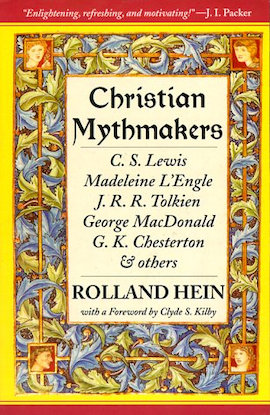
“Myth needs to be seen in a certain context if it is not to appear negligible or silly. I want to try to describe that context.
“The two most basic characteristics of man, beyond his mere physical needs, is [sic] to know and to worship. The great German psychologist, Carl Gustav Jung, thinks that the urge toward knowing is so persistent that it was this urge which brought about his birth and thus his consciousness. ‘Meaninglessness,’ he says, ‘inhibits fullness of life and is therefore equivalent to illness.’
“Our present age in particular is convinced that the main avenue to knowing is the making of statements. Yet all statements whatever, indeed all systems, in becoming statements and systems, become self-destructive. One is at sixes and sevens to translate a language of one hundred thousand words into a language of one thousand words. This is man’s predicament. What man is, what he feels himself to be, makes a wasteland of language. Yet because of man’s insatiable desire to know he requires some sort of verbal actualization. He is like the old woman who said, ‘How do I know what I think until I hear what I say?’ Yet man’s saying, i.e., his systematizing, is always inadequate. The more he defines, the more he abstracts, the farther a satisfying reality seems to fly. A young professor of philosophy said to me, ‘I feel I must write my own philosophy, yet by the end of the twenty years required to do the job, it will be so insufficient as to make the whole task rather foolish.’
“We intellectualize in order to know, but paradoxically, intellectualization tends to destroy its object. The harder we grasp at the thing, the more its reality moves away.
“So what is to be done? Man finds in himself a third characteristic called imagination, by which he can transcend statements and systems. By some magic, imagination is able to disengage our habitual discursive and system-making and send us on a journey toward gestures, pictures, images, rhythms, metaphor, symbol, and at the peak of all, myth. Jung speaks of ‘the slender hints of the knowable’ and the need to discover mythic means of bringing these hints together. Systematizing drives essentiality away, but successful creativity attracts it. While the basic requirement of systematizing is abstracting, myth is concerned not so much with parts as with wholes. Myth is necessary because reality is so much larger than rationality. Not that myth is irrational but that it easily accommodates the rational while rising above it.
“Systematizing flattens, but myth rounds out. Systematizing drains away color and life, but myth restores. Myth is necessary because of what man is. The Roman poet Ovid in the first century said that man was formed in the image of the gods, and unlike animals, was given a ‘lofty countenance and ordered . . . to contemplate the sky and to raise his erected face to the stars.’ The finest explanation of myth is a remark of long ago that man shall not live by bread alone. The truth is that man is less fact than he is myth. Owen Barfield thinks that man did not make myth but that myth made man. Shortly before his crucifixion, Jesus told His disciples that He was going away to prepare a place for them and added, ‘whither I go ye know, and the way ye know.’ But the rationalist Thomas promptly retorted, ‘Lord, we know not whither thou goest; and how can we know the way?’ A great living whole is always the answer to essentiality. An advertisement for diamonds says that engagement is a time ‘when mind and heart and all the beauty of the world beat as one.’
“Actually the wish for that condition is lifelong. All statements, including the one I am now making, are unsatisfying because man is fundamentally mythic. His real health depends upon his knowing and living his metaphysical totality. In myth man discovers and affirms not his disparate nature but his mythic.”
— Clyde S. Kilby, “What Is Myth,” the Foreword to Rolland Hein, Christian Mythmakers (Cornerstone Press, 1998) [
Related reading and listening
- The true places aren’t on any map — Clyde Kilby on C. S. Lewis’s claim that the Gospel is the greatest myth
- Savoring the taste of Reality — C. S. Lewis on the transporting, illuminating capacity of Myth
- When myth becomes fact — In this 1976 interview, Clyde Kilby (1902–1986) discusses C. S. Lewis’s critique of scientism and rationalism, his belief in the primacy of the imagination, and his mythic vision. (37 minutes)
- A great Reality at the core of things — Clyde Kilby on the nature and need for myths
- “A Myth Retold” — Literary critic Thomas Howard explains why he considers C. S. Lewis’s Till We Have Faces to be one of the author’s richest and most rewarding works. (18 minutes)
- How to make war on nothingness? — David Bentley Hart argues that if it rejects Christ, the only remaining option for a post-Christian culture is conscious or “narcotic” nihilism, which takes the form of absolute, meaningless volition. (66 minutes)
- Modernity’s crisis of place — Craig Bartholomew reflects on the importance of place to our humanity. (58 minutes)
- The inward eye, cosmic truth, and making well — Andrew Kern takes his listeners along an “interlinear” reading of a portion of St. Augustine’s Confessions that explores the differences between how God makes and how we create. (38 minutes)
- The cost of “killing” God — In this October 2023 lecture, Carl Trueman explores the concept of “desecration” as a frame for understanding the nature of modernity in our time. (42 minutes)
- How music blesses and teaches — FROM VOL. 64 Theologian and musician Jeremy Begbie explores what we learn about time, theology, and the structure of Creation from the experience of music. (28 minutes)
- Theology and the imagination — Jeffrey Barbeau explains what made C. S. Lewis an effective “translator” of theology for non-theologians. (21 minutes)
- Cosmic realities in the built world — Christopher and Christine Perrin discuss the implications of architect Christopher Alexander’s (1936–2022) discovery of patterns of building that cohere with the the created cosmos and with ourselves as human creatures. (59 minutes)
- The Heav’ns and All the Powers Therein — In this extended interview, Michael Ward makes a compelling case that the qualities attributed to the seven planets in the cosmology of antiquity and the Middle Ages are embodied in C. S. Lewis’s seven books about Narnia. (68 minutes)
- Sacred and Profane Love: Graham Greene and the Catholic Imagination — Katy Carl discusses novelist Graham Greene’s fiction and spiritual struggles in light of the concept of the Catholic imagination. (49 minutes)
- Utopian dreams and cynicism — John Durham Peters discusses the history of the idea of communication, saying that our hopes are too high when we believe that the solution to social discord is just better communication. (49 minutes)
- Man as “both mystic and hobbit” — D. C. Schindler explores how building is a quintessential human activity and an expression of our view of the meaning of reality. (47 minutes)
- Setting the liberal arts free — In addressing the state of liberal arts education in the U.S., Gilbert Meilaender raises some core questions and makes some surprising proposals. (28 minutes)
- Still connected to the land — Nadya Williams on the inescapably earthy character of human flourishing
- “A man after reality” — FROM VOL. 30 Clyde Kilby discusses C. S. Lewis‘s critique of scientism and rationalism, and his belief in the primacy of the imagination. (15 minutes)
- A Christian understanding of human nature — FROM VOL. 35 Robert C. Roberts and Mark R. Talbot discuss the need for Christian psychologists to draw from Christianity’s deep tradition of understanding human nature. (15 minutes)
- Postmodern culture and the gospel — FROM VOL. 6 Roger Lundin discusses the ethical and theological consequences of our postmodern culture. (9 minutes)
- The recovery of an integrated ecology — In this essay, Michael Hanby unpacks the summons of Laudato si’ to an ecological way of life based on a proper understanding of creation in its fullness and integrity. (57 minutes)
- The Transformed Vision of Samuel Taylor Coleridge — Poet Malcolm Guite explores the dramatic and even prophetic parallels between the life of Samuel Taylor Coleridge and that of the titular character in his famous poem “The Rime of the Ancient Mariner.” (59 minutes)
- Politics and the good — FROM VOL. 160 D. C. Schindler argues that political order cannot be disentangled from the social, and that fundamental questions of what humans are and what the good is cannot be bracketed from politics. (30 minutes)
- The profound drama of human sexuality — In this lecture, D. C. Schindler explains the cosmological significance of human sexuality and why it is paradigmatic of the relationship between nature and freedom. (32 minutes)
- A poet’s relationship to time — FROM VOL. 57 Poet Wilmer Mills (1969–2011) discusses how his agricultural and cross-cultural childhood in Brazil shaped his imagination and his relationship with modernity. (11 minutes)
- The downward spiral of all technocracies — Andrew Willard Jones explains the two paths that exist with the development of new technologies: one which leads to an expansion of the humane world and one which exploits and truncates both Creation and humanity. (65 minutes)
- To see people as people — Anthony Bradley argues that a recovery of Christian personalism is needed to counter the dehumanization, polarization, and tribalism of our day. (45 minutes)
- The idiom for the revelation of mystery — Dana Gioia on the foundational place of poetry in Christian faith
- Breaking the frozen sea — Dana Gioia on how poetry enchants
- Flannery at 100 — In honor of Flannery O’Connor’s 100th birthday, we have gathered here an aural feast of interviews with O’Connor scholars and aficionados discussing her life, work, and faith. (3 hours, 28 minutes)
- Ideas made incarnate — In this lecture, Karen Swallow Prior examines the power of great literature to shape lives, nourish imaginations, and develop a vision of the good life. (43 minutes)
- Ethical issues in neurobiological interventions — William Hurlbut explores current neurobiological advancements and the ethics and dangers of biotechnology interventions that go beyond therapy. (62 minutes)
- An impoverished anthropology — FROM VOL. 146 Mark Mitchell asks whether there is anything that truly binds Americans together beyond their commitment to self-creation. (34 minutes)
- St. Thomas the anthropologist — G. K. Chesterton on Aquinas’s complete Science of Man
- An embedded life — Following a move from one state to another, Gilbert Meilaender explores the tension between being simultaneously a sojourner and a body located in place and time. (30 minutes)
- Gratitude, vitalism, and the timid rationalist — In this lecture, Matthew Crawford draws a distinction between an orientation toward receiving life as gift and a timid and cramped rationalism that views man as an object to be synthetically remade. (52 minutes)
- Humans as biological hardware — In this essay, Brad Littlejohn and Clare Morell decry how modern technology tends to hack the human person in pursuit of profit. (55 minutes)
- “The system will be first” — FROM VOL. 27 Robert Kanigel describes the transformation of work due to Frederick Winslow Taylor’s concept of scientific management. (11 minutes)
- What it means to be a person — FROM VOL. 147 Sociologist Craig Gay argues that in order to address the challenges of a technological approach to the world, we need to recover the Christian tradition’s robust theology of personhood. (24 minutes)
- Voluntarily silencing ourselves — FROM VOL. 39 John L. Locke discusses the value of personal communication and how technology is displacing it. (12 minutes)
- Souls in cyberspace — FROM VOL. 25 Douglas Groothuis examines the worldview and mythology behind the creation and marketing of the Internet. (13 minutes)
- Metaphysical impulses beneath techno-utopianism — FROM VOL. 38 Erik Davis describes his research on how humans’ fascination with technology is permeated with “mythic energy” and gnostic aspirations. (11 minutes)
- Knowing by heart — D. C. Schindler reflects on Plato’s idea of “conversion” in education, assuming the symbol of the heart as the center of man. (39 minutes)
- A prophetic “wake-up call” — In this 2024 lecture honoring the bicentennial of George MacDonald’s birth, Malcolm Guite explores MacDonald’s power to awaken readers’ spirits and effect in them a change of consciousness. (59 minutes)
- Perceiving truths that dazzle gradually — Rolland Hein on lessons from George MacDonald about the imagination as a spiritual faculty
- Foolishness, gravity, and the Church — In this essay, Albert L. Shepherd V explains why George MacDonald’s story “The Light Princess” is meant for “all who are childlike in faith and imagination.” (8 minutes)
- Victorian ideas about belief and doubt — FROM VOL. 148 Timothy Larsen situates George MacDonald within a Victorian understanding of faith and doubt. (17 minutes)
- Human nature through the eyes of Lucian Freud — FROM VOL. 7 Art critic and sculptor Ted Prescott discusses the work of British realist painter Lucian Freud (notably, the grandson of Sigmund Freud). (8 minutes)
- The gift of meaningful work — In this lecture, D. C. Schindler argues that genuine work is inherently meaningful and facilitates an encounter with reality and therefore, ultimately, with God. (36 minutes)