
“The classic passage in the New Testament for Christian Platonism is John 1, where John identifies Christ with the Logos. That Greek word has literally dozens of meanings, but one of them is something like The Ultimate Truth about the Nature of All Things, or The Mind of God. John first says ‘In the beginning was the Logos, and the Logos was with God and the Logos was God.’ (Logos means Reason or Mind or Inner Word or Thought; and your thoughts are both with you and they are you; the thinker and his thought are both one and two.) And then John makes the astonishing statement that ‘the Logos became flesh and dwelt among us.’ Eternal Truth got born from Mary’s womb; the heavenly house where all of Plato’s Ideas live became a human being.
“This equation of Jesus and the Logos is a double expansion, a double moreness. It claims that Jesus is more than he seems to be, more than a human being; He is the Logos. And it also says that the Logos is more than it seems to be: it is not just an abstract impersonal truth, but a divine person who became also human.
“Greek philosophers had always sought the Logos, as Odysseus sought his home or Jason sought the Golden Fleece. The word has literally dozens of related meanings, but they can be brought under three headings: metaphysical, psychological, and linguistic. Logos means, first of all, realness, authenticity, truth, intelligibility, meaning, essence, form, order, structure, point, purpose, relationship, unity, principle, or universal. It also meant, in the second place, wisdom, understanding, knowledge, sagacity, intelligence, thought, explanation, reason, or logic: the human, psychological internalization of the first Logos, the metaphysical Logos. Finally, it also means word, words, language, speech, communication, revelation, expression, manifestation, argument, discourse, testimony, witness, or explanation. Logos #3 is a mind’s externalization of Logos #2 as Logos #2 is a mind’s internalization of Logos #1.
“These are the three things Gorgias the Sophist denies. He summarizes his philosophy in three sentences: First, There is no intelligible reality, no order and meaning to reality. Second, even if there were, it could never be known, never understood. Third, even if anyone did understand it, it could never be communicated. So Gorgias is the total alternative to Plato in his triple denial of Logos.
“In fact, the whole history of philosophy has been structured by these three denials. Premodern philosophy, ancient and medieval, centered on metaphysics, and ended with the Nominalism of William of Ockham, which is a denial of Logos #1, intelligible universals. Then, classical Modern philosophy, beginning with Descartes and Bacon, centered on epistemology and ended in the empiricist skepticism of Hume and the even more radical skepticism of Kant, who denied that anyone could ever know things as they are in themselves, in other words objective reality. That’s Gorgias’s second thesis. Finally, twentieth-century philosophy concentrated on philosophy of language and culminated in De-constructionism, which is the denial of Logos #3, the denial that words can tell truths.
“All that — the whole subsequent history of philosophy — is at stake in Logos.
“Logos means all three things: essence, thought, and language; or meaning, idea, and word; but it’s translated ‘word’ in John 1 because that includes all three meanings. If there is an expression, a word, as distinct from just noise, it must express knowledge; and if there is knowledge, not just feeling, it must know knowable, intelligible reality.”
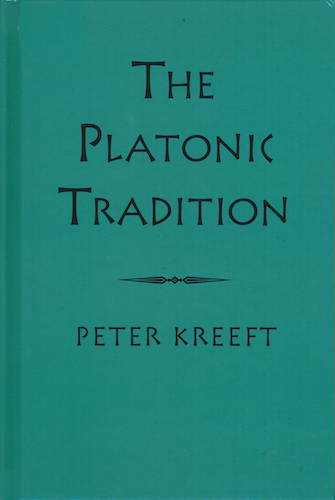
— from Peter Kreeft, The Platonic Tradition (St. Augustine’s Press, 2018)
Click on the tags below for listings of related readings or audio features.