
“AI represents, in a more basic sense, the ultimate expression of modern science’s founding gambit, which is to make practical effectiveness primary over metaphysical or philosophical meaning. The changing nature of scientific explanation need not detain me here, except to note that the natural sciences since Descartes and Galileo have made progress precisely by finding ways to parenthesize or suspend metaphysical questions about the ‘meaning’ of natural phenomena, in favor of quantitative prediction and functional mastery. Milton Friedman put the point as starkly as possible within the context of economics: A hypothesis is tested by its predictive power, not by its conforming to reality. Which is another way of saying that prediction establishes what we count as ‘reality’ at all — we do not even know what else could count as an answer to a ‘why’ anymore. We have found a way to provisionally win at the game, while abstaining from judgment about just what game we’re playing at: the as-ifness of modern science eventuates in the as-ifness of virtual reality. But while the benefits of this early modern gambit have been incalculably great for us, its next iteration will be a world in which prediction loses touch with explanation altogether. Because AI is already capable of outstripping human analysis to the point that we may arrive at effective conclusions which we cannot otherwise account for or demonstrate to be true.”
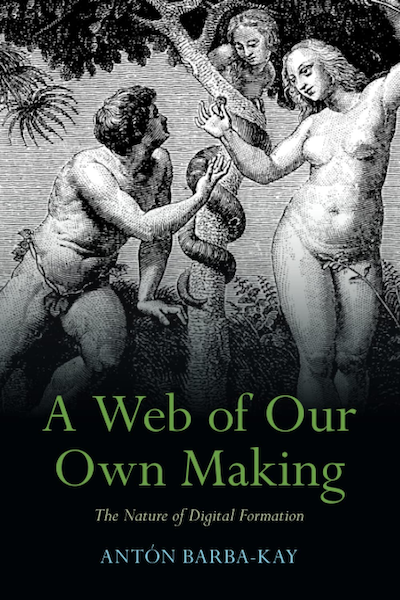
— from Antón Barba-Kay, A Web of Our Own Making: The Nature of Digital Formation (Cambridge University Press, 2023)
Click on the tags below for listings of related readings or audio features.