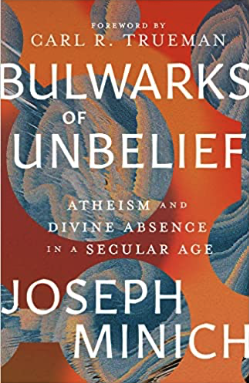
“[W]hat does it mean for a thing to be real in the modern order? In my judgment, the modern technological order tacitly communicates to us, day in and day out, that reality (the sort that actually concerns us) belongs to the order of the manipulable — subject, in principle, to human agency. We saw in Heidegger that modern technology is the destining of revealing such that nature answers back to me in the shape of my questions (i.e., uses) for it. That it appears resonant with the realm of material manipulation has everything to do with how we have approached reality in the first place. For Ellul, technique is a pattern of thought that changes everything it touches — a reduction of reality to the terms of the rational and ordered and the efficient. What does not fit this mold is ultimately invisible.
“It is not that there is no longer a philosophical argument for invisible realities. On the contrary (in my judgment), many classical arguments are compelling, but they belong to a discourse that is unnatural to us and was quite natural (teleology, etc.) in its original context. As such, their persuasive power depends upon accounting for this disjunct and attempting to reharmonize our reality instincts with the conclusions of our free minds. This is because we have been shaped to relate to the cosmos and to perceive the cosmos only (or almost only) in its manipulable dimensions, which is to say that dimension in which human agency can, in principle, interfere. As such, any aspect of it that does not conform to this dimension is perceived to be nonexistent. Or, stated differently, the least personal aspects of reality become the only realms of concern and care for us. Inasmuch as these are that as which we perceive the real, it is natural for us to feel as though anything else is superfluous. We fancy our explanatory itch scratched when it has rather been numbed.
“In any case, it is my claim that this is a large part of why atheism, for instance, and an urbanized modernity are highly correlated. It is here that one can move around in a world that has been controlled for the human and that consequently forecloses the experience of agency that has classically reinforced the notion of God by making personhood seem like a fundamental property of all being. This is especially the case by the 1960s, by which time the majority of those living in the West experienced lifestyle comforts that were historically unimaginable to their ancestors just a few generations before. In any case, this point is made clearest to us as we consider our own immediate context. I, for instance, live in an air-conditioned house. When a storm comes that would have been a crisis to my ancestors, I do not even flinch. I can hardly imagine what it is like to get food or water anywhere else but a grocery store or a tap, the products of each appearing, for all practical purposes, as by magic (albeit I assume of the demystified, technical sort in the hands of an anonymous, different sort of clergy). When I experience nature, it is manicured nature, whether it be the neatly placed trees in my neighborhood, the mowed lawn, the pruned bushes, or the nonthreatening sky. When I walk outside to the bus, the notion that my path is lit, that I walk on smooth concrete, that I am in a vehicle that transports me at high but efficient speeds, does not even enter my consciousness. This is reality to me. I know that it is technologically mediated, but that is only when I am thinking about it. When I am simply moving around in it, it is simply the world. One could go on to speak of technologically mediated encounters with health, death, and other persons. Even the most agentic aspects of reality (human relationships) are increasingly subjected to media, surrogates, and options that are historically unprecedented and mechanistic. That on which I rely is less family and neighbor than institution, expert, and system. To put it bluntly, the world is a world for me. I do not find myself in a big, mysterious world suffused with agencies to which I am subject and around which I must learn to co-navigate with my immediate community. I find myself in a world almost entirely tool-i-fied, a world of my own (agentless!) subjectivity before an increasingly silent cosmos.
“[M]y argument is that it is this shifting background noise that constitutes the existential space within which modern persons develop their sense of the divine in relationship to nature and to the city. And this noise is fundamentally impersonal. This is the era of Freud’s Civilization and its Discontents and Albert Camus’ The Stranger. The former puts the irrational at the very heart of civilization. The latter captures the indifference of the cosmos — a fundamental truth that filters down into the most basic of human realities.”
— from Joseph Minich, Bulwarks of Unbelief: Atheism and Divine Absence in a Secular Age (Lexham Academic, 2023)
Related reading and listening
- The destructive perils of speech without a real partner — Josef Pieper and Marc Barnes on how chatbots pervert the nature of conversation
- Machines and misanthropy — Nicholas Carr on how technology has transformed our understanding of progress (and people)
- Alienation and autoamputation: the price of power — Nicholas Carr on the numbing effect of technology
- Disengagement from the world — Nicholas Carr encourages us to consider how automation technologies impact our ability to engage with the world and whether — like a good tool — they present a more inviting world or close us off from that world. (30 minutes)
- A sampling of newly published lectures — Ken Myers introduces listeners to four recently released lectures, courtesy of our Partners. The lecturers are Jennifer Frey, Gary Saul Morson, N. T. Wright, and Andrew Kern. (27 minutes)
- “If there is no God, all is permitted” — Gary Saul Morson explores the consequences of belief and disbelief in God through Russian literature. (51 minutes)
- Life more abundantly — Jeanne Schindler advocates for a return to an understanding and prioritizing of sensory experience — real engagement with the real world — as foundational to learning and living. (35 minutes)
- Technophiliac obsessions — FROM VOL. 141 Literary and media scholar Grant Wythoff talks about the “father of science fiction,” Hugo Gernsback. (26 minutes)
- Rand’s influence on conservatism — FROM VOL. 100 History professor Jennifer Burns discusses the life and legacy of “goddess of the market” Ayn Rand. (17 minutes)
- Utopian dreams and cynicism — John Durham Peters discusses the history of the idea of communication, saying that our hopes are too high when we believe that the solution to social discord is just better communication. (49 minutes)
- What adolescence misses — FROM VOL. 94 Mark Bauerlein talks about the ways of learning and living practiced by contemporary youth, how they impact the acquisition and use of knowledge and form intellectual habits, and what this means for the future of our society. (16 minutes)
- Helping boys become virtuous men — Teacher and chaplain Mark Perkins describes forms of formation that take the body seriously 50 minutes
- Introducing Volume 165 — Ken Myers introduces listeners to Volume 165 of the Journal with short segments from each interview. (32 minutes)
- The temptations of talismanic technologies — Jeffrey Bilbro on the persistence of techno-utopianism
- Mars Hill Audio Journal, Volume 165 — FEATURED GUESTS: Jeffrey Bilbro, Daniel McInerny, Joseph Minich, Carl Elliott, Nadya Williams, and Don W. King
- In the Image of Our Devices — Nicholas Carr considers how automation technologies impact our ability to engage with the world. (66 minutes)
- The recovery of an integrated ecology — In this essay, Michael Hanby unpacks the summons of Laudato si’ to an ecological way of life based on a proper understanding of creation in its fullness and integrity. (57 minutes)
- The downward spiral of all technocracies — Andrew Willard Jones explains the two paths that exist with the development of new technologies: one which leads to an expansion of the humane world and one which exploits and truncates both Creation and humanity. (65 minutes)
- How social media truncates relationships — In this lecture, Felicia Wu Song explains how social media industrializes and monetizes our relationships, forming us in modes of relationships and identity that are detrimental to ourselves and to society. (41 minutes)
- In technology, we live and move and have our knowing — George Parkin Grant on technology’s establishment of a framework for thinking about technology
- On the Degeneration of Attentiveness — Critic Nicholas Carr talks about how technology-driven trends affect our cultural and personal lives. (56 minutes)
- Gratitude, vitalism, and the timid rationalist — In this lecture, Matthew Crawford draws a distinction between an orientation toward receiving life as gift and a timid and cramped rationalism that views man as an object to be synthetically remade. (52 minutes)
- The transforming power of false divinities — Romano Guardini on the danger of becoming like the gods we invent
- Humans as biological hardware — In this essay, Brad Littlejohn and Clare Morell decry how modern technology tends to hack the human person in pursuit of profit. (55 minutes)
- “The system will be first” — FROM VOL. 27 Robert Kanigel describes the transformation of work due to Frederick Winslow Taylor’s concept of scientific management. (11 minutes)
- Choices about the uses of technology — This Feature presents interviews with David Nye and Brian Brock related to how we evaluate adoption of new technology and how technology influences our thinking. (31 minutes)
- What it means to be a person — FROM VOL. 147 Sociologist Craig Gay argues that in order to address the challenges of a technological approach to the world, we need to recover the Christian tradition’s robust theology of personhood. (24 minutes)
- The problem with dynamism without direction — Paulina Borsook on the biological paradigm of technolibertarianism’s love of spontaneous dynamism, whatever the costs
- The libertarian spawning-ground of tech bros — Paulina Borsook on high tech’s long-standing animosity toward government and regulation
- Tech bros and public power — Paulina Borsook discusses the “bizarrely narcissistic” and ultra-libertarian culture of Silicon Valley. (22 minutes)
- Voluntarily silencing ourselves — FROM VOL. 39 John L. Locke discusses the value of personal communication and how technology is displacing it. (12 minutes)
- Souls in cyberspace — FROM VOL. 25 Douglas Groothuis examines the worldview and mythology behind the creation and marketing of the Internet. (13 minutes)
- Life in a frictionless, synthetic world — FROM VOL. 17 Mark Slouka explores the worldview of techno-visionaries who aim to create a new era of human evolution. (11 minutes)
- The digital revolution and community — FROM VOL. 7 Ken Myers talks with Jane Metcalfe, the founder of WIRED Magazine, about technology and community. (8 minutes)
- Metaphysical impulses beneath techno-utopianism — FROM VOL. 38 Erik Davis describes his research on how humans’ fascination with technology is permeated with “mythic energy” and gnostic aspirations. (11 minutes)
- Post-Christian America and the “unlimited technological future” — George Parkin Grant on technology and the Puritan legacy of “unflinching wills”
- Education that counters alienation — In this lecture, Jeanne Schindler explores how digital technologies warp not only education but our experience of being human. (30 minutes)
- What is lost with labor-saving devices — Romano Guardini on what is lost when cultural pursuits eclipse natural order
- Paradoxical attitudes toward plastic — Jeffrey Meikle traces the technological, economic, and cultural development of plastic and relates it to the American value of authenticity. (15 minutes)
- Technology and the kingdom of God — FROM VOL. 63 Albert Borgmann (1937–2023) believes Christians have an obligation to discuss and discern the kind of world that technology creates and encourages. (12 minutes)
- The gift of meaningful work — In this lecture, D. C. Schindler argues that genuine work is inherently meaningful and facilitates an encounter with reality and therefore, ultimately, with God. (36 minutes)
- Diverting language from its richest possibilities — FROM VOL. 75 Steve Talbott discusses the rich capacities of language and how technology diminishes them. (18 minutes)
- The recovery of true authority for societal flourishing — Michael Hanby addresses a confusion at the heart of our current cultural crisis: a conflation of the concepts of authority and power. (52 minutes)
- Worldliness vs. otherworldliness — FROM VOL. 38 Sociologist Craig Gay speaks of the charge that Christianity is an otherworldly religion. (12 minutes)
- Automation and human agency — FROM VOL. 150 Philosopher and mechanic Matthew Crawford laments the losses of human skill that correspond with gains in mechanical automation. (21 minutes)
- Christopher Hitchens vs. G. K. Chesterton — Ralph Wood compares Christopher Hitchens‘s view of the cosmos with that of G. K. Chesterton, arguing that Chesterton succeeded where Hitchens failed. (44 minutes)
- A fearful darkness in mind, heart, and spirit — Roberta Bayer draws on the work of George Parkin Grant (1918–1988) to argue that our “culture of death” must be countered with an understanding of reality based in love, redemptive suffering, and a recognition of limitations to individual control. (33 minutes)
- Questioning “conservatives” — John Lukacs asserts that believers in unending technological ‘progress’ can’t really be conservatives.
- Seeking control, in white magic and The Green Book — Alan Jacobs on C. S. Lewis’s critique of the modern pursuit of god-like control
- Faith and unbelief — FROM VOL. 98 This Archive Feature revisits two conversations, one with Roger Lundin and one with David Bentley Hart, on what makes Christian belief so implausible to non-believers. (39 minutes)