“People first began thinking about technological progress as a force in history in the latter half of the eighteenth century, when the scientific discoveries of the Enlightenment began to be translated into the practical machinery of the Industrial Revolution. That was also, and not coincidentally, a time of political upheaval. The democratic, humanitarian ideals of the Enlightenment culminated in the revolutions in America and France, and those ideals also infused society’s view of science and technology. Technical advances were valued — by intellectuals, if not always by workers — as means to political reform. Progress was defined in social terms, with technology playing a supporting role. Enlightenment thinkers such as Voltaire, Joseph Priestley, and Thomas Jefferson saw, in the words of the cultural historian Leo Marx, ‘the new sciences and technologies not as ends in themselves, but as instruments for carrying out a comprehensive transformation of society.’
“By the middle of the nineteenth century, however, the reformist view had, at least in the United States, been eclipsed by a new and very different concept of progress in which technology itself played the starring role. ‘With the further development of industrial capitalism,’ writes [Leo] Marx, ‘Americans celebrated the advance of science and technology with increasing fervor, but they began to detach the idea from the goal of social and political liberation.’ Instead, they embraced ‘the now familiar view that innovations in science-based technologies are in themselves a sufficient and reliable basis for progress.’ New technology, once valued as a means to a greater good, came to be revered as a good in itself. [The quotes above are from an article by Leo Marx, “Does Improved Technology Mean Progress?” published in Technology Review, January 1987. Marx is best known for his 1964 book, The Machine in the Garden: Technology and the Pastoral Ideal in America.]
“It’s hardly a surprise, then, that in our own time the capabilities of computers have, as Bainbridge suggested, determined the division of labor in complex automated systems. To boost productivity, reduce labor costs, and avoid human error — to further progress — you simply allocate control over as many activities as possible to software, and as software’s capabilities advance, you extend the scope of its authority even further. The more technology, the better. The flesh-and-blood operators are left with responsibility only for those tasks that the designers can’t figure out how to automate, such as watching for anomalies or providing an emergency backup in the event of a system failure. People are pushed further and further out of what engineers term ‘the loop’ — the cycle of action, feedback, and decision making that controls a system’s moment-by-moment operations.
“Ergonomists call the prevailing approach technology-centered automation. Reflecting an almost religious faith in technology, and an equally fervent distrust of human beings, it substitutes misanthropic goals for humanistic ones. It turns the glib ‘who needs humans?’ attitude of the technophilic dreamer into a design ethic. As the resulting machines and software tools make their way into workplaces and homes, they carry that misanthropic ideal into our lives. ‘Society,’ writes Donald Norman, a cognitive scientist and author of several influential books about product design, ‘has unwittingly fallen into a machine-centered orientation to life, one that emphasizes the needs of technology over those of people, thereby forcing people into a supporting role, one for which we are most unsuited. Worse, the machine-centered viewpoint compares people to machines and finds us wanting, incapable of precise, repetitive, accurate actions.’ Although it now ‘pervades society,’ this view warps our sense of ourselves. ‘It emphasizes tasks and activities that we should not be performing and ignores our primary skills and attributes — activities that are done poorly, if at all, by machines.
When we take the machine-centered point of view, we judge things on artificial, mechanical merits.’ [from David Norman, Things That Make Us Smart: Defending Human Attributes in the Age of Machines (Perseus, 1993)]
“It’s entirely logical that those with a mechanical bent would take a mechanical view of life. The impetus behind invention is often, as Norbert Wiener put it, ‘the desires of the gadgeteer to see the wheels go round.’ And it’s equally logical that such people would come to control the design and construction of the intricate systems and software programs that now govern or mediate society’s workings. They’re the ones who know the code. As society becomes ever more computerized, the programmer becomes its unacknowledged legislator. By defining the human factor as a peripheral concern, the technologist also removes the main impediment to the fulfillment of his desires; the unbridled pursuit of technological progress becomes self-justifying. To judge technology primarily on its technological merits is to give the gadgeteer carte blanche.
“In addition to fitting the dominant ideology of progress, the bias to let technology guide decisions about automation has practical advantages. It greatly simplifies the work of the system builders. Engineers and programmers need only take into account what computers and machines can do. That allows them to narrow their focus and winnow a project’s specifications. It relieves them of having to wrestle with the complexities, vagaries, and frailties of the human body and psyche. But however compelling as a design tactic, the simplicity of technology-centered automation is a mirage. Ignoring the human factor does not remove the human factor.”
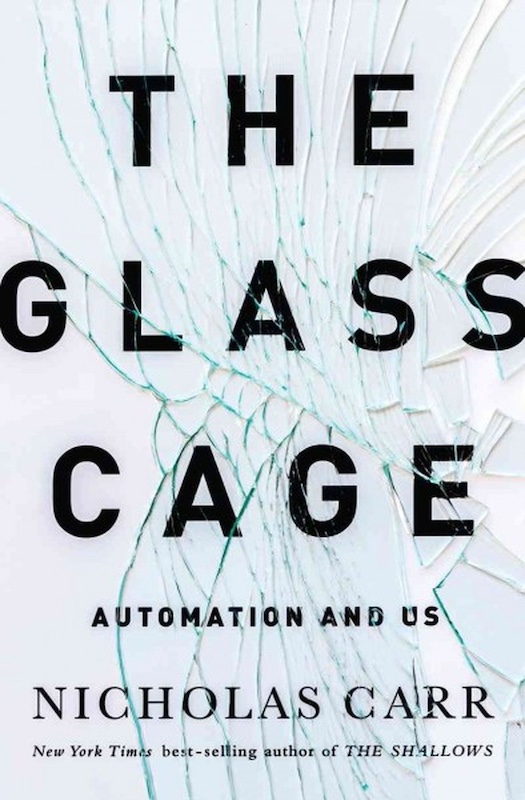
— from Nicholas G. Carr, The Glass Cage: Automation and Us (W. W. Norton, 2014)
Related reading and listening
- The destructive perils of speech without a real partner — Josef Pieper and Marc Barnes on how chatbots pervert the nature of conversation
- Alienation and autoamputation: the price of power — Nicholas Carr on the numbing effect of technology
- Disengagement from the world — Nicholas Carr encourages us to consider how automation technologies impact our ability to engage with the world and whether — like a good tool — they present a more inviting world or close us off from that world. (30 minutes)
- Life more abundantly — Jeanne Schindler advocates for a return to an understanding and prioritizing of sensory experience — real engagement with the real world — as foundational to learning and living. (35 minutes)
- Technophiliac obsessions — FROM VOL. 141 Literary and media scholar Grant Wythoff talks about the “father of science fiction,” Hugo Gernsback. (26 minutes)
- Utopian dreams and cynicism — John Durham Peters discusses the history of the idea of communication, saying that our hopes are too high when we believe that the solution to social discord is just better communication. (49 minutes)
- What adolescence misses — FROM VOL. 94 Mark Bauerlein talks about the ways of learning and living practiced by contemporary youth, how they impact the acquisition and use of knowledge and form intellectual habits, and what this means for the future of our society. (16 minutes)
- Helping boys become virtuous men — Teacher and chaplain Mark Perkins describes forms of formation that take the body seriously 50 minutes
- The temptations of talismanic technologies — Jeffrey Bilbro on the persistence of techno-utopianism
- Living in a tool-i-fied world — Joseph Minich on how the ubiquity of technology makes atheism entirely plausible
- Clips from five extended interviews — We are pleased to share clips from five interviews that we’ve recently produced as full-length Conversations. (30 minutes)
- In the Image of Our Devices — Nicholas Carr considers how automation technologies impact our ability to engage with the world. (66 minutes)
- The recovery of an integrated ecology — In this essay, Michael Hanby unpacks the summons of Laudato si’ to an ecological way of life based on a proper understanding of creation in its fullness and integrity. (57 minutes)
- The downward spiral of all technocracies — Andrew Willard Jones explains the two paths that exist with the development of new technologies: one which leads to an expansion of the humane world and one which exploits and truncates both Creation and humanity. (65 minutes)
- How social media truncates relationships — In this lecture, Felicia Wu Song explains how social media industrializes and monetizes our relationships, forming us in modes of relationships and identity that are detrimental to ourselves and to society. (41 minutes)
- In technology, we live and move and have our knowing — George Parkin Grant on technology’s establishment of a framework for thinking about technology
- On the Degeneration of Attentiveness — Critic Nicholas Carr talks about how technology-driven trends affect our cultural and personal lives. (56 minutes)
- Gratitude, vitalism, and the timid rationalist — In this lecture, Matthew Crawford draws a distinction between an orientation toward receiving life as gift and a timid and cramped rationalism that views man as an object to be synthetically remade. (52 minutes)
- Humans as biological hardware — In this essay, Brad Littlejohn and Clare Morell decry how modern technology tends to hack the human person in pursuit of profit. (55 minutes)
- “The system will be first” — FROM VOL. 27 Robert Kanigel describes the transformation of work due to Frederick Winslow Taylor’s concept of scientific management. (11 minutes)
- Choices about the uses of technology — This Feature presents interviews with David Nye and Brian Brock related to how we evaluate adoption of new technology and how technology influences our thinking. (31 minutes)
- What it means to be a person — FROM VOL. 147 Sociologist Craig Gay argues that in order to address the challenges of a technological approach to the world, we need to recover the Christian tradition’s robust theology of personhood. (24 minutes)
- The problem with dynamism without direction — Paulina Borsook on the biological paradigm of technolibertarianism’s love of spontaneous dynamism, whatever the costs
- The libertarian spawning-ground of tech bros — Paulina Borsook on high tech’s long-standing animosity toward government and regulation
- Tech bros and public power — Paulina Borsook discusses the “bizarrely narcissistic” and ultra-libertarian culture of Silicon Valley. (22 minutes)
- Voluntarily silencing ourselves — FROM VOL. 39 John L. Locke discusses the value of personal communication and how technology is displacing it. (12 minutes)
- Souls in cyberspace — FROM VOL. 25 Douglas Groothuis examines the worldview and mythology behind the creation and marketing of the Internet. (13 minutes)
- Life in a frictionless, synthetic world — FROM VOL. 17 Mark Slouka explores the worldview of techno-visionaries who aim to create a new era of human evolution. (11 minutes)
- The digital revolution and community — FROM VOL. 7 Ken Myers talks with Jane Metcalfe, the founder of WIRED Magazine, about technology and community. (8 minutes)
- Metaphysical impulses beneath techno-utopianism — FROM VOL. 38 Erik Davis describes his research on how humans’ fascination with technology is permeated with “mythic energy” and gnostic aspirations. (11 minutes)
- Post-Christian America and the “unlimited technological future” — George Parkin Grant on technology and the Puritan legacy of “unflinching wills”
- Progress and God’s providence in American history — Historians Daniel Walker Howe and George McKenna explain religious understandings of God’s purpose for America in the 19th century and colonial era, respectively. (34 minutes)
- Education that counters alienation — In this lecture, Jeanne Schindler explores how digital technologies warp not only education but our experience of being human. (30 minutes)
- What is lost with labor-saving devices — Romano Guardini on what is lost when cultural pursuits eclipse natural order
- Paradoxical attitudes toward plastic — Jeffrey Meikle traces the technological, economic, and cultural development of plastic and relates it to the American value of authenticity. (15 minutes)
- Technology and the kingdom of God — FROM VOL. 63 Albert Borgmann (1937–2023) believes Christians have an obligation to discuss and discern the kind of world that technology creates and encourages. (12 minutes)
- The gift of meaningful work — In this lecture, D. C. Schindler argues that genuine work is inherently meaningful and facilitates an encounter with reality and therefore, ultimately, with God. (36 minutes)
- Diverting language from its richest possibilities — FROM VOL. 75 Steve Talbott discusses the rich capacities of language and how technology diminishes them. (18 minutes)
- The recovery of true authority for societal flourishing — Michael Hanby addresses a confusion at the heart of our current cultural crisis: a conflation of the concepts of authority and power. (52 minutes)
- Is American culture now story-less? — From our archives, Michael Kammen compares popular and mass culture, and Philip Fisher analyzes the idea that new cultural forms inevitably dissolve old ones. (26 minutes)
- Automation and human agency — FROM VOL. 150 Philosopher and mechanic Matthew Crawford laments the losses of human skill that correspond with gains in mechanical automation. (21 minutes)
- A fearful darkness in mind, heart, and spirit — Roberta Bayer draws on the work of George Parkin Grant (1918–1988) to argue that our “culture of death” must be countered with an understanding of reality based in love, redemptive suffering, and a recognition of limitations to individual control. (33 minutes)
- Questioning “conservatives” — John Lukacs asserts that believers in unending technological ‘progress’ can’t really be conservatives.
- Seeking control, in white magic and The Green Book — Alan Jacobs on C. S. Lewis’s critique of the modern pursuit of god-like control
- Life, liberty, and the defense of dignity — In a 2003 interview, Leon Kass discussed his book Life, Liberty, and the Defense of Dignity: The Challenge for Bioethics. The unifying theme in the book’s essays is the threat of dehumanization in one form or another. (36 minutes)
- The surrender of culture to technology — FROM VOL. 6Neal Postman discuses the ways in which how we think about the world has been influenced by communications technology, even in its earliest forms. (11 minutes)
- A.I., power, control, & knowledge — Ken Myers shares some paragraphs from Langdon Winner‘s seminal book, Autonomous Technology: Technics-out-of-Control as a Theme in Political Thought (1977) and from Roger Shattuck‘s Forbidden Knowledge: From Prometheus to Pornography (1996). An interview with Shattuck is also presented. (31 minutes)
- Technology and social imaginaries — In this interview from 1999, cultural historian David Nye insists that societies have choices about how they use technologies, but that once choices are made and established, a definite momentum is established. (19 minutes)
- Living into focus — As our lives are increasingly shaped by technologically defined ways of living, Arthur Boers discusses how we might choose focal practices that counter distraction and isolation. (32 minutes)
- Albert Borgmann, R.I.P. — Albert Borgmann argues that, despite its promise to the contrary, technology fails to provide meaning, significance, and coherence to our lives. (47 minutes)