“In ‘Writing Short Stories,’ [Flannery] O’Connor’s most illuminating remarks concern the relationship between story and meaning. These remarks were certainly inspired by the fact that the home O’Connor shared with her mother was a working farm:
I prefer to talk about the meaning in a story rather than the theme of a story. People talk about the theme of a story as if the theme were like the string that a sack of chicken feed is tied with. They think that if you can pick out the theme, the way you pick the right thread in the chicken-feed sack, you can rip the story open and feed the chickens. But this is not the way meaning works in fiction.
“What O’Connor is leery of is the misguided understanding that the meaning of a story is something separable from the story itself. We may remember from our school days identifying the ‘theme’ or ‘meaning’ of a story or poem as if it were an isolated statement that could be neatly detached from the work of literature and memorized for a test. O’Connor invites us to correct this misguided understanding. Tearing back the right thread allows the chicken feed to be dispensed. But the meaning of a story is not some magic thread; it is, as it were, the chicken feed itself:
When you can state the theme of a story, when you can separate it from the story itself, then you can be sure the story is not a very good one. The meaning of a story has to be embodied in it, has to be made concrete in it. A story is a way of saying something that can’t be said in any other way, and it takes every word in the story to say what the meaning is. You tell a story because a statement would be inadequate. When anybody asks what a story is about, the only proper thing is to tell him to read the story.
“This text is a powerful reflection on the way stories work. In order to understand what O’Connor is saying here, it is helpful to keep in mind three ways in which we can know something.
“The first is by way of theoretical statements. We can learn a lot by listening to a lecture. In this mode of knowing, we endeavor to abstract from the particulars of the case and grasp what is essential to it. Although the lecturer might use examples or illustrations to aid comprehension, the primary mode of delivery is by way of statements and arguments made up out of abstract notions.
“Another way we can know something is by what we might call the way of doing. There’s real know-how that comes from doing something, especially when we do something so much that our experience of it becomes rich and varied. For example, our sweet, humble Aunt Emily knows a lot about the virtue of humility by having lived humility over many years. Her theoretical knowledge of humility — her knowledge of humility by way of universal statements and arguments — may be nil. She may have never studied moral theology. If asked to give a definition of humility, she would probably be at a loss. And yet, it’s undeniable that Aunt Emily has a real understanding of what it means to be humble, an experiential knowledge embodied in her habitually humble acts. And by imitating Aunt Emily’s humility, we can proceed along this way of doing as well.
“The third way of knowing is by what we might call the way of showing. By ‘showing,’ I mean the activities of the artistic imagination. A movie is a kind of showing, as is a play. But there are other kinds of showing that do not involve performance either live or recorded. A novel is a kind of showing, as is a poem, as is a short story. These latter arts are showings in the sense that they, just like a movie or play, offer us images of human beings doing things. And whether a showing is performance-based or text-based, it attempts — as we so often say about a work of art — to ‘say’ something. It offers us the experience of something meaningful.”
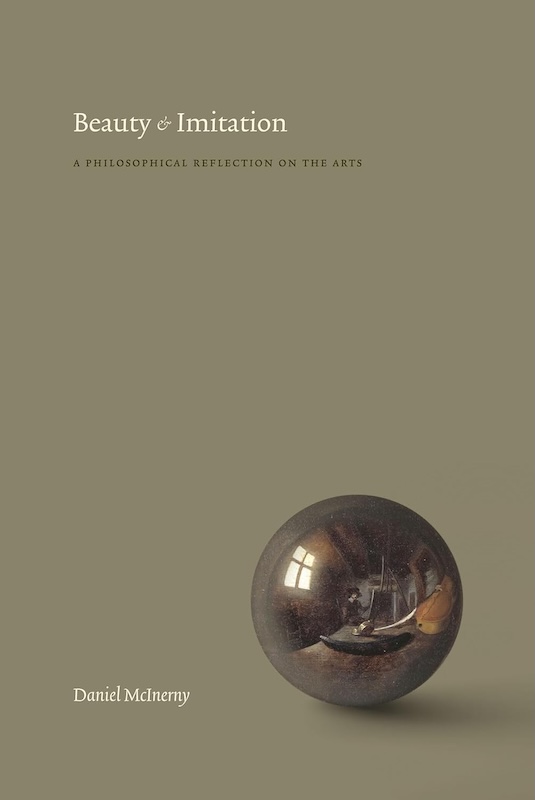
— from Daniel McInerny, Beauty & Imitation: A Philosophical Reflection on the Arts (Word on Fire, 2024)
Related reading and listening
- A sampling of newly published lectures — Ken Myers introduces listeners to four recently released lectures, courtesy of our Partners. The lecturers are Jennifer Frey, Gary Saul Morson, N. T. Wright, and Andrew Kern. (27 minutes)
- Grace and Christian realism — Jennifer Frey explores Thomist elements in Flannery O’Connor’s theology and writing, with a particular emphasis on a Thomist understanding of art. (39 minutes)
- Mars Hill Audio Journal, Volume 166 — FEATURED GUESTS: William Cavanaugh, Kent Burreson, Beth Hoeltke, Jeffrey Barbeau, Jason Baxter, John Betz, and Bruce Herman
- Introducing Volume 165 — Ken Myers introduces listeners to Volume 165 of the Journal with short segments from each interview. (32 minutes)
- Mars Hill Audio Journal, Volume 165 — FEATURED GUESTS: Jeffrey Bilbro, Daniel McInerny, Joseph Minich, Carl Elliott, Nadya Williams, and Don W. King
- “The greatest works of art are endless” — Daniel McInerny argues that more robust reflection about how we attend to art enables us to discover deeper meaning in it and to experience greater sensory and intellectual joy. (16 minutes)
- How paintings convey meaning — FROM VOL. 121 Theologian Walter Hansen and painter Bruce Herman question contemporary conceptions of meaning that confine it to the verbal or consider visual and verbal meaning to be completely exclusive. (20 minutes)
- Beauty, Spirit, & Embodiment: A Christian View of Art — Adrienne Chaplin explains why a Christian approach to art must involve various levels of inquiry and not be limited to discussions of worldview or meaning alone. (46 minutes)
- Learning from experience — Flannery O’Connor on belief and experience
- Hillbilly Augustinian — Ralph Wood on Flannery O’Connor’s refusal to adapt her fiction to the national temper
- The grotesque and the transcendent — Christina Bieber Lake on why Flannery O’Connor’s readers have to work
- Flannery at 100 — In honor of Flannery O’Connor’s 100th birthday, we have gathered here an aural feast of interviews with O’Connor scholars and aficionados discussing her life, work, and faith. (3 hours, 28 minutes)
- Insights into O’Connor’s development as a writer — FROM VOL. 160 Jessica Hooten Wilson discusses her experience studying and organizing Flannery O’Connor’s unfinished third novel, Why Do the Heathen Rage? (27 minutes)
- When philosophy loses its way — FROM VOL. 52 Ralph McInerny (1929–2010) speaks about themes from his 1999 Gifford Lectures, which relate how natural theology came to be regarded as pointless, resulting in a philosophical dead end.(24 minutes)
- Foolishness, gravity, and the Church — In this essay, Albert L. Shepherd V explains why George MacDonald’s story “The Light Princess” is meant for “all who are childlike in faith and imagination.” (8 minutes)
- The (super)natural theology of fairy-tales — Alison Milbank describes Chesterton’s belief that story-telling is an affirmation of transcendent meaning
- The Body Worlds exhibit and Western art — FROM VOL. 88 Michael J. Lewis explores the effects of the Body Worlds exhibits on the moral imagination of the viewer, who encounters human cadavers in a mechanistic way erased of all moral context. (26 minutes)
- Aslan, the Christ-figure of Narnia — Alex Markos explores the transformational power of Aslan as the Christ figure in C. S. Lewis’s Chronicles of Narnia. (31 minutes)
- The abolition of the fine arts — In this lecture, R. V. Young examines why people are increasingly unable to discriminate between base and fine art, arguing why this issue is of particular concern to Christians. (41 minutes)
- Prudence in politics — FROM VOL. 146
Henry T. Edmondson, III talks about Flannery O’Connor’s understanding of political life, which was influenced by a range of thinkers including Aristotle, Thomas Aquinas, Eric Voegelin, and Russell Kirk. (19 minutes)
- Flannery O’Connor and Robert Giroux — FROM VOL. 147 Biographer and priest Patrick Samway talks about the relationship between fiction writer Flannery O’Connor and the legendary editor Robert Giroux. (21 minutes)
- The dangers of the life of the mind — Robert H. Brinkmeyer, Jr., on why Flannery O’Connor encouraged the cultivation of “Christian skepticism”
- Remembering Miss O’Connor — Literary critic Richard Gilman shares impressions of his relationship with Flannery O’Connor
- God is in the details — Flannery O’Connor on why stories rely on the particularities of reality
- The artist’s commitment to truth — Fr. Damian Ference, author of Understanding the Hillbilly Thomist, explores the depths to which Flannery O’Connor was steeped in Thomistic philosophy. (18 minutes)
- Flannery O’Connor and Thomistic philosophy — Fr. Damian Ference explores the depths to which Flannery O’Connor was steeped in Thomistic philosophy, as evidenced by her reading habits, letters, prayer journal, and, of course, essays and fiction. (48 minutes)
- Developing a Christian aesthetic — In the inaugural lecture for the Eliot Society, titled “Faithful Imaginations in a Meaningful Creation,” Ken Myers addresses the question of the relationship between the arts and the Church. (59 minutes)
- The negation of transcendence — Michael Hanby argues that our current civilizational crisis can be understood as a “new totalitarianism” that negates or disallows every form of transcendence. (32 minutes)
- Mars Hill Audio Journal, Volume 161 — FEATURED GUESTS: Andrew Wilson, Kyle Edward Williams, Andrew James Spencer, Landon Loftin, Esther Lightcap Meek, Andrew Davison
- At the trailhead of a long trek — Jessica Hooten Wilson on the discovery of a literary remnant
- Mars Hill Audio Journal, Volume 160 — FEATURED GUESTS:
Jessica Hooten Wilson, Kyle Hughes, Gil Bailie, D. C. Schindler, Paul Tyson, and Holly Ordway
- A myth which is also a fact — Holly Ordway on the existentially resonant power of myth
- R.I.P. Larry Woiwode — In this tribute to Larry Woiwode’s life and work, Ken Myers presents previously unreleased portions of a 2000 interview about one of his volumes of memoirs, What I Think I Did: A Season of Survival in Two Acts. (29 minutes)
- Communion of saints — Jessica Hooten Wilson asserts that reading stories of holiness in the lives of “literary saints” helps to cultivate Christian character in us. (25 minutes)
- Art and the truth of things — Joseph Nicolello explains the origins and themes of his imaginary dialogue between Jacques Maritain and Flannery O’Connor. (28 minutes)
- The story of the demotion of stories — Malcolm Guite on the Enlightenment’s rash dismissal of poetic knowledge
- Mars Hill Audio Journal, Volume 147 — FEATURED GUESTS:
R. Jared Staudt, Jason Peters, D. C. Schindler, Craig Gay, Mary Hirschfeld, and Patrick Samway
- Mars Hill Audio Journal, Volume 146 — FEATURED GUESTS:
Mark Mitchell, Hans Boersma, Henry T. Edmondson, III, Brian Clayton, Douglas Kries, Conor Sweeney, and Carole Vanderhoof
- Freedom and equality according to Flannery O’Connor — Three guests discuss Flannery O’Connor’s ideas: Henry T. Edmondson, III, on O’Connor’s understanding of political life; Ralph C. Wood, on O’Connor as a “hillbilly Thomist”; and Susan Srigley, on O’Connor’s sacramental and incarnational fiction. (18 minutes)
- The risk of stories — George Steiner on the necessity of vulnerable imaginations
- How literature becomes a habit — Flannery O’Connor exhorts English teachers to maintain high standards
- Education as the formation of taste — Flannery O’Connor on the shaping of literary experience
- Mars Hill Audio Journal, Volume 121 — FEATURED GUESTS:
Daniel Gabelman, Curtis White, Michael Hanby, Alan Jacobs, James K. A. Smith, Bruce Herman, and Walter Hansen
- Mars Hill Audio Journal, Volume 120 — FEATURED GUESTS:
Douglas Rushkoff, Phillip Thompson, Jonathan Wilson, James Bratt, D. C. Schindler, and Paul Elie
- Mars Hill Audio Journal, Volume 95 — FEATURED GUESTS: Stewart Davenport, William T. Cavanaugh, J. Matthew Bonzo, Michael R. Stevens, Craig Gay, Eugene Peterson, and Barry Hankins
- Mars Hill Audio Journal, Volume 81 — FEATURED GUESTS: Nigel Cameron, Joel James Shuman, Brian Volck, Russell Hittinger, Mark Noll, and Stephen Miller
- Hillbilly Thomist: Flannery O’Connor and the Truth of Things — Susan Srigley and Ralph Wood examine Flannery O’Connor‘s sacramental fiction and her understanding of the wisdom of limits. (60 minutes)
- Mars Hill Audio Journal, Volume 73 — FEATURED GUESTS: Richard John Neuhaus, Nigel Cameron, Carlos F. Gomez, Michael Uhlmann, Patrick Carey, John W. O’Malley, Patricia Owen, Susan Srigley, and Ralph C. Wood
- Mars Hill Audio Journal, Volume 59 — FEATURED GUESTS: Ron Hansen, Bernard Lewis, Alan Jacobs, Adrienne Chaplin, Todd Gitlin, and Quentin Schultze
- Mars Hill Audio Journal, Volume 48 — FEATURED GUESTS: Jon Butler, Gary Cross, Zygmunt Bauman, Pico Iyer, Richard Stivers, Larry Woiwode, Alan Jacobs, and James Trott