In the first chapter of the letter to the Ephesians, the eternal purpose of God is described as “a plan for the fullness of time, to unite all things in him, things in heaven and things on earth.” Two paragraphs later, we glimpse Christ’s ascension to rule all things seated at the right hand of the Father. “And he put all things under his feet and gave him as head over all things to the church, which is his body, the fullness of him who fills all in all.”
Summarizing this passage, theologian Philip Turner writes: “The goal of the entire creation is unity in God’s Son. Given the extraordinary expanse of this purpose, the assertion found in Ephesians 1:22–23 is arresting. The arena in which God’s plan for the world now unfolds is small rather than large. It is in God’s assembly, the church, rather than in an empire, that Christ’s administration of the divine purpose first becomes visible.”
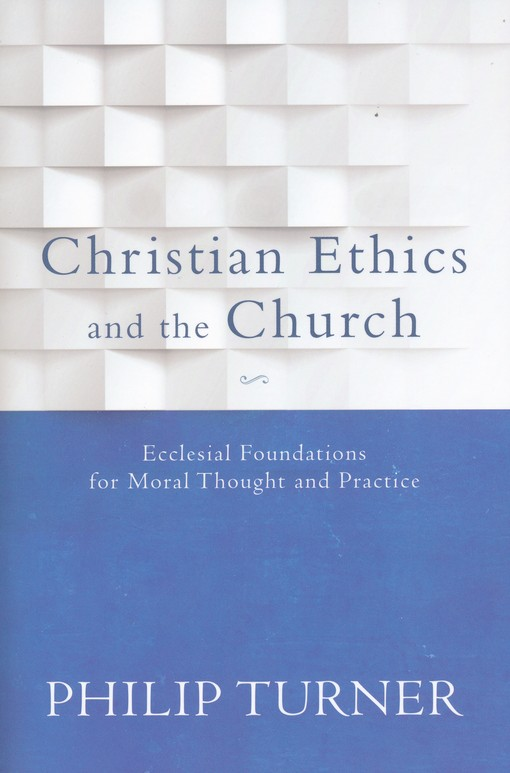
The letter to the Ephesians is the central concern in Turner’s Christian Ethics for the Church: Ecclesial Foundations for Moral Thought and Practice. But the fact that the Church is at the center of God’s purposes does not imply that Christians can be indifferent to or relentlessly cynical concerning questions about social and political order. So the last three chapters of his book examine social and political life as understood in light of the Church’s primacy in God’s plan for the world.
Here are several paragraphs from the chapter titled “An Ecclesial View of Life within Political Society.” Note that this passage is only a part of a larger argument that Turner develops.
“For minds shaped by the view that governance has been brought into being and sustained by human will and wit, the thought that government owes its origin and continuance to divine power and the purposeful intervention of God in history no doubt appears at best fanciful and at worst more than a little frightening. After all, has it not been the case that when the power of God is linked to ‘the powers that be,’ too frequently a way has been opened for authoritarian rule? Those whose moral focus is the common life of the church should be fully alive to this possibility. Again and again in the history of the church, believers have been confronted by the dread power and divine pretensions of government. It is not without reason that martyrdom became a fundamental marker of Christian identity early on.
“Aware as they may be of the demonic potential of all forms of governance, Christians nonetheless hold to a providential view of the basis of political authority not only because they rightly see that no government can guarantee its continued existence by the exercise of will alone but also because they believe the scriptural witness that God has power and authority to overcome all the forces (no matter how dreadful) that oppose his purposes. Because they believe that God’s governance of the course of history is both dependable and good, they place the rise and fall of nations not within the orbit of human will and wit but within the providence of a good and faithful God. This belief, drawn forth by God’s faithfulness, offers hope in the midst of history’s most dire moments.
“This belief also provides a way to address a question that remains unresolved by various contemporary attempts to root political authority and obligation in the dictates of human will and intelligence. The issue can be posed in this way. Contract theory roots political authority in a shared prudential judgment about what political arrangement best serves the interests of individual choosers. On this account we recognize political authority and accord obligation to it because, in doing so, we affirm our autonomy and so also our dignity as moral beings. One need not hold the beliefs in providence set out above to recognize three problems this view presents. First, speaking of an obligation to oneself hardly does justice to the standard meaning of the word (involving a debt to others). Second, if the authority of government rests finally upon our own will, in cases of serious conflict, if we find ourselves at odds with the judgments of authority, in a real sense we are forced to will against ourselves. As a result, we find ourselves in a state of alienation from the authority to which we once considered ourselves bound. Third, it is notoriously difficult to give an adequate account of why people who, in theory, recognize their interest in a particular form of contract will in reality support this contract when they survey the less-than-ideal circumstances in which the putative agreement must be lived out.
“By way of contrast, the account of the basis of political authority given by those who root political order in divine providence does not begin with conflicts between contending human wills. For them the originating issue is not how to manage conflicting human wills. Rather, it is the profound conflict between divine and human will. As Oliver O’Donovan has written, the command of political authority ‘strikes us like a meteor from outside our world, cutting across our projects and ambitions precisely because it is not the human will that has generated it, but the divine will mediated through human agents.’ For those who root governing authority in divine providence the first question is, therefore, not how conflicts between contending human wills can be resolved but whether God’s providential ordering of our conflicted wills is in fact good.
“The appropriate response to this question is not a political theory but a testimony to the faithfulness of a good and merciful God who will not desert his creation, who (again and again) will bring order out of the contending wills of the peoples of the earth, and who will preserve his people throughout the vicissitudes of history until his redemption of the world is complete. That said, the purpose or purposes of God’s preservative provenance remain unclear, as does the sort of order God wills to establish it. In our hands, political order can serve any number of purposes. Indeed, some forms of order can prove more terrible than the worst forms of disorder. In response to this dread possibility, Christian tradition has stated with considerable boldness what the purpose of God’s providential ordering of human affairs is. It has also insisted that not just any form of order will do.
“Christian tradition holds that the basis of political authority is divine providence and that the first goal of divine governance is the establishment of political order. Order preserves life within a ‘war-torn’ world, and as such is to be understood as an aspect of divine providence. Order is consequently a goal that Christians dare not pass by. The view of fallen human nature held by Christians through the ages (along with observation of what happens when public order breaks down) draws them to the conclusion that, in the absence of political order, divine purpose cannot be realized and human goals cannot be reached. From an ecclesial perspective, however, the establishment of order does not exhaust God’s providential purposes.
“The Augustinian tradition holds that God’s purpose in establishing political authority involves more than provision of a peaceful space in which life can continue. The deep purpose of that peaceful space is to provide opportunity for the church to carry out its mission. This tradition can and has been interpreted simply as a justification for governance that grants the churches special privileges. This interpretation entirely misses the point, however. The point is that the purpose of what we call ‘the state’ cannot be properly understood until the fact of its existence is located within God’s providential ordering of human history. Within the providence of God, the purpose of political authority is not to provide the church with political support. Rather, it is to provide space and time within a fallen world for God, through his people, to accomplish his purposes. In theological terms, all forms of governance (including church governance) can be rightly understood only as they are viewed through the lens of God’s final purposes. From this perspective, all forms of governance are but temporary measures designed to facilitate God’s eternal purpose and namely, in the words of John 4:23, bring the people’s worship of God ‘in spirit and truth.’ Hence it can be fairly said that Christians understand God’s purpose for the establishment of political order to be evangelical. This is not to say that our various forms of governance serve as divinely appointed instruments of salvation. They emphatically do not! It is to say only that these temporary arrangements make it possible for the church (words of the Book of Common Prayer) to carry out its assigned task in ‘peace and tranquility.’ If, however, governance claims to be an instrument of salvation or if it turns its face against the church and seeks its suppression or destruction, Christians may be certain governance now stands in opposition to its assigned role within divine providence and, in consequence, has become demonic — the instrument of anti-godly power.”
Related reading and listening
- War and loving our enemy-neighbor — Oliver O’Donovan on evaluating the conduct of war in light of the evangelical command of love
- The primacy of the Body of Christ — FROM VOL. 134 Philip Turner reflects on how Christian ethics is misplaced if it has as its central concern individual moral behavior or social justice. (28 minutes)
- A flood of images — Oliver O’Donovan describes the distinctive character of publicity in modernity, which drowns us in a flood of ever-changing representations that do not serve the common good. (37 minutes)
- How communities remember who they are — Oliver O’Donovan on the necessity of tradition in sustaining communal identity
- Publicity and representative images in society — Oliver O’Donovan describes the nature of publicity as the force that mediates our communication with one another, creating common interests and then rapidly subsuming them into newer ones.(Lecture 3 of 3; 57 minutes)
- How common loves shape communities — Oliver O’Donovan discusses how communities mediate love and knowledge to their members and what challenges arise as a community’s traditions are confronted by sin, error, and plurality. (Lecture 2 of 3; 49 minutes)
- The “sovereign uselessness of moral reflection” — Calling on the wisdom of St. Augustine, Oliver O’Donovan reminds his listeners that all knowledge participates in the eternal Logos of God and is rooted in love, not disinterested moral judgement.(Lecture 1 of 3; 52 minutes)
- How the Church promotes the cause of freedom — Oliver O’Donovan: “We discover we are free when we are commanded by that authority which commands us according to the law of our being, disclosing the secrets of the heart.”
- “The search for shared ends” — Oliver O’Donovan examines whether and to what extent there might be the possibility of a unifying Christian perspective on political doctrine or policy. (59 minutes)
- Thinking coherently about politics — Ken Myers gives an introduction to political theologian Oliver O’Donovan, whose work has been instrumental in teaching many how to think about social and political life in light of the gospel of Christ. (57 minutes)
- The law of faith and of love — Oliver O’Donovan compares St. Augustine’s interpretation of Psalm 119 with that of others, revealing Augustine’s more nuanced understanding of the complexities of the life of faith that the psalmist explores. (64 minutes)
- “Only a real world can save us” — Oliver O’Donovan explores how the “religion” of modernity lacks a coherent world in which one may participate with full human agency and moral purpose. (Lecture 3 of 3; 61 minutes)
- Christian unity and civil society — Oliver O’Donovan introduces listeners to Dutch lay theologian Hugo Grotius, arguing that the questions he tackled relate to perennial concerns about the relationship between divine and human agency, and between civil and ecclesiastical authority. (Lecture 2 of 3; 57 minutes)
- The demoralizing effect of pagan Roman religion — Oliver O’Donovan examines St. Augustine’s critique of pagan Roman religion in Book II of his treatise City of God and asks his audience to consider what insights Augustine’s critique has for us today. (Lecture 1 of 3; 51 minutes)
- Knowing and doing the good — Oliver O’Donovan raises several key questions and complications involved in the task of taking concrete and practical action toward a recognized moral good. (Lecture 3 of 3; 63 minutes)
- Moral knowledge of reality — Oliver O’Donovan argues that admiration is the fundamental form of knowing the world, as we cannot know fully those elements of reality (“bare facts”) that contain no significance for us. (Lecture 2 of 3; 55 minutes)
- Attentiveness to the world, the self, and time — Oliver O’Donovan uses the metaphor of waking to discuss the concept of moral sensibility as attention to the world, the self, and time. (Lecture 1 of 3; 60 minutes)
- Antagonism or fruitfulness? — FROM VOL. 108 Jean Porter describes how natural law justifies legal and moral authority within the life of the human person. (17 minutes)
- A more robust account of political life — FROM VOL. 138 John Milbank and Adrian Pabst on why politics needs to recognize the human soul in its depth (and what happens when it doesn’t). (51 minutes)
- The troubled marriage of art and democracy — Historian David Smith explains the idealistic (and naïve) political motivations behind the establishing of the National Endowment for the Arts, founded in 1965. (52 minutes)
- Governments officially committed to ignorance — In this lecture, D. C. Schindler explains why authority, properly understood, is essential to genuinely human life. (39 minutes)
- Against hacking babies — Oliver O’Donovan raises questions about IVF and the technologically ordered motive for efficiency
- Impact of “infotainment” on community — Neil Gabler and C. John Sommerville discuss how the mentalities conveyed by our experience with communications media work against the nurturing of community. (36 minutes)
- Recognizing the Puritan flavor of “America” — George McKenna on the originally theocentric vision for the American vocation
- Critiquing “empire criticism” — Allan Bevere and Peter Leithart evaluate “empire criticism,” a way of reading the New Testament with an anti-imperial focus. (36 minutes)
- The fatal polytheism of late liberalism — Oliver O’Donovan on the failure that leads to social collapse, marked by conflict, suspicion, and violence
- Insisting that political leaders are incapable of obeying Christ — Oliver O’Donovan on the unintended consequences of the First Amendment to the U.S. Constitution.
- When is civil disobedience necessary? — Douglas Farrow examines the relation between “the kings of the earth” and the law of Christ, particularly when governmental law is exercised without reference to natural or divine law. (49 minutes)
- The gift of objective reality — Moral philosopher Oliver O’Donovan makes an argument for the consistency of the idea of law when it is conceived in a theological context. (40 minutes)
- Power and paranoia — From our cassette tape archives, Daniel Chirot talks about political tyranny, and Daniel Pipes explains how conspiracy theories flourish. (31 minutes)
- Freedom as conformity to reality — W. Bradford Littlejohn summarizes the definitions of liberty offered by Richard Bauckham and Oliver O’Donovan
- Renewal of authentic political authority — Brad Littlejohn builds a case for the idea that authority makes free action possible, illustrating how that occurs within the forms of political and epistemic authority, properly understood and wisely practiced. (45 minutes)
- The sovereignty of love — In this 2022 lecture, Oliver O’Donovan explains the historical background — and present consequences — of the assertion by Jesus of two great commands. (67 minutes)
- O’Donovan, Oliver — FROM THE GUEST PAGE: Oliver O’Donovan held teaching posts at Wycliffe Hall, Oxford and Wycliffe College Toronto before becoming Regius Professor of Moral & Pastoral Theology and Canon of Christ Church at the University of Oxford in 1982.
- Why kings are compelling — Historian Francis Oakley describes how the modern idea of “secular” politics is a striking departure in human history. (32 minutes)
- Mars Hill Audio Journal, Volume 159 — FEATURED GUESTS:
Kirk Farney, Andrew Willard Jones, James L. Nolan, Jr., Andrew Kaethler, Peter Ramey, and Kathryn Wehr
- Conscience seared with a red-hot iron — Oliver O’Donovan on the convicting role of a good conscience
- Culture in light of Easter — Oliver O’Donovan rejects a gnostic reading of redemption
- Mars Hill Audio Journal, Volume 154 — FEATURED GUESTS:
Felicia Wu Song, Michael Ward, Norman Wirzba, Carl Trueman, D. C. Schindler, and Kerry McCarthy
- Religion within the bounds of citizenship — In a 2006 lecture, Oliver O’Donovan argues that the conventional way of describing Western civil society creates obstacles to the participation of believers (Muslim, Christian, and other). (68 minutes)
- Republican freedom — and ideological flexibility — Mark Noll on the novelty of America’s Christian republicanism
- The Church and the powers that be — Historian Mark Noll summarizes Christian ideas about political life in the last few centuries, examining how those ideas were worked out in various contexts in Western Europe and North America. (39 minutes)
- Politics in light of the Ascension — Oliver O’Donovan on the necessity of situating all political authority within redemptive history
- A foretaste of the kingdom of God — Oliver O’Donovan on the sovereignty of love
- Loving relationships in community — In conversation with moral philosopher Oliver O’Donovan, and with readings from his book, Entering into Rest, Ken Myers explores a central theme in O’Donovan’s work: that we are created to enjoy loving relationships in community. (27 minutes)
- The first virtue of citizenship: Taking the law seriously — Oliver O’Donovan reflects on how the reality of the Kingship of Christ must be affirmed as a present reality
- Reasoning about values — Revisiting a 1974 text that examined the mutual animosities of the 1960s
- “Whose kingdom shall have no end” — Oliver O’Donovan and his mentor, George B. Caird, offer lessons from the book of Revelation for thinking about politics
- The social context of freedom — Brad Littlejohn talks about the necessity of a more expansive understanding of freedom, one which recognizes that we are really only free within the social experience of shared meaning and mutual recognition. (17 minutes)
- The problem of a degenerate electorate — Aquinas, Augustine, and Aristotle on good government, as summarized by Reginald Garrigou-Lagrange