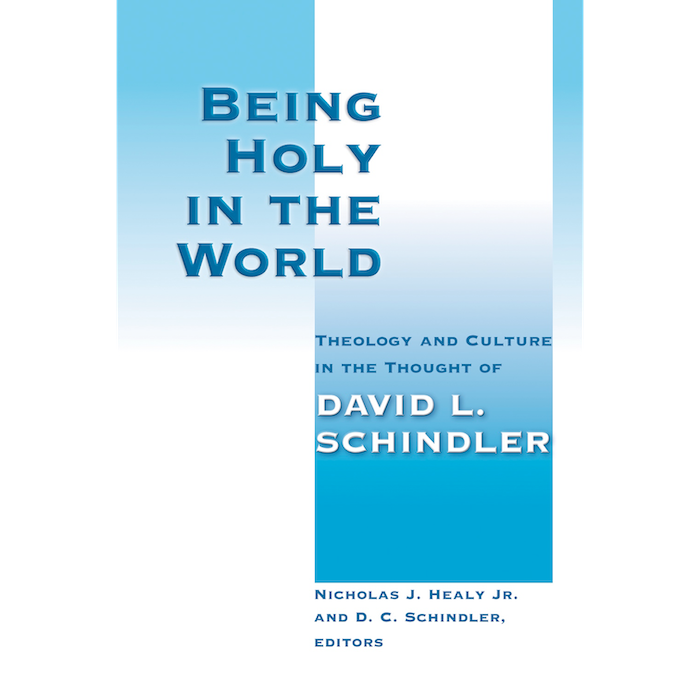
“[T]he commonly seen endeavor to ‘bracket out’ Christianity from one’s thinking or one’s formation of and participation in cultural institutions (with the intention, of course, of reintroducing it at the appropriate moment, namely, when moral questions come to the fore) betrays at once a false understanding of Christianity and a false understanding of understanding. . . .
“The most fundamental truth of religion is that the being of the world cannot ultimately be accounted for simply in terms of itself — world as eternal or self-created — but implies reference to a source beyond itself; in other words, the world is created. The two dimensions of the ‘logic’ of religion stem directly from the created character of the world’s being. In the first place, there is the ‘infinity’ of God that follows upon a notion of God as Creator, and thus as one who transcends all worldly being as its source, and who therefore is more intimately within all worldly being as the non-aliud, to use the expression of Nicholas of Cusa that Hans Urs von Balthasar admired so much. A true conception of the transcendence of God necessarily entails a radical immanence, for a God who is excluded from being, i.e., who ‘merely’ transcends things in the sense of being apart from them, is a God who exists within the same order as created being so as to be able to be ‘juxtaposed’ to it. This would be a God who is not truly transcendent but rather caught within the immanent ambit of the world. In other words, a Creator God is necessarily an infinite God, and an infinite God, by definition, must in some sense effectively bear on all things without exception, all the time. ‘A God who is truly God must affect everything. A God who in some significant sense is not everywhere and does not affect everything, and every aspect of everything, is not infinite but finite.’* There is a certain parallel between a misunderstanding of the nature of transcendence, which would exclude God from the world and by that very fact include God within the world as one discrete entity among other created entities, and the understanding of religious health that is satisfied with the (discrete) affirmation of the existence of God and feels no need to ask deeper questions. If God is the Creator of the world, then his existence has effective, formal, final, and indeed in some sense material significance for everything in the world, and so the affirmation of God’s existence must coincide with a particular way of thinking and speaking about, and dealing with, all other things. If God does not make at least implicitly a difference in the way one thinks about everything that is not God, if one assumes that God’s existence is simply a fact that can be tidily captured in sociological data, empirically gathered, one is in fact denying God’s existence. A fervent believer may be a practical atheist. God’s existence is more than a fact; it is an all-embracing truth the significance of which the mind will never be able to catch up to. As such, there is an essential mystery to God’s existence that will necessarily elude the positivistic methods of sociological data collection.”
—from D. C. Schindler, “Beauty and the Holiness of Mind,” in Being Holy in the World: Theology and Culture in the Thought of David L. Schindler (Grand Rapids: Eerdmans, 2011)
(*quotation from David L. Schindler, Heart of the World, Center of the Church [Eerdmans, 1996])
Related reading and listening
- When myth becomes fact — In this 1976 interview, Clyde Kilby (1902–1986) discusses C. S. Lewis’s critique of scientism and rationalism, his belief in the primacy of the imagination, and his mythic vision. (37 minutes)
- A sampling of newly published lectures — Ken Myers introduces listeners to four recently released lectures, courtesy of our Partners. The lecturers are Jennifer Frey, Gary Saul Morson, N. T. Wright, and Andrew Kern. (27 minutes)
- The inward eye, cosmic truth, and making well — Andrew Kern takes his listeners along an “interlinear” reading of a portion of St. Augustine’s Confessions that explores the differences between how God makes and how we create. (38 minutes)
- “Investigations of divine works” — Greg Wilbur explains how closely connected music is to the order of the cosmos and how it even reveals attributes of God. (56 minutes)
- To be at home in the world — D. C. Schindler examines how rituals enable us to experience time in a meaningful way — how they actually make time habitable for us. (41 minutes)
- A letter from Ken Myers — Ken Myers examines the cultural implications of the Incarnation and the deep-seated dualism of modernity that divorces spirituality from our material experience. (22 minutes)
- How music blesses and teaches — FROM VOL. 64 Theologian and musician Jeremy Begbie explores what we learn about time, theology, and the structure of Creation from the experience of music. (28 minutes)
- Mars Hill Audio Journal, Volume 166 — FEATURED GUESTS: William Cavanaugh, Kent Burreson, Beth Hoeltke, Jeffrey Barbeau, Jason Baxter, John Betz, and Bruce Herman
- Creation, in harmony with the Logos — Rowan Williams on the Logos and the diverse logoi that mirror it
- An icon of the whole world — Jason Baxter explains how Dante includes a panoply of characters and creatures in his Comedia, offering a prismatic view of all of Creation in its glory. (20 minutes)
- Rehearsing the Christian story — FROM VOL. 101 Thomas Long describes how funeral practices have the capacity to convey an understanding of the meaning of discipleship and death. (16 minutes)
- Cosmic realities in the built world — Christopher and Christine Perrin discuss the implications of architect Christopher Alexander’s (1936–2022) discovery of patterns of building that cohere with the the created cosmos and with ourselves as human creatures. (59 minutes)
- The “book” of Creation — Alan Noble explains why the modern world makes it profoundly difficult to experience Creation as revelation, and he encourages unmediated encounters with Creation that lead to meditation. (52 minutes)
- Life more abundantly — Jeanne Schindler advocates for a return to an understanding and prioritizing of sensory experience — real engagement with the real world — as foundational to learning and living. (35 minutes)
- Heaven and earth are full of His glory — Gerald R. McDermott examines the typological tradition of the Church, particularly through Jonathan Edwards’s thought, and he argues for a recovery of the Christian understanding of the universe as an “immense Trinitarian symbol.” (61 minutes)
- An invitation to a feast — Christina Bieber Lake explains how poetry is an invitation to experience the beauty and goodness of Creation as gift. (44 minutes)
- Stewarding God’s creation — FROM VOL. 116 Fred Bahnson talks about how a Christian understanding of God’s redemptive work on the earth should influence our practices of growing and sharing food. (19 minutes)
- “Earth-shaking” and “heart-breaking” beauty — FROM VOL. 151 Junius Johnson warns that the pursuit of beauty is both perilous and an experience that points to the desire for God. (25 minutes)
- Man as “both mystic and hobbit” — D. C. Schindler explores how building is a quintessential human activity and an expression of our view of the meaning of reality. (47 minutes)
- Clips from five extended interviews — We are pleased to share clips from five interviews that we’ve recently produced as full-length Conversations. (30 minutes)
- Breaking out of the immanent frame — Norman Wirzba on the true character of Creation and of our creatureliness
- Good News for All Creation — Theologian Norman Wirzba helps us rethink the category of nature in terms of the Christian doctrine of creation. (66 minutes)
- What is beyond our choosing? — D. C. Schindler on our nihilistic quest for freedom
- Ten, seven, and the rhythm of God’s love — Joseph Cardinal Ratzinger on the meaningfulness of numbers in Creation and Scripture
- Lives of generosity — Jonathan Wilson distinguishes between two fundamental ways of viewing Creation: a true Christian account of the world and a “survival of the fittest” one. (21 minutes)
- Creation and redemption as trinitarian projects — Colin Gunton on Christ and Spirit in creation and redemption
- Reflecting the being of God in communion — Colin Gunton on the relationality at the heart of Creation
- The whole world in his Hands — Colin Gunton on the trinitarian emphasis in St. Irenaeus’s doctrine of Creation
- The recovery of an integrated ecology — In this essay, Michael Hanby unpacks the summons of Laudato si’ to an ecological way of life based on a proper understanding of creation in its fullness and integrity. (57 minutes)
- The hatred of logos — D. C. Schindler draws on Plato to argue that in its very form, social media evidences a general contempt for logos — reason and language — which defines man. (26 minutes)
- Politics and the good — FROM VOL. 160 D. C. Schindler argues that political order cannot be disentangled from the social, and that fundamental questions of what humans are and what the good is cannot be bracketed from politics. (30 minutes)
- The collapse of public life — FROM VOL. 154 D. C. Schindler explains how liberalism sought to make way for individuals to function together without any orientation to an explicit common good. (37 minutes)
- Truth, goodness, and beauty (and why they matter) — FROM VOL. 147 Philosopher D. C. Schindler examines how postmodernism poses a unique threat to our sense of an interior self. (28 minutes)
- The interiority of reality — FROM VOL. 132 D. C. Schindler discusses the thought of contemporary German philosopher Robert Spaemann, and his defense of a purposeful structure in nature. (28 minutes))
- The dramatic ecstasy of reason — FROM VOL. 120 D. C. Schindler argues that the Enlightenment was not wrong for giving too much to reason; it was wrong in endorsing an impoverished conception of reason. (19 minutes)
- Speaking the word in love — In this lecture, D. C. Schindler examines core insights from Ferdinand Ulrich on the central vocation of man and the meaning of being. (32 minutes)
- The profound drama of human sexuality — In this lecture, D. C. Schindler explains the cosmological significance of human sexuality and why it is paradigmatic of the relationship between nature and freedom. (32 minutes)
- Personhood and the gift of the self — In this lecture, D. C. Schindler examines the concept of self-gift which was central to Karol Wojtyła’s thought. (39 minutes)
- Governments officially committed to ignorance — In this lecture, D. C. Schindler explains why authority, properly understood, is essential to genuinely human life. (39 minutes)
- Coming unstuck from the earth — Henru de Lubac on how being heavenly minded makes one of immense earthly good
- Metaphysics and sub-creation — FROM VOL. 144 Jonathan McIntosh claims that scholarship has tended to ignore the depth of St. Thomas Aquinas’s influence on J. R. R. Tolkien’s work. (28 minutes)
- Knowing by heart — D. C. Schindler reflects on Plato’s idea of “conversion” in education, assuming the symbol of the heart as the center of man. (39 minutes)
- Music, silence, and the order of Creation — In this lecture, Ken Myers explains how it is that our participation in harmonic beauty in music is a kind of participation in the life of God, in Whom all order and beauty coheres and is sustained. (61 minutes)
- The gift of liturgical time — In this lecture, Gregory Wilbur explains how liturgy and liturgical time align us to the rhythms and order of Creation, forming us as disciples. (45 minutes)
- Seasons and everyday saints — Sylvie Vanhoozer introduces a French Advent tradition that involves a community of “little saints” whose stories have something to teach us about following Christ throughout the year. (28 minutes)
- The confident optimism in true Christian asceticism — Philosopher Étienne Gilson on the essential goodness of Creation
- The gift of meaningful work — In this lecture, D. C. Schindler argues that genuine work is inherently meaningful and facilitates an encounter with reality and therefore, ultimately, with God. (36 minutes)
- Festivity and the goodness of Creation — Drawing on Josef Pieper’s ideas, Ken Myers explains why the spirit of festivity is the spirit of worship, and that “entertainment” is ultimately an artificial, contrived, and empty effort to achieve festivity. (25 minutes)
- Unmasking claims of “secular neutrality” — Lesslie Newbigin on the Church’s prophetic duty concerning public life
- The kingdom of God has public consequences — Lesslie Newbigin on the subversiveness of the Church’s message to the world