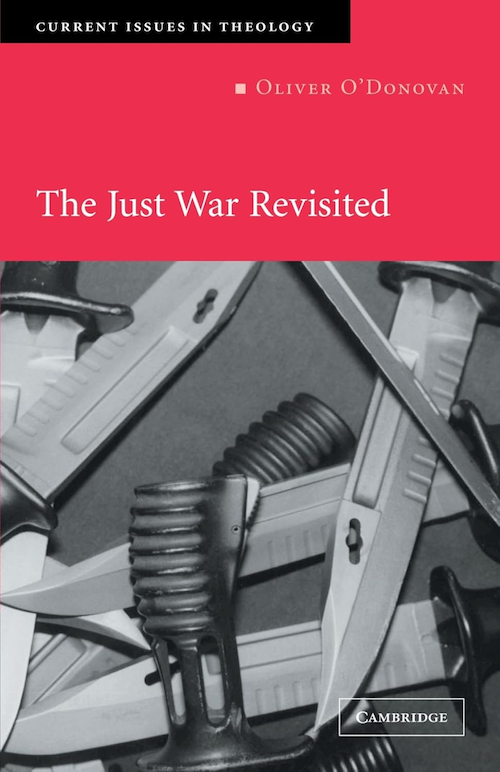
“On the famous Ghent altarpiece, on which the Van Eyck brothers depicted the adoration of the Lamb of God standing upon an altar on a greensward in front of the Heavenly Jerusalem, there appear in the lower left-hand panel two groups of people at the edge of the worshipping crowd. They are separated from each other by a rocky outcrop, but share a common urban background; and that contrasts them with a balancing pair of groups on the lower right-hand panel, set against a wilderness landscape. Those on the right are the hermits and the pilgrims of the church; but the groups on the left are identified as the church’s just judges and milites Christi, ‘soldiers of Christ’. To our modern sensibilities this is immediately shocking. How, we wonder, could the lay service exercised in a civil context by Christian judges come to be extended to soldiers? The one group serves peace, the other war; this seems enough to set an infinite spiritual distance between them. Can one who fights offer worship to the sacrificed Lamb? Our sense of shock is excusable. Yet the idea that these two roles, judges and soldiers, are analogous, an idea that grew out of the twelfth-century romanticisation of the Christian knight such as we meet in the legends of the Round Table, was one of the great achievements of the late middle ages. Today we commonly call it the ‘just war theory’.
“There are good reasons to hesitate over this achievement. The will of God for humankind is peace: that all-determining truth contains, and shapes, any further truths that we may hope to learn on this subject. And from it flow three further propositions. First, God’s peace is the original ontological truth of creation. We must deny the sceptical proposition that competition and what metaphysicians call ‘difference’ are the fundamental realities of the universe, a proposition which the creation, preservation and redemption of the world make impossible to entertain. Secondly, God’s peace is the goal of history. We must deny the supposed cultural value of war, its heroic glorification as an advancement of civilisation. For war serves the ends of history only as evil serves good, and the power to bring good out of evil belongs to God alone. Thirdly, God’s peace is a practical demand laid upon us. We must deny any ‘right’ to the pursuit of war, any claim on the part of a people that it may sacrifice its neighbours in the cause of its own survival or prosperity. For the Gospel demands that we renounce goods that can only be won at the cost of our neighbours’ good.
“Philologically, bellum is duellum, the confrontation of two, the simple and unmediated difference of opposites. No Christian believes that duellum can be ‘just’ or ‘necessary’, because no Christian believes that opposition can in fact be unmediated. All oppositions are subject to the pacific judgment of God, of which neither party is independent. To this extent every Christian is, to use a term which had some currency early in the twentieth century, a ‘pacificist’, rejecting antagonistic praxis, the praxis of unmediated conflict. All Christians, therefore, can recognise something like a sin of belligerence or a ‘crime against peace’. That crime consists in making antagonistic praxis a goal of politics, whether as means or end; that sin consists in cultivating antagonism as a form of self-perfection. . . .
“From the earliest attempts to understand how armed conflict might be compatible with Christian discipleship, the church has taken its bearings from the evangelical command of love. Augustine’s famous letter to Boniface treats the obligation of military action as an obligation of love to the neighbour. St Thomas and his followers locate the discussion of war within the treatise on the virtue of charity. In the context of war we find in its sharpest and most paradoxical form the thought that love can sometimes smite, and even slay. If this thought marks the parting of the ways with pacifism, it also indicates the point at which Christian thought on war is irreconcilable with the alternative strategy for refusing the judicial proposal, which is to make survival the final criterion of what may and may not be done. To take survival as the bottom line is to revert to the antagonistic model of mortal combat, and so inevitably to retreat from the Gospel proclamation of the universal rule of Christ and from the praxis of loving judgment. When self-defence, of state, community or individual, has the last word, paganism is restored. Precisely for this reason a Christian witness to God’s peace must always be acted out against the horizon of suffering and martyrdom. Suffering and martyrdom mark the point at which the possibilities of true judgment run out within the conditions of the world. They are necessary components of Christian practical reason, because they demonstrate the vulnerability of the praxis of judgment, and so protect it from serious misunderstanding. Judgment is an undertaking always under threat within the terms of this world, always liable to be overwhelmed by violence. It cannot possibly issue a licence to avoid defeat by all possible means.
“Yet the horizon on which we are called to suffer and to die rather than wrong our neighbour is not reached before we actually reach it. The possibilities of active witness to God’s peace are not exhausted until we have exhausted them, which we will not have done if we have not explored them. In this context, as in all others, the duties which confront us do not begin with martyrdom; they end with it, when we have gone as far as we are permitted to go, done as much as we are permitted to do. Martyrdom is not, in fact, a strategy for doing anything, but a testimony to God’s faithfulness when there is nothing left to do. Which is simply to say that we cannot describe the praxis of international judgment solely by pointing to the moment at which its possibilities run out. A child invited to paint a fish may begin by painting the sea, and when the paper is awash in blue, discover too late that the fish’s outline needed to be sketched in first. The praxis of judgment is that of a certain type of action, and no account of it can be offered in words with the prefix ‘non-’. Non-violence, non-resistance and all the other great watchwords of pacifism evoke a set of limits which circumscribe the possibility of action in the world. They belong to the philosophy of transcendence, the via negativa. They frame every Christian witness within the eschatological non-coincidence of worldly success and the triumph of God’s kingdom. But they do not describe this witness.”
— from Oliver O’Donovan, The Just War Revisited (Cambridge University Press, 2003)
A flood of images — Oliver O’Donovan describes the distinctive character of publicity in modernity, which drowns us in a flood of ever-changing representations that do not serve the common good. (37 minutes)
Publicity and representative images in society — Oliver O’Donovan describes the nature of publicity as the force that mediates our communication with one another, creating common interests and then rapidly subsuming them into newer ones.(Lecture 3 of 3; 57 minutes)
How common loves shape communities — Oliver O’Donovan discusses how communities mediate love and knowledge to their members and what challenges arise as a community’s traditions are confronted by sin, error, and plurality. (Lecture 2 of 3; 49 minutes)
The “sovereign uselessness of moral reflection” — Calling on the wisdom of St. Augustine, Oliver O’Donovan reminds his listeners that all knowledge participates in the eternal Logos of God and is rooted in love, not disinterested moral judgement.(Lecture 1 of 3; 52 minutes)
How the Church promotes the cause of freedom — Oliver O’Donovan: “We discover we are free when we are commanded by that authority which commands us according to the law of our being, disclosing the secrets of the heart.”
“The search for shared ends” — Oliver O’Donovan examines whether and to what extent there might be the possibility of a unifying Christian perspective on political doctrine or policy. (59 minutes)
Thinking coherently about politics — Ken Myers gives an introduction to political theologian Oliver O’Donovan, whose work has been instrumental in teaching many how to think about social and political life in light of the gospel of Christ. (57 minutes)
The law of faith and of love — Oliver O’Donovan compares St. Augustine’s interpretation of Psalm 119 with that of others, revealing Augustine’s more nuanced understanding of the complexities of the life of faith that the psalmist explores. (64 minutes)
“Only a real world can save us” — Oliver O’Donovan explores how the “religion” of modernity lacks a coherent world in which one may participate with full human agency and moral purpose. (Lecture 3 of 3; 61 minutes)
Christian unity and civil society — Oliver O’Donovan introduces listeners to Dutch lay theologian Hugo Grotius, arguing that the questions he tackled relate to perennial concerns about the relationship between divine and human agency, and between civil and ecclesiastical authority. (Lecture 2 of 3; 57 minutes)
The demoralizing effect of pagan Roman religion — Oliver O’Donovan examines St. Augustine’s critique of pagan Roman religion in Book II of his treatise City of God and asks his audience to consider what insights Augustine’s critique has for us today. (Lecture 1 of 3; 51 minutes)
Knowing and doing the good — Oliver O’Donovan raises several key questions and complications involved in the task of taking concrete and practical action toward a recognized moral good. (Lecture 3 of 3; 63 minutes)
Moral knowledge of reality — Oliver O’Donovan argues that admiration is the fundamental form of knowing the world, as we cannot know fully those elements of reality (“bare facts”) that contain no significance for us. (Lecture 2 of 3; 55 minutes)
Attentiveness to the world, the self, and time — Oliver O’Donovan uses the metaphor of waking to discuss the concept of moral sensibility as attention to the world, the self, and time. (Lecture 1 of 3; 60 minutes)
John Milbank and Adrian Pabst on why politics needs to recognize the human soul in its depth (and what happens when it doesn’t). (51 minutes)
Against hacking babies — Oliver O’Donovan raises questions about IVF and the technologically ordered motive for efficiency
Impact of “infotainment” on community — Neil Gabler and C. John Sommerville discuss how the mentalities conveyed by our experience with communications media work against the nurturing of community. (36 minutes)
Critiquing “empire criticism” — Allan Bevere and Peter Leithart evaluate “empire criticism,” a way of reading the New Testament with an anti-imperial focus. (36 minutes)
The gift of objective reality — Moral philosopher Oliver O’Donovan makes an argument for the consistency of the idea of law when it is conceived in a theological context. (40 minutes)
Freedom as conformity to reality — W. Bradford Littlejohn summarizes the definitions of liberty offered by Richard Bauckham and Oliver O’Donovan
The sovereignty of love — In this 2022 lecture, Oliver O’Donovan explains the historical background — and present consequences — of the assertion by Jesus of two great commands. (67 minutes)
O’Donovan, Oliver — FROM THE GUEST PAGE: Oliver O’Donovan held teaching posts at Wycliffe Hall, Oxford and Wycliffe College Toronto before becoming Regius Professor of Moral & Pastoral Theology and Canon of Christ Church at the University of Oxford in 1982.
Why kings are compelling — Historian Francis Oakley describes how the modern idea of “secular” politics is a striking departure in human history. (32 minutes)
Mars Hill Audio Journal, Volume 159 — FEATURED GUESTS:
Kirk Farney, Andrew Willard Jones, James L. Nolan, Jr., Andrew Kaethler, Peter Ramey, and Kathryn Wehr
Mars Hill Audio Journal, Volume 154 — FEATURED GUESTS:
Felicia Wu Song, Michael Ward, Norman Wirzba, Carl Trueman, D. C. Schindler, and Kerry McCarthy
Religion within the bounds of citizenship — In a 2006 lecture, Oliver O’Donovan argues that the conventional way of describing Western civil society creates obstacles to the participation of believers (Muslim, Christian, and other). (68 minutes)
The Church and the powers that be — Historian Mark Noll summarizes Christian ideas about political life in the last few centuries, examining how those ideas were worked out in various contexts in Western Europe and North America. (39 minutes)
Loving relationships in community — In conversation with moral philosopher Oliver O’Donovan, and with readings from his book, Entering into Rest, Ken Myers explores a central theme in O’Donovan’s work: that we are created to enjoy loving relationships in community. (27 minutes)
Reasoning about values — Revisiting a 1974 text that examined the mutual animosities of the 1960s
“Whose kingdom shall have no end” — Oliver O’Donovan and his mentor, George B. Caird, offer lessons from the book of Revelation for thinking about politics
The social context of freedom — Brad Littlejohn talks about the necessity of a more expansive understanding of freedom, one which recognizes that we are really only free within the social experience of shared meaning and mutual recognition. (17 minutes)
The Kingdom of God and the kings of the earth — In a 90-minute conversation with Matthew Lee Anderson and Ken Myers, Oliver O’Donovan explains some of the central themes of his work in political theology. (91 minutes)
Learning about the meaning of government — In a telephone conversation during COVID-19 lockdowns, Oliver O’Donovan talks about lessons we can learn about the proper role of government from our experience of pandemics and quarantine. (51 minutes)
Ethics as Theology, Part 2 — Drawing from St. Augustine and figures such as Aelred of Rievaulx, Oliver O’Donovan describes how the Church, communication, community, and friendship all significantly contribute to how we understand the role of love in both ethical and political reflection. (52 minutes)
Ethics as Theology, Part 1 — Moral philosopher Oliver O’Donovan discusses the first two volumes of his three-volume set, Ethics as Theology. Among other topics, he reflects on the significance of the thinking moral subject as well as what form of moral inadequacy the “life of the flesh” suggests. (58 minutes)
The inevitability of escalating public animosity — With excerpts from books and lectures by Alasdair MacIntyre, Oliver O’Donovan, and Wendell Berry, Ken Myers argues that modern political theory has guaranteed increasing levels of public conflict. (19 minutes)
Mars Hill Audio Journal, Volume 139 — FEATURED GUESTS:
W. Bradford Littlejohn, Simon Oliver, Matthew Levering, Esther Lightcap Meek, Paul Tyson, and David Fagerberg