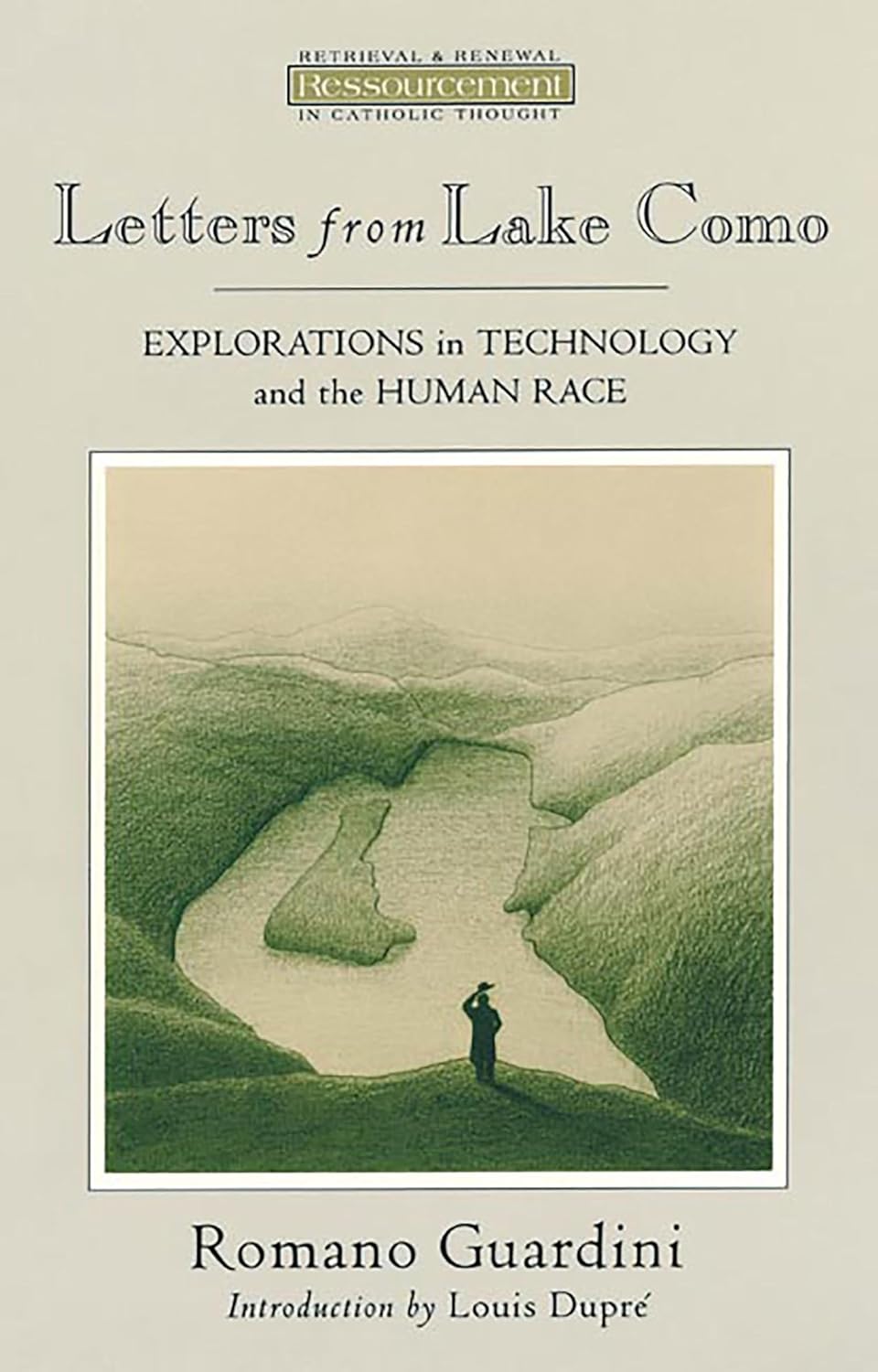
In the late 1950s, theologian Romano Guardini gave an address at the Munich College of Technology, a talk published later under the title “The Machine and Humanity.” The address resonated with many of the themes that Guardini pursued in Letters from Lake Como, originally published in periodical form between 1923 and 1925.
“Every technical action involves the possessing, using, and shaping of nature. Nature becomes culture. Nature is what is there on its own; culture is what we humans make of it. In the course of history, the culture factor in existence has become stronger, while the natural factor has become weaker.
“With the coming of the machine this process has reached a new stage. Nature has been seized and made ready for use. Human beings take a cultural attitude to nature when they go to it. We need only think of photography, which has become the way travelers encounter things, or of the way in which we organize travel and vacations and furnish them with all the amenities of city life.
“The process seems to be unavoidable. Still, this question arises: What will be the effect of this constant weakening of the natural factor that still remains in human existence? Each new machine means that something we previously mastered with the help of our organic intellectual equipment is now left to a technical construct. We thus make an object of something that used to be subjective, part of life’s initiative. This means release — we are freed. But it means also that we have lost a possibility of creating, of experiencing the world, and of self-development. So long as we had only sailing ships, sea journeys were often dangerous, but they also brought to life the enhancement that goes along with risk. Modern ships have greatly reduced the dangers. They give travelers a few peaceful days in floating hotels. Relative to existence as a whole, is that a gain or a loss?
“The fact that the machine brings a measure of freedom hitherto unknown is in the first instance a gain. The value of freedom, however, is not fixed solely by the question ‘Freedom from what?’ but decisively by the further question ‘Freedom for what?’ Every social pedagogue knows what problems arise regarding use of the time that is made free by machines. If we do not succeed in making meaningful use of the free days, then the result of such ‘freedom’ is negative.
“Finally, we need to say something about that which concerns our innermost life. The ongoing intensification of science and technology, with all that this means in economic life, communications, and public consciousness, seems to be a hindrance to our ability to have immediate religious experience or to our receptivity to religious motivation. Some time ago in Westphalia, or so I am told, a motto was in parlance that where the railroad comes, second sight disappears. In an incidental way this seems to point to what I have in mind. Our attention today is claimed for rational and utilitarian tasks in such a way that we can no longer pay attention to that other dimension of our existence.
“It is no accident that the worldview which sees in the machine the symbol of fulfilled culture — namely, materialistic communism — is trying systematically to destroy the religious life. It proceeds on the premise that science and technology are the only foundations of existence and that they demand such a level of empirical concentration that everything religious has to be harmful. For positivists who think in terms of Comte’s formula for historical progress — lowest stage = religion, second stage = philosophy, third and true stage = science — the disappearance of the religious element is a gain. Those who look deeper realize, however, that this means a loss, not only of an essential part of the human, but of the innermost part.”
—from Romano Guardini, Letters from Lake Como: Explorations in Technology and the Human Race (William B. Eerdmans Publishing Company, 1926, 1994)
Related reading and listening
- Watching, waiting, persevering — Romano Guardini on the necessarily eschatological character of Christian living
- The destructive perils of speech without a real partner — Josef Pieper and Marc Barnes on how chatbots pervert the nature of conversation
- Paradoxes of “nature” and “culture” — Robert Spaemann, on the destructive consequences of a merely naturalistic understanding of nature
- Machines and misanthropy — Nicholas Carr on how technology has transformed our understanding of progress (and people)
- Alienation and autoamputation: the price of power — Nicholas Carr on the numbing effect of technology
- Disengagement from the world — Nicholas Carr encourages us to consider how automation technologies impact our ability to engage with the world and whether — like a good tool — they present a more inviting world or close us off from that world. (30 minutes)
- Life more abundantly — Jeanne Schindler advocates for a return to an understanding and prioritizing of sensory experience — real engagement with the real world — as foundational to learning and living. (35 minutes)
- Technophiliac obsessions — FROM VOL. 141 Literary and media scholar Grant Wythoff talks about the “father of science fiction,” Hugo Gernsback. (26 minutes)
- Utopian dreams and cynicism — John Durham Peters discusses the history of the idea of communication, saying that our hopes are too high when we believe that the solution to social discord is just better communication. (49 minutes)
- What adolescence misses — FROM VOL. 94 Mark Bauerlein talks about the ways of learning and living practiced by contemporary youth, how they impact the acquisition and use of knowledge and form intellectual habits, and what this means for the future of our society. (16 minutes)
- Helping boys become virtuous men — Teacher and chaplain Mark Perkins describes forms of formation that take the body seriously 50 minutes
- The temptations of talismanic technologies — Jeffrey Bilbro on the persistence of techno-utopianism
- Living in a tool-i-fied world — Joseph Minich on how the ubiquity of technology makes atheism entirely plausible
- In the Image of Our Devices — Nicholas Carr considers how automation technologies impact our ability to engage with the world. (66 minutes)
- Good News for All Creation — Theologian Norman Wirzba helps us rethink the category of nature in terms of the Christian doctrine of creation. (66 minutes)
- The recovery of an integrated ecology — In this essay, Michael Hanby unpacks the summons of Laudato si’ to an ecological way of life based on a proper understanding of creation in its fullness and integrity. (57 minutes)
- Awakening before what is great — Romano Guardini on the proper posture of one in the presence of greatness
- The interiority of reality — FROM VOL. 132 D. C. Schindler discusses the thought of contemporary German philosopher Robert Spaemann, and his defense of a purposeful structure in nature. (28 minutes))
- The profound drama of human sexuality — In this lecture, D. C. Schindler explains the cosmological significance of human sexuality and why it is paradigmatic of the relationship between nature and freedom. (32 minutes)
- The downward spiral of all technocracies — Andrew Willard Jones explains the two paths that exist with the development of new technologies: one which leads to an expansion of the humane world and one which exploits and truncates both Creation and humanity. (65 minutes)
- Mars Hill Audio Journal, Volume 164 — FEATURED GUESTS: Dana Gioia, Brady Stiller, Robert Royal, Richard DeClue, Tiffany Schubert, and Joonas Sildre
- The grotesque and the transcendent — Christina Bieber Lake on why Flannery O’Connor’s readers have to work
- How social media truncates relationships — In this lecture, Felicia Wu Song explains how social media industrializes and monetizes our relationships, forming us in modes of relationships and identity that are detrimental to ourselves and to society. (41 minutes)
- The need to recollect ourselves as whole persons — In this 2016 lecture, John F. Crosby explores key personalist insights found in the thinking of John Henry Newman and Romano Guardini. (60 minutes)
- In technology, we live and move and have our knowing — George Parkin Grant on technology’s establishment of a framework for thinking about technology
- On the Degeneration of Attentiveness — Critic Nicholas Carr talks about how technology-driven trends affect our cultural and personal lives. (56 minutes)
- Gratitude, vitalism, and the timid rationalist — In this lecture, Matthew Crawford draws a distinction between an orientation toward receiving life as gift and a timid and cramped rationalism that views man as an object to be synthetically remade. (52 minutes)
- The transforming power of false divinities — Romano Guardini on the danger of becoming like the gods we invent
- Humans as biological hardware — In this essay, Brad Littlejohn and Clare Morell decry how modern technology tends to hack the human person in pursuit of profit. (55 minutes)
- “The system will be first” — FROM VOL. 27 Robert Kanigel describes the transformation of work due to Frederick Winslow Taylor’s concept of scientific management. (11 minutes)
- Choices about the uses of technology — This Feature presents interviews with David Nye and Brian Brock related to how we evaluate adoption of new technology and how technology influences our thinking. (31 minutes)
- What it means to be a person — FROM VOL. 147 Sociologist Craig Gay argues that in order to address the challenges of a technological approach to the world, we need to recover the Christian tradition’s robust theology of personhood. (24 minutes)
- The problem with dynamism without direction — Paulina Borsook on the biological paradigm of technolibertarianism’s love of spontaneous dynamism, whatever the costs
- The libertarian spawning-ground of tech bros — Paulina Borsook on high tech’s long-standing animosity toward government and regulation
- Tech bros and public power — Paulina Borsook discusses the “bizarrely narcissistic” and ultra-libertarian culture of Silicon Valley. (22 minutes)
- Voluntarily silencing ourselves — FROM VOL. 39 John L. Locke discusses the value of personal communication and how technology is displacing it. (12 minutes)
- Souls in cyberspace — FROM VOL. 25 Douglas Groothuis examines the worldview and mythology behind the creation and marketing of the Internet. (13 minutes)
- Life in a frictionless, synthetic world — FROM VOL. 17 Mark Slouka explores the worldview of techno-visionaries who aim to create a new era of human evolution. (11 minutes)
- The digital revolution and community — FROM VOL. 7 Ken Myers talks with Jane Metcalfe, the founder of WIRED Magazine, about technology and community. (8 minutes)
- Metaphysical impulses beneath techno-utopianism — FROM VOL. 38 Erik Davis describes his research on how humans’ fascination with technology is permeated with “mythic energy” and gnostic aspirations. (11 minutes)
- Post-Christian America and the “unlimited technological future” — George Parkin Grant on technology and the Puritan legacy of “unflinching wills”
- Education that counters alienation — In this lecture, Jeanne Schindler explores how digital technologies warp not only education but our experience of being human. (30 minutes)
- Nature’s intelligibility — In this lecture, Christopher Blum argues that scientists need to regain a full appreciation of nature’s intelligibility, as they are apt to lose sight of reality due to the reductionism produced by their theories. (31 minutes)
- Faith that is more than “chemically pure” — Romano Guardini on sustaining a Christian understanding of all of Creation
- Paradoxical attitudes toward plastic — Jeffrey Meikle traces the technological, economic, and cultural development of plastic and relates it to the American value of authenticity. (15 minutes)
- Technology and the kingdom of God — FROM VOL. 63 Albert Borgmann (1937–2023) believes Christians have an obligation to discuss and discern the kind of world that technology creates and encourages. (12 minutes)
- The gift of meaningful work — In this lecture, D. C. Schindler argues that genuine work is inherently meaningful and facilitates an encounter with reality and therefore, ultimately, with God. (36 minutes)
- Diverting language from its richest possibilities — FROM VOL. 75 Steve Talbott discusses the rich capacities of language and how technology diminishes them. (18 minutes)
- The recovery of true authority for societal flourishing — Michael Hanby addresses a confusion at the heart of our current cultural crisis: a conflation of the concepts of authority and power. (52 minutes)
- Automation and human agency — FROM VOL. 150 Philosopher and mechanic Matthew Crawford laments the losses of human skill that correspond with gains in mechanical automation. (21 minutes)