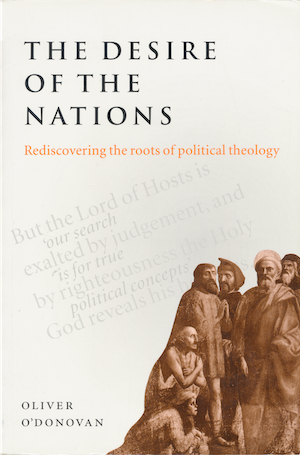
The rulers of the world bowed before Christ’s throne
“What claim has this ‘Christendom’, this millennium and a half of respectfulness on the part of Gentile lords, upon our interest now? Not the claim of revelation, certainly, which is the claim of Israel and the Christ. Nor even the claim of tradition, since tradition is continuity, and its claim is the claim of what has proved its worth by survival. We now have little continuity with Christendom; it is not our tradition anymore; its assumptions are alien to us. Its claim on us is simply that of witness. It attests, as a matter of history, the actual impact of the Christian faith on European politics, and it expounds this impact in its developed political reflections. Those who ruled in Christendom and those who thought and argued about government believed that the Gospel was true. They intended their institutions to reflect Christ’s coming reign. We can criticize their understanding of the Gospel; we can criticize their applications of it; but we can no more be uninterested in their witness then an astronomer can be uninterested in what people see through telescopes. And while no testimony to Christ can safely be ignored, this one lays claim with a special seriousness; for although it is no longer our tradition, we are its dénouement, or perhaps its débâcle. It was the womb in which our late-modernity came to birth. Even our refusal of Christendom has been learned from Christendom. Its insights and errors have fashioned, sometimes by repetition and sometimes by reaction, the insights and errors which comprise the platitudes of our own era.
“Christendom, then, offers two things: a reading of those political concepts with which Scripture furnishes us, and a reading of ourselves and of our situation from a point of observation outside ourselves but not too far outside. Either of these readings we are free to question or to doubt; but for neither of them can we find a ready substitute. The more the political character of Israel’s hope engages us, the more we need to know how it has actually shaped the government of nations. The more the problem of our own modernity engages us, the more we need to see modernity against its background.
“I use the term ‘Christendom’ (in keeping with a good deal of current discussion) to refer to a historical idea: that is to say, the idea of a professionally Christian secular political order, and the history of that idea in practice. Christendom is an era, an era in which the truth of Christianity was taken to be a truth of secular politics. . . . Let us say that the era lies between ad 313, the date of the Edict of Milan, and 1791, the date of the First Amendment to the US Constitution, though these moments are symbolic only, and others could no doubt be found that would do as well. In the course of this period, the idea of Christendom developed and underwent corrections and elaborations; sometimes it was taken to apply more, sometimes less. Yet the idea is always there, giving a unity to the whole era which entitles it to the name ‘Christendom’: it is the idea of a confessionally Christian government, at once ‘secular’ (in the proper sense of that word, confined to the present age) and obedient to Christ, a promise of the age of his unhindered rule.
“The rulers of the world have bowed before Christ’s throne. The core idea of Christendom is therefore intimately bound up with the church’s mission. But the relationship between mission and Christian political order should not be misconstrued. It is not, as is often suggested, that Christian political order is a project of the church’s mission, either as an end in itself, or as a means to the further missionary end. The church’s one project is to witness to the Kingdom of God. Christendom is a response to mission, and as such a sign that God has blessed it. It is constituted not by the church’s seizing alien power, but by alien power’s becoming attentive to the church.”
— from Oliver O’Donovan, The Desire of the Nations: Rediscovering the Roots of Political Theology (Cambridge: Cambridge University Press, 1996)
Related reading and listening
How to make war on nothingness? — David Bentley Hart argues that if it rejects Christ, the only remaining option for a post-Christian culture is conscious or “narcotic” nihilism, which takes the form of absolute, meaningless volition. (66 minutes)
A flood of images — Oliver O’Donovan describes the distinctive character of publicity in modernity, which drowns us in a flood of ever-changing representations that do not serve the common good. (37 minutes)
Publicity and representative images in society — Oliver O’Donovan describes the nature of publicity as the force that mediates our communication with one another, creating common interests and then rapidly subsuming them into newer ones.(Lecture 3 of 3; 57 minutes)
How common loves shape communities — Oliver O’Donovan discusses how communities mediate love and knowledge to their members and what challenges arise as a community’s traditions are confronted by sin, error, and plurality. (Lecture 2 of 3; 49 minutes)
The “sovereign uselessness of moral reflection” — Calling on the wisdom of St. Augustine, Oliver O’Donovan reminds his listeners that all knowledge participates in the eternal Logos of God and is rooted in love, not disinterested moral judgement.(Lecture 1 of 3; 52 minutes)
Mordor versus the Shire — In this lecture, Heidi White explains how the modern project is a diabolical inversion of Christendom and calls for Christians to build lives and a culture that can counter it. (53 minutes)
How the Church promotes the cause of freedom — Oliver O’Donovan: “We discover we are free when we are commanded by that authority which commands us according to the law of our being, disclosing the secrets of the heart.”
“The search for shared ends” — Oliver O’Donovan examines whether and to what extent there might be the possibility of a unifying Christian perspective on political doctrine or policy. (59 minutes)
Thinking coherently about politics — Ken Myers gives an introduction to political theologian Oliver O’Donovan, whose work has been instrumental in teaching many how to think about social and political life in light of the gospel of Christ. (57 minutes)
The law of faith and of love — Oliver O’Donovan compares St. Augustine’s interpretation of Psalm 119 with that of others, revealing Augustine’s more nuanced understanding of the complexities of the life of faith that the psalmist explores. (64 minutes)
“Only a real world can save us” — Oliver O’Donovan explores how the “religion” of modernity lacks a coherent world in which one may participate with full human agency and moral purpose. (Lecture 3 of 3; 61 minutes)
Christian unity and civil society — Oliver O’Donovan introduces listeners to Dutch lay theologian Hugo Grotius, arguing that the questions he tackled relate to perennial concerns about the relationship between divine and human agency, and between civil and ecclesiastical authority. (Lecture 2 of 3; 57 minutes)
The demoralizing effect of pagan Roman religion — Oliver O’Donovan examines St. Augustine’s critique of pagan Roman religion in Book II of his treatise City of God and asks his audience to consider what insights Augustine’s critique has for us today. (Lecture 1 of 3; 51 minutes)
Knowing and doing the good — Oliver O’Donovan raises several key questions and complications involved in the task of taking concrete and practical action toward a recognized moral good. (Lecture 3 of 3; 63 minutes)
Moral knowledge of reality — Oliver O’Donovan argues that admiration is the fundamental form of knowing the world, as we cannot know fully those elements of reality (“bare facts”) that contain no significance for us. (Lecture 2 of 3; 55 minutes)
Attentiveness to the world, the self, and time — Oliver O’Donovan uses the metaphor of waking to discuss the concept of moral sensibility as attention to the world, the self, and time. (Lecture 1 of 3; 60 minutes)
John Milbank and Adrian Pabst on why politics needs to recognize the human soul in its depth (and what happens when it doesn’t). (51 minutes)
Against hacking babies — Oliver O’Donovan raises questions about IVF and the technologically ordered motive for efficiency
Impact of “infotainment” on community — Neil Gabler and C. John Sommerville discuss how the mentalities conveyed by our experience with communications media work against the nurturing of community. (36 minutes)
Critiquing “empire criticism” — Allan Bevere and Peter Leithart evaluate “empire criticism,” a way of reading the New Testament with an anti-imperial focus. (36 minutes)
The gift of objective reality — Moral philosopher Oliver O’Donovan makes an argument for the consistency of the idea of law when it is conceived in a theological context. (40 minutes)
Freedom as conformity to reality — W. Bradford Littlejohn summarizes the definitions of liberty offered by Richard Bauckham and Oliver O’Donovan
The sovereignty of love — In this 2022 lecture, Oliver O’Donovan explains the historical background — and present consequences — of the assertion by Jesus of two great commands. (67 minutes)
O’Donovan, Oliver — FROM THE GUEST PAGE: Oliver O’Donovan held teaching posts at Wycliffe Hall, Oxford and Wycliffe College Toronto before becoming Regius Professor of Moral & Pastoral Theology and Canon of Christ Church at the University of Oxford in 1982.
Why kings are compelling — Historian Francis Oakley describes how the modern idea of “secular” politics is a striking departure in human history. (32 minutes)
The future of Christian learning — Historian Mark Noll insists that for Christian intellectual life to flourish, a vision for comprehensive and universal social and cultural consequences of the Gospel has to be assumed. (18 minutes)
Mars Hill Audio Journal, Volume 159 — FEATURED GUESTS:
Kirk Farney, Andrew Willard Jones, James L. Nolan, Jr., Andrew Kaethler, Peter Ramey, and Kathryn Wehr
Mars Hill Audio Journal, Volume 154 — FEATURED GUESTS:
Felicia Wu Song, Michael Ward, Norman Wirzba, Carl Trueman, D. C. Schindler, and Kerry McCarthy
Religion within the bounds of citizenship — In a 2006 lecture, Oliver O’Donovan argues that the conventional way of describing Western civil society creates obstacles to the participation of believers (Muslim, Christian, and other). (68 minutes)
The Church and the powers that be — Historian Mark Noll summarizes Christian ideas about political life in the last few centuries, examining how those ideas were worked out in various contexts in Western Europe and North America. (39 minutes)
Loving relationships in community — In conversation with moral philosopher Oliver O’Donovan, and with readings from his book, Entering into Rest, Ken Myers explores a central theme in O’Donovan’s work: that we are created to enjoy loving relationships in community. (27 minutes)
Reasoning about values — Revisiting a 1974 text that examined the mutual animosities of the 1960s
“Whose kingdom shall have no end” — Oliver O’Donovan and his mentor, George B. Caird, offer lessons from the book of Revelation for thinking about politics
The social context of freedom — Brad Littlejohn talks about the necessity of a more expansive understanding of freedom, one which recognizes that we are really only free within the social experience of shared meaning and mutual recognition. (17 minutes)
The Kingdom of God and the kings of the earth — In a 90-minute conversation with Matthew Lee Anderson and Ken Myers, Oliver O’Donovan explains some of the central themes of his work in political theology. (91 minutes)