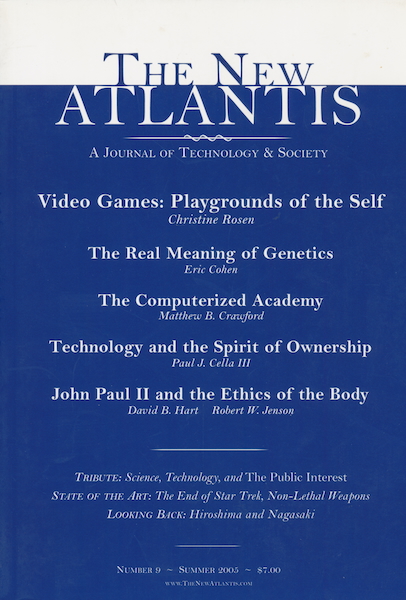
The newest issue of The New Atlantis (Summer 2005; available on-line here) provides further evidence that it is the most instructive and insightful publication examining the many facets of the relationship between technology and culture. Christine Rosen (a guest on Mars Hill Audio Journal Volume 70) continues her series of reflections on how some of the most private and personal technologies (iPods, TiVo, cosmetic surgery) shape our consciousness and our sense of personal identity and of the shape and texture of relationships. In “Video Games: Playgrounds of the Self,” Rosen shows why explicit sex and graphic violence are only the more superficial problems facing heavy game players.
Eric Cohen, the editor of The New Atlantis and Director of the Project on Bioethics and American Democracy at the Ethics and Public Policy Center, also focuses on the inner effects of living in a technological society. In “The Real Meaning of Genetics,” Cohen argues that the real challenge posed by radical programs of genetic engineering are not in the potentially monstrous products created by new techniques, but in new attitudes toward life, death, children, and love. In his concluding paragraphs, he reminds us that “too often, we easily assume that the progress of science is identical to the progress of man. The truth, as always, is much more complicated. Many men and women of the past were superior in virtue to us now, and many scientific discoveries of the present and future will prove a mixed blessing, and sometimes even a curse.”
Two theologians, David Bentley Hart (featured on Volume 67 of the Journal) and Robert W. Jenson (a guest back on volume 20) contribute essays assessing the importance of John Paul II’s Theology of the Body for bioethics and for cultural and social wisdom more generally. Hart, an Eastern Orthodox theologian, contrasts the elevated view of the human in John Paul II’s work and in Christian thought more generally with the view that dominates in various “transhumanist” and eugenist circles. This latter view appears at first glance to present human beings in a more Promethean, grander guise, since there is a lot of talk about acquiring more and more power over nature and human nature and “becoming as gods.” Yet Hart (in “The Anti-Theology of the Body”) maintains that there is a pathetic paradox in this hubris: “The materialist who wishes to see modern humanity’s Baconian mastery over cosmic nature expanded to encompass human nature as well — granting us absolute power over the flesh and what is born from it, banishing all fortuity and uncertainty from the future of the race — is someone who seeks to reach the divine by ceasing to be human, by surpassing the human, by destroying the human. It is a desire both fantastic and depraved: a diseased titanism, the dream of an infinite passage through monstrosity, a perpetual and ruthless sacrifice of every present good to the featureless, abysmal, and insatiable god who is to come.”
In “Reading the Body,” Robert W. Jenson insists that one of the effects of John Paul II’s Theology of the Body is simply to re-focus attention in medical ethics to the human body. So Jenson writes: “I propose that most questions conventionally bundled together as ‘bioethica,’ together with some medical-ethical questions at the boundary, can be cast in the form: Should/may we do (x) with/to bodies that are human? Interpreting bioethical problems as problems about bodies . . . does assume that some entities — such as embryos or even cells — may be regarded as bodies that are human without necessarily insisting that they have the status of human persons.” Jenson continues discussing a number of other bioethical maxims suggested by John Paul II’s remarkable reminder of the biblical teaching of the meaning of the human as centered in the body. If this isn’t enough to encourage you to read the current issue of The New Atlantis, there are also reflections about Paris Hilton and the end of the Star Trek franchise.
Related reading and listening
- The destructive perils of speech without a real partner — Josef Pieper and Marc Barnes on how chatbots pervert the nature of conversation
- Christian culture and the myth of the secular — Ken Myers draws on T. S. Eliot to argue that Western civilization has broken down, not into a multiplicity of cultures, but into a “post-culture.” (47 minutes)
- How to make war on nothingness? — David Bentley Hart argues that if it rejects Christ, the only remaining option for a post-Christian culture is conscious or “narcotic” nihilism, which takes the form of absolute, meaningless volition. (66 minutes)
- Machines and misanthropy — Nicholas Carr on how technology has transformed our understanding of progress (and people)
- Alienation and autoamputation: the price of power — Nicholas Carr on the numbing effect of technology
- Disengagement from the world — Nicholas Carr encourages us to consider how automation technologies impact our ability to engage with the world and whether — like a good tool — they present a more inviting world or close us off from that world. (30 minutes)
- Life more abundantly — Jeanne Schindler advocates for a return to an understanding and prioritizing of sensory experience — real engagement with the real world — as foundational to learning and living. (35 minutes)
- Technophiliac obsessions — FROM VOL. 141 Literary and media scholar Grant Wythoff talks about the “father of science fiction,” Hugo Gernsback. (26 minutes)
- Utopian dreams and cynicism — John Durham Peters discusses the history of the idea of communication, saying that our hopes are too high when we believe that the solution to social discord is just better communication. (49 minutes)
- What adolescence misses — FROM VOL. 94 Mark Bauerlein talks about the ways of learning and living practiced by contemporary youth, how they impact the acquisition and use of knowledge and form intellectual habits, and what this means for the future of our society. (16 minutes)
- Helping boys become virtuous men — Teacher and chaplain Mark Perkins describes forms of formation that take the body seriously 50 minutes
- The temptations of talismanic technologies — Jeffrey Bilbro on the persistence of techno-utopianism
- Living in a tool-i-fied world — Joseph Minich on how the ubiquity of technology makes atheism entirely plausible
- In the Image of Our Devices — Nicholas Carr considers how automation technologies impact our ability to engage with the world. (66 minutes)
- The recovery of an integrated ecology — In this essay, Michael Hanby unpacks the summons of Laudato si’ to an ecological way of life based on a proper understanding of creation in its fullness and integrity. (57 minutes)
- Natural law as “performance” — FROM VOL. 124 R. J. Snell discusses how novel ideas about natural law focus less on moral propositions and concepts and more on the thrust for meaning and value. (27 minutes)
- The downward spiral of all technocracies — Andrew Willard Jones explains the two paths that exist with the development of new technologies: one which leads to an expansion of the humane world and one which exploits and truncates both Creation and humanity. (65 minutes)
- How social media truncates relationships — In this lecture, Felicia Wu Song explains how social media industrializes and monetizes our relationships, forming us in modes of relationships and identity that are detrimental to ourselves and to society. (41 minutes)
- In technology, we live and move and have our knowing — George Parkin Grant on technology’s establishment of a framework for thinking about technology
- On the Degeneration of Attentiveness — Critic Nicholas Carr talks about how technology-driven trends affect our cultural and personal lives. (56 minutes)
- On Eugenics in America — Christine Rosen explores early eugenics support in the early 1900s and current “participatory evolution” practices. (50 minutes)
- Gratitude, vitalism, and the timid rationalist — In this lecture, Matthew Crawford draws a distinction between an orientation toward receiving life as gift and a timid and cramped rationalism that views man as an object to be synthetically remade. (52 minutes)
- Humans as biological hardware — In this essay, Brad Littlejohn and Clare Morell decry how modern technology tends to hack the human person in pursuit of profit. (55 minutes)
- “The system will be first” — FROM VOL. 27 Robert Kanigel describes the transformation of work due to Frederick Winslow Taylor’s concept of scientific management. (11 minutes)
- Choices about the uses of technology — This Feature presents interviews with David Nye and Brian Brock related to how we evaluate adoption of new technology and how technology influences our thinking. (31 minutes)
- What it means to be a person — FROM VOL. 147 Sociologist Craig Gay argues that in order to address the challenges of a technological approach to the world, we need to recover the Christian tradition’s robust theology of personhood. (24 minutes)
- The problem with dynamism without direction — Paulina Borsook on the biological paradigm of technolibertarianism’s love of spontaneous dynamism, whatever the costs
- The libertarian spawning-ground of tech bros — Paulina Borsook on high tech’s long-standing animosity toward government and regulation
- Tech bros and public power — Paulina Borsook discusses the “bizarrely narcissistic” and ultra-libertarian culture of Silicon Valley. (22 minutes)
- Voluntarily silencing ourselves — FROM VOL. 39 John L. Locke discusses the value of personal communication and how technology is displacing it. (12 minutes)
- Souls in cyberspace — FROM VOL. 25 Douglas Groothuis examines the worldview and mythology behind the creation and marketing of the Internet. (13 minutes)
- Life in a frictionless, synthetic world — FROM VOL. 17 Mark Slouka explores the worldview of techno-visionaries who aim to create a new era of human evolution. (11 minutes)
- The digital revolution and community — FROM VOL. 7 Ken Myers talks with Jane Metcalfe, the founder of WIRED Magazine, about technology and community. (8 minutes)
- Metaphysical impulses beneath techno-utopianism — FROM VOL. 38 Erik Davis describes his research on how humans’ fascination with technology is permeated with “mythic energy” and gnostic aspirations. (11 minutes)
- Post-Christian America and the “unlimited technological future” — George Parkin Grant on technology and the Puritan legacy of “unflinching wills”
- Education that counters alienation — In this lecture, Jeanne Schindler explores how digital technologies warp not only education but our experience of being human. (30 minutes)
- What is lost with labor-saving devices — Romano Guardini on what is lost when cultural pursuits eclipse natural order
- Paradoxical attitudes toward plastic — Jeffrey Meikle traces the technological, economic, and cultural development of plastic and relates it to the American value of authenticity. (15 minutes)
- Technology and the kingdom of God — FROM VOL. 63 Albert Borgmann (1937–2023) believes Christians have an obligation to discuss and discern the kind of world that technology creates and encourages. (12 minutes)
- The gift of meaningful work — In this lecture, D. C. Schindler argues that genuine work is inherently meaningful and facilitates an encounter with reality and therefore, ultimately, with God. (36 minutes)
- Diverting language from its richest possibilities — FROM VOL. 75 Steve Talbott discusses the rich capacities of language and how technology diminishes them. (18 minutes)
- The recovery of true authority for societal flourishing — Michael Hanby addresses a confusion at the heart of our current cultural crisis: a conflation of the concepts of authority and power. (52 minutes)
- Automation and human agency — FROM VOL. 150 Philosopher and mechanic Matthew Crawford laments the losses of human skill that correspond with gains in mechanical automation. (21 minutes)
- Christopher Hitchens vs. G. K. Chesterton — Ralph Wood compares Christopher Hitchens‘s view of the cosmos with that of G. K. Chesterton, arguing that Chesterton succeeded where Hitchens failed. (44 minutes)
- A fearful darkness in mind, heart, and spirit — Roberta Bayer draws on the work of George Parkin Grant (1918–1988) to argue that our “culture of death” must be countered with an understanding of reality based in love, redemptive suffering, and a recognition of limitations to individual control. (33 minutes)
- Questioning “conservatives” — John Lukacs asserts that believers in unending technological ‘progress’ can’t really be conservatives.
- The life was the light of men — Robert Jenson reflects on the relationship that should be sustained between the Church and those of her members with an “intellectual” vocation.
- Seeking control, in white magic and The Green Book — Alan Jacobs on C. S. Lewis’s critique of the modern pursuit of god-like control
- Faith and unbelief — FROM VOL. 98 This Archive Feature revisits two conversations, one with Roger Lundin and one with David Bentley Hart, on what makes Christian belief so implausible to non-believers. (39 minutes)
- Creation as beauty and gift — FROM VOL. 67 David Bentley Hart describes how the Christian understanding of Creation as beauty and gift, as the outward expression of the delight the Trinity has in itself, reveals a vision of reality different from the pagan or fatalist vision of reality. (12 minutes)