The word “demonstration” derives from an ancient root that means “to think.” Other English derivatives include “mind,” “mental,” “mentor,” “memento,” “comment,” and “Minerva,” the Greek goddess of wisdom. “Admonish” is a bit more obviously related to “demonstrate,” reminding us that admonishment involves the presentation of reasons and not simply an angry scolding.
In my American Heritage Dictionary, “demonstration” is defined as 1) the act of showing or making evident; 2) conclusive evidence or proof; and 3) an illustration or explanation. In these first three uses, the word retains it ties to rationality. In such usage, “demonstration” suggests the end (in both senses) of an argument. Q.E.D., Quod erat demonstrandum, announces that the thing we set out to prove — and not simply assert arbitrarily — has been revealed to be so.
But my dictionary’s fourth and fifth definitions take an odd turn. The idea of making something evident is retained, but what is now made manifest is not truth or reality reasonably understood but a purely subjective state: “4) A manifestation, as of one’s feelings.” And then the final use of the word: “5) A public display of group opinion, as by a rally or march.”
Of course words can be wayward, prone to wander. But the fact that, in the early twenty-first century, the word “demonstration” is much more likely to suggest a passionate display of feelings or opinions than the reasonable path toward common understanding is a sign of a fundamental disorientation in contemporary society. It is a sign (among other things) of our denial of the correlativity of truth and goodness. “Truth” is at best typically regarded as a description of factuality. “Goodness” is sentimentalized or subjectivized, not a matter for public, rational discussion.
In The Desire of the Nations, moral philosopher Oliver O’Donovan described the fate of political communities that have marginalized the Good and trivialized Truth:
“Because the normal content of political communication . . . has come to be the conflict of competing wills, speech has lost its orientation to deliberation on the common good and has come to serve the assertion of competing interests. . . . ’Demonstrations’ aimed at communicating anger or menace, rather than argument or reason, are viewed with complacency as proof of a liberal and open society.”
The demonstrations of recent months have obviously not promoted argument or reason about how we might improve our shared life together. The slogans that appear on placards, T-shirts, banners, and ball caps are asserted with an air of arrogant invulnerability. “Agree with me (and my thousands of co-belligerents) or else.” Some pundits have wrung their hands at the destructive spirit of these demonstrations, and seen them as a failure of civility. We cannot repair the torn fabric of our nation, they warn, until we address one another with kindness and respect. Others lament the irrational mood of these increasingly heated displays of conviction and call for a return to the values of the Enlightenment, which established political life on rational foundations. But there are good reasons to interpret the angry irrationality of these demonstrations — and the millions of similarly spirited op-ed pieces, blog posts, faculty memos, tweets, and sidewalk trash-talking — as the culmination of the Enlightenment’s fatally flawed conception of reason
During the past year, some commentators have compared the recent demonstrations to the raucous events of the 1960s and 70s. Sometimes these comparisons are made to assure is that there really is nothing to worry about in our political life, because these sorts of things happen all the time. But the fact that symptoms are chronic is no warrant for the assumption that there is nothing seriously disordered. If our epidemic of violent demonstrations is like that of fifty years ago, maybe we can understand the ailment better with the help of thoughtful diagnosticians who observed that outbreak.
Literary critic Wayne C. Booth (1920-2005) was on the faculty of the University of Chicago during the demonstrations of the late 1960s. He witnessed first hand the stand-off between students — who understood themselves as the defenders of values — and faculty and administrators — who saw their institution as a bastion of reason. Each side in this battle was suspicious of the other, because both sides accepted the long-standing dogma of Enlightenment culture that separated “facts” (the raw material of reason) and “values.”
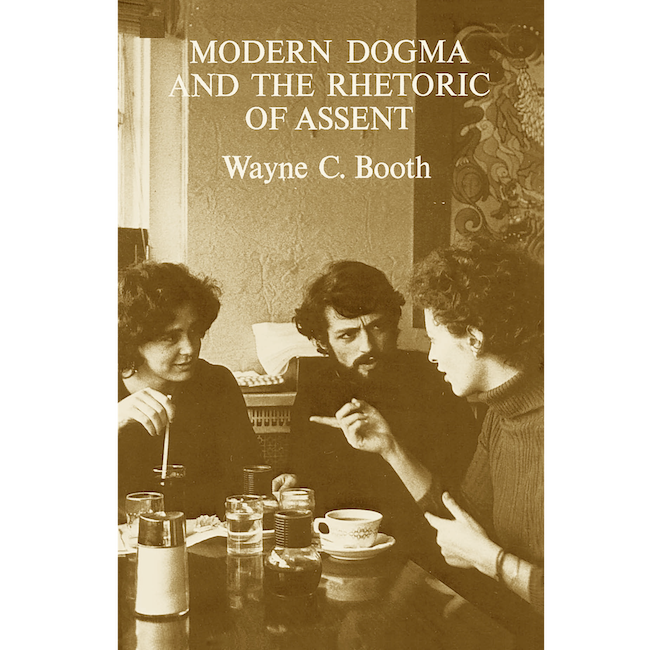
In 1971, while many cities and campuses were still roiling from violent confrontations, Booth gave the Ward-Phillips Lectures in English Language and Literature at the University of Notre Dame. The content of those lectures was expanded and published in 1974 as Modern Dogma and the Rhetoric of Assent (University of Chicago Press). Booth believed that the uneasy tension that was increasingly evident across the American social and political landscape — and in the West more generally — was a symptom of the fact that “we have lost our faith in the very possibility of finding a rational path through any thicket that includes what we call value judgments.” Anticipating Alasdair MacIntyre’s 1981 After Virtue, which diagnosed in philosophical terms the common assumption that all value judgments were simply expressions of irrational preference, Booth used the tools of rhetoric to critique “the belief that you cannot and indeed should not allow your values to intrude upon your cognitive life — that thought and knowledge and fact are on one side and affirmations of value on the other.”
In the book’s Introduction, Booth affirms “the belief that the primary mental act of man is to assent to truth rather than to detect error, ‘to take in’ and even ‘to be taken in’ rather than ‘to resist being taken in.’” The mental world we have inherited from the Enlightenment has made us very adept at being suspicious of claims made by others, but bereft of the skills of changing our minds when we ought to. He summarizes the project of his lectures and book as the promotion of “a view of rhetoric as the whole art of discovering and sharing warrantable assertion.”
Here are some other introductory explanations from Booth’s book:
“Instead of pursuing ways of testing values in public discourse, defenders of value have often enough simply accepted the fact-value distinction and then leapt blindly for the value side. Convinced that reason’s domain is a tiny little cold corner of man’s life — whatever can be proved or disproved by scientific method — these counter-dogmatists feel free to assert any value that ‘feels’ right. Since acceptance of the dichotomy — whether by men of reason or men of faith — is often taken as the key test of modernity, I shall call the whole collection of dogmas that spring from it modernism, even though the term has often meant other things.
“The characteristic debate of modernists is a kind of meaningless logomachy between the adherents of reason or knowledge or science and the adherents of values or faith or feeling or wisdom or ‘true knowledge.’ Each of these two main sects — which I shall for shorthand call the scientismists and the irrationalists — can easily show the absurdities of the other, but the polemical displays of either side are so far from engaging the real issues that they often seem to confirm, in their demonstration that meaningful argument about such matters is impossible, the very distinction on which the war is based. . . .
“[I]t is probably accurate to say that from the seventeenth century until quite recently, it grew increasingly unfashionable to see the universe or world or nature or ‘the facts’ as implicating values.. . .
“It is really only in the last seventy-five years or so that the fact-value split became a truism and that the split began to entail the helplessness of reason in dealing with any values but the calculation of means to ends. I cannot trace here the story of the rise and fall of the disjunction, and of various conclusions thought to follow from it. Suffice it to say that by now it has been attacked everywhere, yet it survives everywhere, survives as strongly in the thought of many who defend values as in the thought of those who cling to positivist notions of scientific value.”
Related reading and listening
- When myth becomes fact — In this 1976 interview, Clyde Kilby (1902–1986) discusses C. S. Lewis’s critique of scientism and rationalism, his belief in the primacy of the imagination, and his mythic vision. (37 minutes)
- Reason and the love of truth — FROM VOL. 97 James Peters discusses historical understandings of reason and rationality and how they differ from the modern notion of rationality. (21 minutes)
- War and loving our enemy-neighbor — Oliver O’Donovan on evaluating the conduct of war in light of the evangelical command of love
- A flood of images — Oliver O’Donovan describes the distinctive character of publicity in modernity, which drowns us in a flood of ever-changing representations that do not serve the common good. (37 minutes)
- How communities remember who they are — Oliver O’Donovan on the necessity of tradition in sustaining communal identity
- Publicity and representative images in society — Oliver O’Donovan describes the nature of publicity as the force that mediates our communication with one another, creating common interests and then rapidly subsuming them into newer ones.(Lecture 3 of 3; 57 minutes)
- How common loves shape communities — Oliver O’Donovan discusses how communities mediate love and knowledge to their members and what challenges arise as a community’s traditions are confronted by sin, error, and plurality. (Lecture 2 of 3; 49 minutes)
- The “sovereign uselessness of moral reflection” — Calling on the wisdom of St. Augustine, Oliver O’Donovan reminds his listeners that all knowledge participates in the eternal Logos of God and is rooted in love, not disinterested moral judgement.(Lecture 1 of 3; 52 minutes)
- Beyond a reasonable doubt — From a 1980 interview with Ken Myers, Mortimer J. Adler discusses his argument that belief in the existence of God is rational. (14 minutes)
- Universities as the hosts of reciprocating speech — Robert Jenson on how the Christian understanding of Truth in a personal Word shaped the Western university
- How the Church promotes the cause of freedom — Oliver O’Donovan: “We discover we are free when we are commanded by that authority which commands us according to the law of our being, disclosing the secrets of the heart.”
- “The search for shared ends” — Oliver O’Donovan examines whether and to what extent there might be the possibility of a unifying Christian perspective on political doctrine or policy. (59 minutes)
- Thinking coherently about politics — Ken Myers gives an introduction to political theologian Oliver O’Donovan, whose work has been instrumental in teaching many how to think about social and political life in light of the gospel of Christ. (57 minutes)
- The law of faith and of love — Oliver O’Donovan compares St. Augustine’s interpretation of Psalm 119 with that of others, revealing Augustine’s more nuanced understanding of the complexities of the life of faith that the psalmist explores. (64 minutes)
- “A man after reality” — FROM VOL. 30 Clyde Kilby discusses C. S. Lewis‘s critique of scientism and rationalism, and his belief in the primacy of the imagination. (15 minutes)
- “Only a real world can save us” — Oliver O’Donovan explores how the “religion” of modernity lacks a coherent world in which one may participate with full human agency and moral purpose. (Lecture 3 of 3; 61 minutes)
- Christian unity and civil society — Oliver O’Donovan introduces listeners to Dutch lay theologian Hugo Grotius, arguing that the questions he tackled relate to perennial concerns about the relationship between divine and human agency, and between civil and ecclesiastical authority. (Lecture 2 of 3; 57 minutes)
- The demoralizing effect of pagan Roman religion — Oliver O’Donovan examines St. Augustine’s critique of pagan Roman religion in Book II of his treatise City of God and asks his audience to consider what insights Augustine’s critique has for us today. (Lecture 1 of 3; 51 minutes)
- Knowing and doing the good — Oliver O’Donovan raises several key questions and complications involved in the task of taking concrete and practical action toward a recognized moral good. (Lecture 3 of 3; 63 minutes)
- Moral knowledge of reality — Oliver O’Donovan argues that admiration is the fundamental form of knowing the world, as we cannot know fully those elements of reality (“bare facts”) that contain no significance for us. (Lecture 2 of 3; 55 minutes)
- Attentiveness to the world, the self, and time — Oliver O’Donovan uses the metaphor of waking to discuss the concept of moral sensibility as attention to the world, the self, and time. (Lecture 1 of 3; 60 minutes)
- A life well lived — In this essay, Stanley Hauerwas explains the breadth and depth of Alasdair MacIntyre’s thought, the goal of which was to help people to act intelligibly and live morally worthy lives. (40 minutes)
- How the Enlightenment blinded us — Alasdair MacIntyre on the dependence of rationality on a lived tradition
- The Transformed Vision of Samuel Taylor Coleridge — Poet Malcolm Guite explores the dramatic and even prophetic parallels between the life of Samuel Taylor Coleridge and that of the titular character in his famous poem “The Rime of the Ancient Mariner.” (59 minutes)
- Politics and the good — FROM VOL. 160 D. C. Schindler argues that political order cannot be disentangled from the social, and that fundamental questions of what humans are and what the good is cannot be bracketed from politics. (30 minutes)
- The dramatic ecstasy of reason — FROM VOL. 120 D. C. Schindler argues that the Enlightenment was not wrong for giving too much to reason; it was wrong in endorsing an impoverished conception of reason. (19 minutes)
- Wonder, being, skepticism, and reason — FROM VOL. 135 Matthew Levering talks about the long and rich tradition of reasoning about God. (23 minutes)
- The need to recollect ourselves as whole persons — In this 2016 lecture, John F. Crosby explores key personalist insights found in the thinking of John Henry Newman and Romano Guardini. (60 minutes)
- Against hacking babies — Oliver O’Donovan raises questions about IVF and the technologically ordered motive for efficiency
- Impact of “infotainment” on community — Neil Gabler and C. John Sommerville discuss how the mentalities conveyed by our experience with communications media work against the nurturing of community. (36 minutes)
- A prophetic “wake-up call” — In this 2024 lecture honoring the bicentennial of George MacDonald’s birth, Malcolm Guite explores MacDonald’s power to awaken readers’ spirits and effect in them a change of consciousness. (59 minutes)
- The fatal polytheism of late liberalism — Oliver O’Donovan on the failure that leads to social collapse, marked by conflict, suspicion, and violence
- William Cowper: Reconciling the Heart with the Head — Daniel E. Ritchie discusses the life and work of poet William Cowper (1731–1800), comparing his commitment to understanding reality through personal knowledge, intuition, and rigorous contemplation with the thought of Michael Polanyi. (43 minutes)
- Recovering the primacy of contemplation — Augusto Del Noce finds in St. Augustine resources to diagnose the fatal flaw in progressivism
- Insisting that political leaders are incapable of obeying Christ — Oliver O’Donovan on the unintended consequences of the First Amendment to the U.S. Constitution.
- The historian’s communal role as storyteller — FROM VOL. 127 Historian Christopher Shannon discusses how American academic historical writing presents a grand narrative of progressivism, which it defends by subscribing to an orthodoxy of objective Reason. (21 minutes)
- The gift of objective reality — Moral philosopher Oliver O’Donovan makes an argument for the consistency of the idea of law when it is conceived in a theological context. (40 minutes)
- Freedom as conformity to reality — W. Bradford Littlejohn summarizes the definitions of liberty offered by Richard Bauckham and Oliver O’Donovan
- The Life was the Light of men — In a lecture from 2018, Ken Myers contrasts the Enlightenment’s understanding of reason with the Christocentric conception of reason. (57 minutes)
- The sovereignty of love — In this 2022 lecture, Oliver O’Donovan explains the historical background — and present consequences — of the assertion by Jesus of two great commands. (67 minutes)
- O’Donovan, Oliver — FROM THE GUEST PAGE: Oliver O’Donovan held teaching posts at Wycliffe Hall, Oxford and Wycliffe College Toronto before becoming Regius Professor of Moral & Pastoral Theology and Canon of Christ Church at the University of Oxford in 1982.
- In the image of our devices? — In light of the history of the meaning of intellectus, D. C. Schindler questions the use of the word “intelligence” to describe systems employing large language models. (18 minutes)
- Why kings are compelling — Historian Francis Oakley describes how the modern idea of “secular” politics is a striking departure in human history. (32 minutes)
- On Earth as it is in Heaven — FROM VOL. 108Hans Boersma — author of Heavenly Participation: The Weaving of a Sacramental Tapestry — explains why Christians should reject the modern separation of Heaven and Earth and recover a “sacramental ontology.” (26 minutes)
- Conscience seared with a red-hot iron — Oliver O’Donovan on the convicting role of a good conscience
- Culture in light of Easter — Oliver O’Donovan rejects a gnostic reading of redemption
- Is irrational freedom truly freedom? — Joseph Cardinal Ratzinger argues that freedom must be understood in the context of interplay of reason and the will
- Religion within the bounds of citizenship — In a 2006 lecture, Oliver O’Donovan argues that the conventional way of describing Western civil society creates obstacles to the participation of believers (Muslim, Christian, and other). (68 minutes)
- The purpose of government and God’s eternal purpose — Philip Turner on understanding the state in light of the eschatological reality of the Church
- The story of the demotion of stories — Malcolm Guite on the Enlightenment’s rash dismissal of poetic knowledge