
“For Christian theology, all the questions come to a centre in christology. As a human being, God become man, Jesus of Nazareth shares in the structures, and that includes the fallen structures, of the created order. He is tempted to turn stones into bread, and indeed does multiply loaves and fishes, in the one miracle recorded in all four gospels. He stills the wind and the waves, and cures sickness. Yet to what end? Human salvation alone? It has been argued that when the New Testament speaks of ‘new creation’ — and that includes the apparently cosmic language of Romans 8 — it is speaking only of the remaking of human life. But that begs the question of what is involved in human salvation. Here we reach one necessary complication in our approach to a resolution of the problem, if such can be expected. For ‘salvation’ may appear to centre on the human — and why should it not, for we are the problem? — but we still have to ask the questions of, first, what is the nature of that salvation, and, second, how it involves us in the material world. After all, war, sex and abortion all concern action towards the created world, and specifically towards the image of God embodied in that world; and Christian conversion has always involved a change of attitude and bearing towards these realities.
“The real weakness of the Western tradition is that neglect of the trinitarian mediation of the doctrine of creation enabled gnostic elements to enter the bloodstream of theology. After the achievement of Irenaeus, no mainstream Christian theologian has entirely succumbed to the heresy he repudiated in so splendid and thoroughgoing a manner. The creator of the whole world, material and spiritual alike, is the one God and Father of the Lord Jesus Christ. Jesus’ recapitulation, in the flesh, of the human story is also a recapitulation of the cosmic story, and at once reverses the fall and re-inaugurates the project of creation. However, since that time Irenaeus’ affirmation of the goodness of the material world has come to be qualified in a number of ways inimical to his wholeheartedness. Origen’s teaching that the material world is essentially a secondary purpose of God, produced in order to provide a place of education for the fallen spirits, was succeeded by Augustine’s less damaging but none the less problematic teaching that the material world was less real and important than the spiritual. The rather gnosticising outcome is to be found in the tendency Feuerbach exaggerates: to see salvation as being out of this world rather than in and with it.
“In his study of The Travail of Nature Paul Santmire spoke of an ambivalence: that there are in many theologians of the tradition competing pulls, so that even those mediaeval theologies most affirmative of the glories of nature cannot in the end avoid using it as a ladder, to be kicked away when the summit is reached, of human ascent to the spiritual realm. Only one real exception is found in Santmire’s review of the Middle Ages, and it is St Francis. As he says, there is much romanticising of St Francis, and it is important to see whence the heart of his difference from his age derived. It is, according to this author, to be found in his christology:
Francis . . . became the Christ-like servant of nature. He impoverished himself in order that he might give himself to others, both to human and to natural creatures. So in his life and thought . . . he, in effect, united two grand theological schemes: on the one hand, the vision of the descending goodness of God, which makes all things good and worthy of respect, in their own right . . . on the other hand, the vision of the descending love of God in Christ, the self-giving . . . Savior, who, in turn, mandated sacrificial love for the world.
“Christology, then, is our first key, because it is Jesus Christ, the incarnate, crucified, risen and ascended Lord, who must be at the centre of any satisfactory construing of the relation of creation and redemption. According to the New Testament he is, after all, the agent of both creation and redemption, the one through whom, in the text that was one of Irenaeus’ great inspirations, God proposes to reconcile all things, things in heaven and things on earth: not merely, that is to say, the human species (Ephesians 1:10). Here, if we are to take seriously the radical nature of the evil that impedes the end of creation, the centre of the story in the crucifixion of Jesus must never be underplayed.
“This means in turn that the shape of a christology depends upon what can be called its trinitarian placing: how do we understand the work of Christ in the world in relation to the work of the Father and the Spirit? As the history of the tradition shows, an apparently orthodox christology can co-exist with a view of the creation, according to which it exists mainly to provide a place for a spatial ascent of the human spirit beyond and outside the material order to a higher spiritual realm. We meet again the crucial question of how we construe the work of the Spirit. In so far as modernity has a conception of the Spirit, it is a secularised version of the Christian. Spirit becomes, as in Hegel’s definitive execution of the modern project, an inner force propelling human culture to its eschatological perfection. Ultimately, this is the most thoroughgoing spiritualising of all, and certainly leaves far behind the human, fleshly, Jesus. But although its centre is completely wrong, for there is no divine Spirit who is not the Spirit of Jesus of Nazareth, it is looking in the right place, and in two respects.
“First, it stresses the time dimension rather than the merely spatial, recalling us to our theology of creation as project and the eschatological dimensions of the doctrine. We are created not to ascend through the material to the spiritual, but to be perfected in time, through Christ and the Spirit, in and with the created order as a whole. Second, there is throughout the Bible, and nowhere more than in characterisations of the resurrection, a clear relation between the Holy Spirit and God’s presence to the creation in perfecting power. Hegel’s mistake was thus to secularise the Spirit, bringing him out of eternity and out of perichoretic relation with the Son and Father into what is in effect a complete or unqualified and immanent involvement in time. The divine Spirit becomes almost a function of the created order, not its lord. But if the Spirit is first of all the eternal Spirit of the one triune God, his relation to the created order can only be from ‘outside’, however much he works towards and within the structures of created reality. Here, the resurrection serves as the model for an understanding of the action of the Spirit, the eschatological action par excellence. Like the wind in Ezekiel’s vision of the bones, the Spirit blows upon the crucified Jesus — as ‘the coming God’ of Moltmann’s characterisation. And that ‘outsideness’ must not be understood merely spatially, because as eternal the Spirit transcends both our space and our time: indeed, the whole space-time universe which it is his function to perfect by relating it to the Father through the Son, the one through whom it came to be and in whom it holds together.
“The introduction of a theology of the Spirit, as the one who brings the creation to God through the Son who became incarnate, also makes possible a more integrated account of the place of human action in relation to the natural world. It is sometimes taken as an implication of Irenaeus’ theology that the human creature is the one through whom the remainder of the created world is enabled to become articulate. He centred his account of this human calling in the church’s use of the bread and wine of the Lord’s Supper, thus reminding us that the project of creation, as both creation and providence, is not finally complete without the rescue, through Christ and the Spirit, of all things from their bondage to decay and dissolution. This produces the apparently anthropocentric conclusion that the perfection of the creation comes about only by means of what some New Testament writers call the new creation, the recreating action of God realised through the Spirit’s formation in the womb of Mary of a body for the Son, through the same Spirit’s enablement of the incarnate Son’s obedience until the cross, his raising him from the tomb on the third day, and his calling of a people to embody that redemption in the world. But it is only anthropocentric in a limited sense, and certainly far from Feuerbach’s charge that the Christian is interested only in the salvation of the soul. For the birth, ministry, death, resurrection and ascension of Jesus are all functions of his full humanity, just as the water, bread and wine are material. The Christian gospel bears upon the whole embodied person, and along with that the whole created world which is the context of that embodied life. The Spirit’s redemptive action is similarly eschatological in that it brings about the perfection of this particular sector of the created order — the humanity of Jesus Christ — as the guarantee and first fruits of the reconciliation of all things. This is the work of the Lord who is the Spirit. Redemption means the completion of the whole project of creation, not the saving of a few souls from hell.”
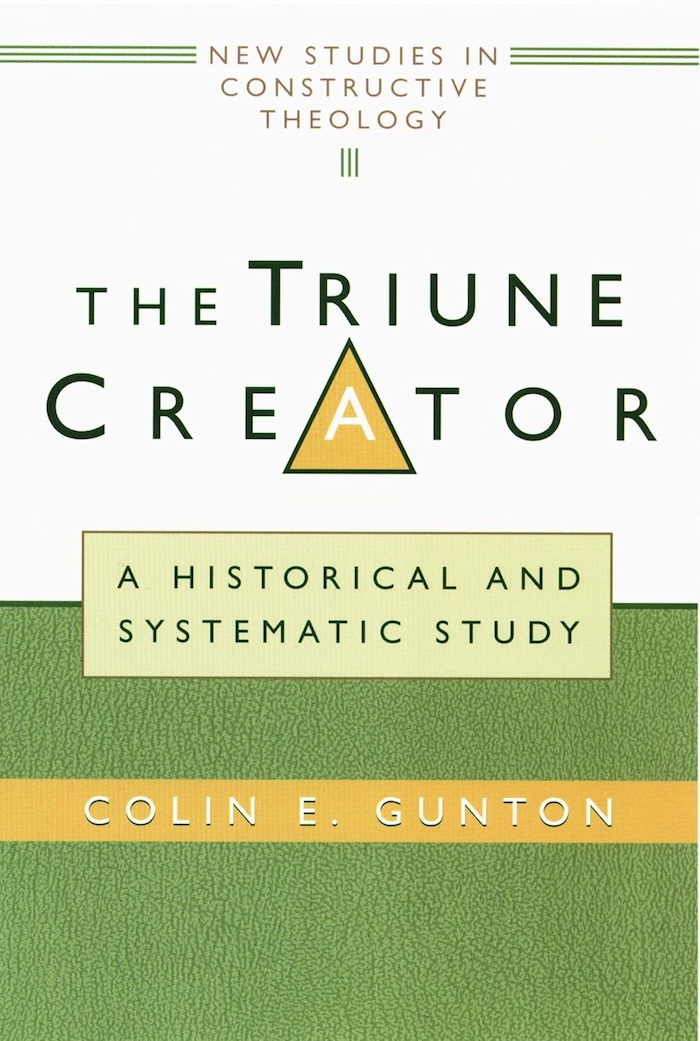
— from Colin E. Gunton, The Triune Creator: A Historical and Systematic Study (William B. Eerdmans Publishing Company, 1998)
Click on the tags below for listings of related readings or audio features.