
“On the famous Ghent altarpiece, on which the Van Eyck brothers depicted the adoration of the Lamb of God standing upon an altar on a greensward in front of the Heavenly Jerusalem, there appear in the lower left-hand panel two groups of people at the edge of the worshipping crowd. They are separated from each other by a rocky outcrop, but share a common urban background; and that contrasts them with a balancing pair of groups on the lower right-hand panel, set against a wilderness landscape. Those on the right are the hermits and the pilgrims of the church; but the groups on the left are identified as the church’s just judges and milites Christi, ‘soldiers of Christ’. To our modern sensibilities this is immediately shocking. How, we wonder, could the lay service exercised in a civil context by Christian judges come to be extended to soldiers? The one group serves peace, the other war; this seems enough to set an infinite spiritual distance between them. Can one who fights offer worship to the sacrificed Lamb? Our sense of shock is excusable. Yet the idea that these two roles, judges and soldiers, are analogous, an idea that grew out of the twelfth-century romanticisation of the Christian knight such as we meet in the legends of the Round Table, was one of the great achievements of the late middle ages. Today we commonly call it the ‘just war theory’.
“There are good reasons to hesitate over this achievement. The will of God for humankind is peace: that all-determining truth contains, and shapes, any further truths that we may hope to learn on this subject. And from it flow three further propositions. First, God’s peace is the original ontological truth of creation. We must deny the sceptical proposition that competition and what metaphysicians call ‘difference’ are the fundamental realities of the universe, a proposition which the creation, preservation and redemption of the world make impossible to entertain. Secondly, God’s peace is the goal of history. We must deny the supposed cultural value of war, its heroic glorification as an advancement of civilisation. For war serves the ends of history only as evil serves good, and the power to bring good out of evil belongs to God alone. Thirdly, God’s peace is a practical demand laid upon us. We must deny any ‘right’ to the pursuit of war, any claim on the part of a people that it may sacrifice its neighbours in the cause of its own survival or prosperity. For the Gospel demands that we renounce goods that can only be won at the cost of our neighbours’ good.
“Philologically, bellum is duellum, the confrontation of two, the simple and unmediated difference of opposites. No Christian believes that duellum can be ‘just’ or ‘necessary’, because no Christian believes that opposition can in fact be unmediated. All oppositions are subject to the pacific judgment of God, of which neither party is independent. To this extent every Christian is, to use a term which had some currency early in the twentieth century, a ‘pacificist’, rejecting antagonistic praxis, the praxis of unmediated conflict. All Christians, therefore, can recognise something like a sin of belligerence or a ‘crime against peace’. That crime consists in making antagonistic praxis a goal of politics, whether as means or end; that sin consists in cultivating antagonism as a form of self-perfection. . . .
“From the earliest attempts to understand how armed conflict might be compatible with Christian discipleship, the church has taken its bearings from the evangelical command of love. Augustine’s famous letter to Boniface treats the obligation of military action as an obligation of love to the neighbour. St Thomas and his followers locate the discussion of war within the treatise on the virtue of charity. In the context of war we find in its sharpest and most paradoxical form the thought that love can sometimes smite, and even slay. If this thought marks the parting of the ways with pacifism, it also indicates the point at which Christian thought on war is irreconcilable with the alternative strategy for refusing the judicial proposal, which is to make survival the final criterion of what may and may not be done. To take survival as the bottom line is to revert to the antagonistic model of mortal combat, and so inevitably to retreat from the Gospel proclamation of the universal rule of Christ and from the praxis of loving judgment. When self-defence, of state, community or individual, has the last word, paganism is restored. Precisely for this reason a Christian witness to God’s peace must always be acted out against the horizon of suffering and martyrdom. Suffering and martyrdom mark the point at which the possibilities of true judgment run out within the conditions of the world. They are necessary components of Christian practical reason, because they demonstrate the vulnerability of the praxis of judgment, and so protect it from serious misunderstanding. Judgment is an undertaking always under threat within the terms of this world, always liable to be overwhelmed by violence. It cannot possibly issue a licence to avoid defeat by all possible means.
“Yet the horizon on which we are called to suffer and to die rather than wrong our neighbour is not reached before we actually reach it. The possibilities of active witness to God’s peace are not exhausted until we have exhausted them, which we will not have done if we have not explored them. In this context, as in all others, the duties which confront us do not begin with martyrdom; they end with it, when we have gone as far as we are permitted to go, done as much as we are permitted to do. Martyrdom is not, in fact, a strategy for doing anything, but a testimony to God’s faithfulness when there is nothing left to do. Which is simply to say that we cannot describe the praxis of international judgment solely by pointing to the moment at which its possibilities run out. A child invited to paint a fish may begin by painting the sea, and when the paper is awash in blue, discover too late that the fish’s outline needed to be sketched in first. The praxis of judgment is that of a certain type of action, and no account of it can be offered in words with the prefix ‘non-’. Non-violence, non-resistance and all the other great watchwords of pacifism evoke a set of limits which circumscribe the possibility of action in the world. They belong to the philosophy of transcendence, the via negativa. They frame every Christian witness within the eschatological non-coincidence of worldly success and the triumph of God’s kingdom. But they do not describe this witness.”
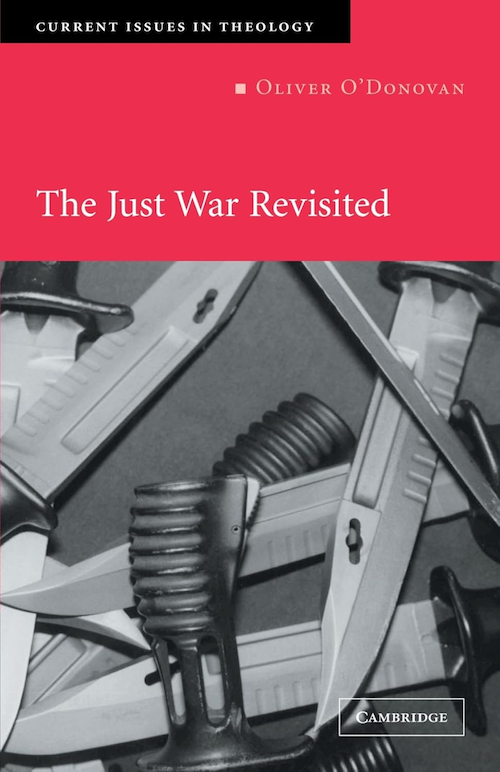
— from Oliver O’Donovan, The Just War Revisited (Cambridge University Press, 2003)
Click on the tags below for listings of related readings or audio features.