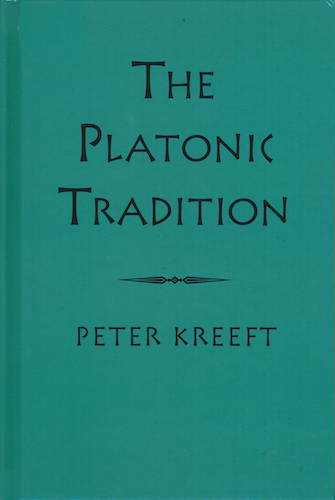
“The classic passage in the New Testament for Christian Platonism is John 1, where John identifies Christ with the Logos. That Greek word has literally dozens of meanings, but one of them is something like The Ultimate Truth about the Nature of All Things, or The Mind of God. John first says ‘In the beginning was the Logos, and the Logos was with God and the Logos was God.’ (Logos means Reason or Mind or Inner Word or Thought; and your thoughts are both with you and they are you; the thinker and his thought are both one and two.) And then John makes the astonishing statement that ‘the Logos became flesh and dwelt among us.’ Eternal Truth got born from Mary’s womb; the heavenly house where all of Plato’s Ideas live became a human being.
“This equation of Jesus and the Logos is a double expansion, a double moreness. It claims that Jesus is more than he seems to be, more than a human being; He is the Logos. And it also says that the Logos is more than it seems to be: it is not just an abstract impersonal truth, but a divine person who became also human.
“Greek philosophers had always sought the Logos, as Odysseus sought his home or Jason sought the Golden Fleece. The word has literally dozens of related meanings, but they can be brought under three headings: metaphysical, psychological, and linguistic. Logos means, first of all, realness, authenticity, truth, intelligibility, meaning, essence, form, order, structure, point, purpose, relationship, unity, principle, or universal. It also meant, in the second place, wisdom, understanding, knowledge, sagacity, intelligence, thought, explanation, reason, or logic: the human, psychological internalization of the first Logos, the metaphysical Logos. Finally, it also means word, words, language, speech, communication, revelation, expression, manifestation, argument, discourse, testimony, witness, or explanation. Logos #3 is a mind’s externalization of Logos #2 as Logos #2 is a mind’s internalization of Logos #1.
“These are the three things Gorgias the Sophist denies. He summarizes his philosophy in three sentences: First, There is no intelligible reality, no order and meaning to reality. Second, even if there were, it could never be known, never understood. Third, even if anyone did understand it, it could never be communicated. So Gorgias is the total alternative to Plato in his triple denial of Logos.
“In fact, the whole history of philosophy has been structured by these three denials. Premodern philosophy, ancient and medieval, centered on metaphysics, and ended with the Nominalism of William of Ockham, which is a denial of Logos #1, intelligible universals. Then, classical Modern philosophy, beginning with Descartes and Bacon, centered on epistemology and ended in the empiricist skepticism of Hume and the even more radical skepticism of Kant, who denied that anyone could ever know things as they are in themselves, in other words objective reality. That’s Gorgias’s second thesis. Finally, twentieth-century philosophy concentrated on philosophy of language and culminated in De-constructionism, which is the denial of Logos #3, the denial that words can tell truths.
“All that — the whole subsequent history of philosophy — is at stake in Logos.
“Logos means all three things: essence, thought, and language; or meaning, idea, and word; but it’s translated ‘word’ in John 1 because that includes all three meanings. If there is an expression, a word, as distinct from just noise, it must express knowledge; and if there is knowledge, not just feeling, it must know knowable, intelligible reality.”
— from Peter Kreeft, The Platonic Tradition (St. Augustine’s Press, 2018)
Related reading and listening
- Creation, in harmony with the Logos — Rowan Williams on the Logos and the diverse logoi that mirror it
- We are not “stochastic parrots” — In this essay, Talbot Brewer argues that our understanding of the nature of words and their relationship to human nature is “teetering” due to artificial intelligence chatbot systems and large language models (LLMs). (42 minutes)
- Truth lives in language — Craig Gay reflects on how language is not merely a tool for humans to use, but is a part of our very being as creatures made in the image of the God who is the living Word. (52 minutes)
- A living tradition — In this lecture, James Matthew Wilson explores the nature of tradition as a “condition of possibility” that situates both reason and poetry. (49 minutes)
- Mars Hill Audio Journal, Volume 167 — FEATURED GUESTS: Nicholas Carr, Thomas Ward, Joseph Stuart, Steven Knepper, Robert Wyllie, Ephraim Radner, and Andrew Willard Jones
- “A Myth Retold” — Literary critic Thomas Howard explains why he considers C. S. Lewis’s Till We Have Faces to be one of the author’s richest and most rewarding works. (18 minutes)
- How to make war on nothingness? — David Bentley Hart argues that if it rejects Christ, the only remaining option for a post-Christian culture is conscious or “narcotic” nihilism, which takes the form of absolute, meaningless volition. (66 minutes)
- A letter from Ken Myers — Ken Myers examines the cultural implications of the Incarnation and the deep-seated dualism of modernity that divorces spirituality from our material experience. (22 minutes)
- “Subtraction stories” and a longing for transcendence — In this lecture, James K. A. Smith explores key elements of Charles Taylor’s understanding of what it means to live in a secular age. (43 minutes)
- Mars Hill Audio Journal, Volume 166 — FEATURED GUESTS: William Cavanaugh, Kent Burreson, Beth Hoeltke, Jeffrey Barbeau, Jason Baxter, John Betz, and Bruce Herman
- Good News for All Creation — Theologian Norman Wirzba helps us rethink the category of nature in terms of the Christian doctrine of creation. (66 minutes)
- The Transformed Vision of Samuel Taylor Coleridge — Poet Malcolm Guite explores the dramatic and even prophetic parallels between the life of Samuel Taylor Coleridge and that of the titular character in his famous poem “The Rime of the Ancient Mariner.” (59 minutes)
- The hatred of logos — D. C. Schindler draws on Plato to argue that in its very form, social media evidences a general contempt for logos — reason and language — which defines man. (26 minutes)
- Speaking the word in love — In this lecture, D. C. Schindler examines core insights from Ferdinand Ulrich on the central vocation of man and the meaning of being. (32 minutes)
- Seneca’s moral courage — Dana Gioia explains how Seneca’s family was interwoven with the Roman governing class, ultimately leading to the philospher’s death at the hands of Emperor Nero. (27 minutes)
- Wonder, being, skepticism, and reason — FROM VOL. 135 Matthew Levering talks about the long and rich tradition of reasoning about God. (23 minutes)
- Mars Hill Audio Journal, Volume 163 — FEATURED GUESTS: Andrew Youngblood, R. J. Snell, Nicholas Denysenko, Nigel Biggar, Robert McNamara, and David Cayley
- Embodied knowledge — FROM VOL. 121 James K. A. Smith advocates for a return to some pre-modern conceptualizations of the human body. (18 minutes)
- From shadows to the light of reality — FROM VOL. 153 Louis Markos argues that Plato needs to be recognized for his unique and serendipitous role in preparing the world for Christ. (24 minutes)
- How words are central to the human experience — FROM VOL. 95 Craig Gay reflects on the essential linguistic nature of humanity: how our growth (or decline) in life is tied to words. (18 minutes)
- Mars Hill Audio Journal, Volume 162 — FEATURED GUESTS: Mark Noll, R. Jared Staudt, Paul Weston, William C. Hackett, Hans Boersma, and David Paul Baird
- The Life was the Light of men — In a lecture from 2018, Ken Myers contrasts the Enlightenment’s understanding of reason with the Christocentric conception of reason. (57 minutes)
- An unlikely trio in life (and in death) — FROM VOL. 1Philosopher Peter Kreeft was interviewed in 1982 by Ken Myers about his book, Between Heaven and Hell. In 1992, that interview was featured on the pilot cassette tape which became the Mars Hill Tapes. (10 minutes)
- Learning to see the world aright — Norman Wirzba on cultivating a Christocentric vision of Creation
- Alice von Hildebrand centennial — Today’s Feature presents a recording of remarks made by Alice von Hildebrand at an event celebrating her 90th birthday, where she spoke of gratitude and the gifts of God in her life. (17 minutes)
- Mars Hill Audio Journal, Volume 156 — FEATURED GUESTS:
Kimbell Kornu, Paul Tyson, Mark Noll, David Ney, William C. Hackett, and Marian Schwartz
- Volume 1 revisited — In August of 1992, Mars Hill Audio released the pilot edition of what became known as the MARS HILL Tapes. In celebration of this anniversary, we recycle three interviews heard in that distant era, with Ted Prescott, Edward Mendelson, and Peter Kreeft. (30 minutes)
- Postmodern man in search of a soul — Christopher Kaczor argues that celebrity psychologist Jordan Peterson asks important, forgotten questions as a “fellow traveler” to Christianity. (27 minutes)
- Mars Hill Audio Journal, Volume 152 — FEATURED GUESTS:
Elisabeth Lasch-Quinn, Jeffrey Bilbro, Zena Hitz, James L. Nolan, Jr., Bishop Robert Barron, and Jason Blakely
- Discovering inherited metaphysical commitments — Andrew Davison on the importance for theology of becoming more philosophically self-conscious
- Diagnosing our political conflicts — Michael Hanby explains why the modern pursuit of freedom — obeying its founding logic — has taken such a destructive turn. (36 minutes)
- The religion of the Logos — Joseph Cardinal Ratzinger on acknowledging the Source of rationality
- Three books by Peter Kreeft — In excerpts from three interviews, Peter Kreeft discusses our “brave new world”; the importance of integrity in “creed, code, and cult”; and the reality of transcendence in our human story. (36 minutes)
- St. Thomas and the wisdom of Creation — Christopher Thompson offers a renewed vision of “the human person [as] an embodied, spiritual creature dwelling in a cosmos of created natures, intelligently ordered by God and capable of being intelligibly grasped by human reason.” (16 minutes)
- Mars Hill Audio Journal, Volume 143 — FEATURED GUESTS:
Mark Regnerus, Jessica Hooten Wilson, John Henry Crosby, John F. Crosby, Wynand De Beer, and Sørina Higgins
- The truth sent from above — Josef Pieper on why philosophy needs theology
- Mars Hill Audio Journal, Volume 110 — FEATURED GUESTS: Kevin Belmonte, David Lyle Jeffrey and Gregory Maillet, Mark Noll, Alan Jacobs, and Jonathan Chaplin
- Mars Hill Audio Journal, Volume 108 — FEATURED GUESTS: Thomas Albert Howard, Jean Porter, Peter Augustine Lawler, Hans Boersma, Felicia Wu Song, and Elias Aboujaoude
- Mars Hill Audio Journal, Volume 100 — FEATURED GUESTS: Jennifer Burns, Christian Smith, Dallas Willard, Peter Kreeft, P. D. James, James Davison Hunter, Paul McHugh, Ted Prescott, Ed Knippers, Martha Bayles, Dominic Aquila, Gilbert Meilaender, Neil Postman, and Alan Jacobs