
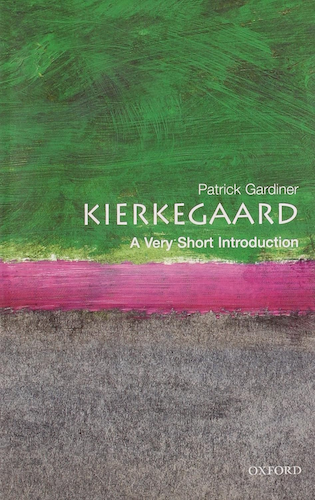
“Kierkegaard on more than one occasion likened genius to a thunderstorm that comes up against the wind. Whether or not he had himself partly in mind when making the comparison, it seems in retrospect to have been an apt one so far as his own intellectual career was concerned. Like Marx and Nietzsche, he emerges as one of the outstanding iconoclasts and rebels of 19th-century thought, writers whose works were composed in conscious opposition to the prevailing assumptions and conventions of their age and whose crucial contentions only achieved widespread recognition after they were dead.
“In Kierkegaard’s case recognition was particularly slow in coming. He wrote in Danish, and to his Danish contemporaries he was — in his own eyes at least — a ‘superfluous’ figure; either they did not read what he wrote or else, if they did, they misunderstood its underlying import. Even when, not very long after his death in 1855, German translations began to appear, they made little initial impact, although they were to become increasingly influential in Central Europe during and immediately after the First World War. It was, however, largely through its association with existentialism, which emerged as a well-publicized philosophical movement in the 1930s and 1940s, that his name can first be said to have acquired the kind of international prominence it indisputably enjoys today. As a thinker he may be regarded as awkward, controversial, difficult to classify; but he is certainly not ignored.
“Such posthumous fame would in fact have caused Kierkegaard no surprise. He himself confidently predicted it, foreseeing a time when his books would be the subject of serious study and when he would be applauded for the novelty and depth of the insights they contained. Whether, on the other hand, it would have afforded him undiluted satisfaction is a different matter. When he referred to the prospect he treated it as an occasion, not for self-congratulation, but for sardonic comment. For the persons whose approbation he anticipated were those he labelled ‘professors’; in other words, future members of the selfsame academic institutions which during his lifetime were the target of some of his sharpest criticism. Admittedly his opinions on this score, like the pronounced antipathy he came to feel towards the Church, were voiced most stridently towards the end of his career. None the less, his hostility to the academic establishment was continuous with an earlier and deep-rooted suspicion of something that he believed to be endemic to the intellectual climate of his period. This was its preoccupation with what he called the ‘illusions of objectivity’, exhibiting itself, on the one hand, in a tendency to smother the vital core of subjective experience beneath layers of historical commentary and pseudo-scientific generalization and, on the other, in a proneness to discuss ideas from an abstract theoretical viewpoint that took no account of their significance for the particular outlooks and commitments of flesh-and-blood human beings. All Kierkegaard’s writings, in one way or another, bore witness to the necessity of affirming the integrity of the individual in the face of such trends, and the same can be said to have been true of his life. His work and his personal existence were indeed inseparably intertwined, the connections between the two being faithfully recorded in the copious journals which he kept from the age of 21 onwards and which throw a vivid light upon the labyrinthine recesses of his strange and complex disposition.”
— from Patrick Gardiner, Kierkegaard: A Very Short Introduction (Oxford University Press, 1988)
Click on the tags below for listings of related readings or audio features.