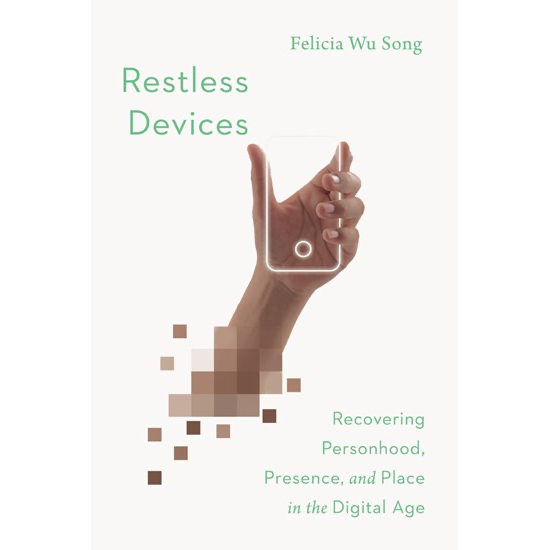
“The earliest proponents and champions of the internet spoke in glowing terms that directly drew from the legacy of Enlightenment dreams. They were breathless over the sheer marvel of digital communication and distribution of information across time and space. They sang familiar choruses that praised scientific knowledge and innovation as the inevitable means of human progress. The creation of what seemed like a parallel universe in cyberspace amplified existing questions about the presumed nature of reality and its limitations, and offered new possibilities of unlocking humanity’s full potential. Internet technology became a cultural container that would catch all of our turn-of-the-century hopes of fixing the age-old quandaries of human suffering and global conflict. As such, the internet was always a value-laden technology: It was never neutral and it was never just a tool. It was designed to promote individual freedoms over structural constraints, and the market for its subsequent digital media and services wrapped the technology within a morally valanced story about information being power, and digital connection promising prosperity, equality, and happiness. (As far as I know, nobody has ever promised anything remotely close to that list of social goods about a hammer!)
“As the technology evolved and found new life in cloud computing, data-driven services, and user-generated content through social media and blogging, a new industry of digital media and startups took center stage in Silicon Valley. The remnant of software engineers and countercultural utopians who defined the earlier companies like AOL, Microsoft, and IBM, were overshadowed by a new breed of venture capitalists and entrepreneurs whose eyes were trained on the fresh and exciting outside-of-the-box modes of creativity found in companies like Google, Facebook, and YouTube. Like the Gold Rush settlers, Silicon Valley entrepreneurs emerged as modern-day heroes. They were praised for their ‘rugged individualism’ and capacity to strike out on their own, making their mark through sheer ingenuity and wits as they ran headlong into a new untapped digital market that brimmed with potential reward.
“With a sure faith in the capacity to engineer and design solutions for virtually any puzzle that arose, startup culture’s celebrated mantra to ‘move fast and break things’ gave companies license to privilege the virtues of disruption and innovation over and above social responsibility. Unfortunately as we have all seen, this starry-eyed belief — that any emergent problem can be fixed with better programming or better algorithms — fed a willful blindness to the polarizing and radicalizing tendencies of social media and the digital landscape. As these troubling dynamics began to clearly affect American civic and political life in 2016, these tech companies have been increasingly called on by consumer advocacy groups, government officials, and scholars alike to address the ways in which the priorities that were embedded in their technology’s design and platform’s policies have unintentionally led to deleterious consequences for American democracy.
“Despite Silicon Valley’s desire to imagine itself as an enlightened industry that delivers services and products that are universally inclusive and empowering, the confirmed biases found among venture capitalists to favor those entrepreneurs who are young, white, and male signal the degree to which the digital industry privileges certain voices and perspectives over others. And insofar as every technology is imprinted by the cultural ethos it was borne out of, it should not be surprising to discover that the internet and its digital landscape inextricably mirrors American society in all of its glory and all of its shame.
“If we are to recognize how our digital technologies carry within them the values and perspectives of their makers, their culture, and their societal assumptions, perhaps we should be asking: Whose values or dreams are embedded in the design of our apps, platforms, and digital experiences? What type of world was this technology supposed to make possible and encourage? What kinds of lives are these technologies meant to enhance? And how is it shaping mine?”
— from Felicia Wu Song, Restless Devices: Recovering Personhood, Presence, and Place in the Digital Age (InterVarsity Press, 2021). Felicia Wu Song talked about this book on Volume 154 of the Journal.
Related reading and listening
- The destructive perils of speech without a real partner — Josef Pieper and Marc Barnes on how chatbots pervert the nature of conversation
- Machines and misanthropy — Nicholas Carr on how technology has transformed our understanding of progress (and people)
- Alienation and autoamputation: the price of power — Nicholas Carr on the numbing effect of technology
- Disengagement from the world — Nicholas Carr encourages us to consider how automation technologies impact our ability to engage with the world and whether — like a good tool — they present a more inviting world or close us off from that world. (30 minutes)
- Life more abundantly — Jeanne Schindler advocates for a return to an understanding and prioritizing of sensory experience — real engagement with the real world — as foundational to learning and living. (35 minutes)
- Technophiliac obsessions — FROM VOL. 141 Literary and media scholar Grant Wythoff talks about the “father of science fiction,” Hugo Gernsback. (26 minutes)
- Utopian dreams and cynicism — John Durham Peters discusses the history of the idea of communication, saying that our hopes are too high when we believe that the solution to social discord is just better communication. (49 minutes)
- Thinking Together — Alan Jacobs discusses some principles he’s compiled to help us think well (and charitably) in our cultural context, and he warns us to be attentive to the ways technology displaces previously fixed communities. (53 minutes)
- What adolescence misses — FROM VOL. 94 Mark Bauerlein talks about the ways of learning and living practiced by contemporary youth, how they impact the acquisition and use of knowledge and form intellectual habits, and what this means for the future of our society. (16 minutes)
- Helping boys become virtuous men — Teacher and chaplain Mark Perkins describes forms of formation that take the body seriously 50 minutes
- The temptations of talismanic technologies — Jeffrey Bilbro on the persistence of techno-utopianism
- Living in a tool-i-fied world — Joseph Minich on how the ubiquity of technology makes atheism entirely plausible
- The amplification of distraction — FROM VOL. 152 Jeffrey Bilbro advocates a Christian posture toward our contemporary digital media ecosystem that addresses its disorienting and disintegrating effects. (23 minutes)
- In the Image of Our Devices — Nicholas Carr considers how automation technologies impact our ability to engage with the world. (66 minutes)
- The recovery of an integrated ecology — In this essay, Michael Hanby unpacks the summons of Laudato si’ to an ecological way of life based on a proper understanding of creation in its fullness and integrity. (57 minutes)
- The hatred of logos — D. C. Schindler draws on Plato to argue that in its very form, social media evidences a general contempt for logos — reason and language — which defines man. (26 minutes)
- The downward spiral of all technocracies — Andrew Willard Jones explains the two paths that exist with the development of new technologies: one which leads to an expansion of the humane world and one which exploits and truncates both Creation and humanity. (65 minutes)
- How social media truncates relationships — In this lecture, Felicia Wu Song explains how social media industrializes and monetizes our relationships, forming us in modes of relationships and identity that are detrimental to ourselves and to society. (41 minutes)
- In technology, we live and move and have our knowing — George Parkin Grant on technology’s establishment of a framework for thinking about technology
- Impact of “infotainment” on community — Neil Gabler and C. John Sommerville discuss how the mentalities conveyed by our experience with communications media work against the nurturing of community. (36 minutes)
- On the Degeneration of Attentiveness — Critic Nicholas Carr talks about how technology-driven trends affect our cultural and personal lives. (56 minutes)
- Gratitude, vitalism, and the timid rationalist — In this lecture, Matthew Crawford draws a distinction between an orientation toward receiving life as gift and a timid and cramped rationalism that views man as an object to be synthetically remade. (52 minutes)
- Humans as biological hardware — In this essay, Brad Littlejohn and Clare Morell decry how modern technology tends to hack the human person in pursuit of profit. (55 minutes)
- “The system will be first” — FROM VOL. 27 Robert Kanigel describes the transformation of work due to Frederick Winslow Taylor’s concept of scientific management. (11 minutes)
- Choices about the uses of technology — This Feature presents interviews with David Nye and Brian Brock related to how we evaluate adoption of new technology and how technology influences our thinking. (31 minutes)
- What it means to be a person — FROM VOL. 147 Sociologist Craig Gay argues that in order to address the challenges of a technological approach to the world, we need to recover the Christian tradition’s robust theology of personhood. (24 minutes)
- The problem with dynamism without direction — Paulina Borsook on the biological paradigm of technolibertarianism’s love of spontaneous dynamism, whatever the costs
- The libertarian spawning-ground of tech bros — Paulina Borsook on high tech’s long-standing animosity toward government and regulation
- Tech bros and public power — Paulina Borsook discusses the “bizarrely narcissistic” and ultra-libertarian culture of Silicon Valley. (22 minutes)
- Voluntarily silencing ourselves — FROM VOL. 39 John L. Locke discusses the value of personal communication and how technology is displacing it. (12 minutes)
- Souls in cyberspace — FROM VOL. 25 Douglas Groothuis examines the worldview and mythology behind the creation and marketing of the Internet. (13 minutes)
- Life in a frictionless, synthetic world — FROM VOL. 17 Mark Slouka explores the worldview of techno-visionaries who aim to create a new era of human evolution. (11 minutes)
- The digital revolution and community — FROM VOL. 7 Ken Myers talks with Jane Metcalfe, the founder of WIRED Magazine, about technology and community. (8 minutes)
- Metaphysical impulses beneath techno-utopianism — FROM VOL. 38 Erik Davis describes his research on how humans’ fascination with technology is permeated with “mythic energy” and gnostic aspirations. (11 minutes)
- Post-Christian America and the “unlimited technological future” — George Parkin Grant on technology and the Puritan legacy of “unflinching wills”
- Education that counters alienation — In this lecture, Jeanne Schindler explores how digital technologies warp not only education but our experience of being human. (30 minutes)
- What is lost with labor-saving devices — Romano Guardini on what is lost when cultural pursuits eclipse natural order
- Paradoxical attitudes toward plastic — Jeffrey Meikle traces the technological, economic, and cultural development of plastic and relates it to the American value of authenticity. (15 minutes)
- Technology and the kingdom of God — FROM VOL. 63 Albert Borgmann (1937–2023) believes Christians have an obligation to discuss and discern the kind of world that technology creates and encourages. (12 minutes)
- The gift of meaningful work — In this lecture, D. C. Schindler argues that genuine work is inherently meaningful and facilitates an encounter with reality and therefore, ultimately, with God. (36 minutes)
- Diverting language from its richest possibilities — FROM VOL. 75 Steve Talbott discusses the rich capacities of language and how technology diminishes them. (18 minutes)
- The recovery of true authority for societal flourishing — Michael Hanby addresses a confusion at the heart of our current cultural crisis: a conflation of the concepts of authority and power. (52 minutes)
- Automation and human agency — FROM VOL. 150 Philosopher and mechanic Matthew Crawford laments the losses of human skill that correspond with gains in mechanical automation. (21 minutes)
- A fearful darkness in mind, heart, and spirit — Roberta Bayer draws on the work of George Parkin Grant (1918–1988) to argue that our “culture of death” must be countered with an understanding of reality based in love, redemptive suffering, and a recognition of limitations to individual control. (33 minutes)
- Questioning “conservatives” — John Lukacs asserts that believers in unending technological ‘progress’ can’t really be conservatives.
- Seeking control, in white magic and The Green Book — Alan Jacobs on C. S. Lewis’s critique of the modern pursuit of god-like control
- Song, Felicia Wu — FROM THE GUEST PAGE: Felicia Wu Song is a cultural sociologist who studies the social effects of digital technologies on community and identity in contemporary life.
- Life, liberty, and the defense of dignity — In a 2003 interview, Leon Kass discussed his book Life, Liberty, and the Defense of Dignity: The Challenge for Bioethics. The unifying theme in the book’s essays is the threat of dehumanization in one form or another. (36 minutes)
- The surrender of culture to technology — FROM VOL. 6Neal Postman discuses the ways in which how we think about the world has been influenced by communications technology, even in its earliest forms. (11 minutes)
- A.I., power, control, & knowledge — Ken Myers shares some paragraphs from Langdon Winner‘s seminal book, Autonomous Technology: Technics-out-of-Control as a Theme in Political Thought (1977) and from Roger Shattuck‘s Forbidden Knowledge: From Prometheus to Pornography (1996). An interview with Shattuck is also presented. (31 minutes)