
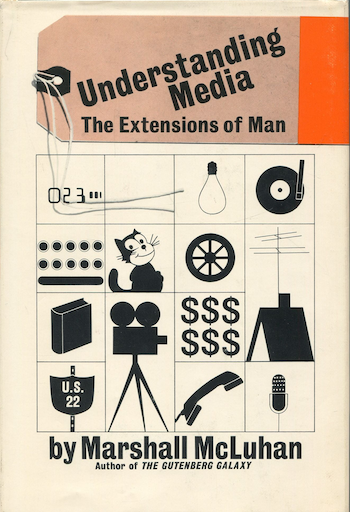
Long before parents, teachers, and sociologists reflected on how engagement with social media platforms shaped their users’ emotional lives, critics attended to the inner effects of radio, television, comic books, and other forms of popular culture. And the best critics have always focused attention on the media of communication, not just the words and pictures.
The first chapter of Marshall McLuhan’s 1964 book Understanding Media: The Extensions of Man was titled “The Medium is the Message.” That concise clause was a central insight in all of McLuhan’s work. He realized that anxieties about sex, violence, or political deviance were missing the deeper and more systemic formation conveyed by various media. He was writing at a time when cultural institutions and sensibilities had long been dominated by standards of literacy, by the logic of the written word. But he saw the increasing presence of electronic media (radio and television) in the everyday lives of Western citizens — a presence that conveyed radically different patterns of intuition and emotion — and realized that profound shifts in public and private life were already underway. Remember that the 1960 presidential election was the first American political campaign in which television played a decisive role. And it was the medium of television, not what Nixon or Kennedy said in the famous debate, that determined the winner.
“In a culture like ours, long accustomed to splitting and dividing all things as a means of control, it is sometimes a bit of a shock to be reminded that, in operational and practical fact, the medium is the message. This is merely to say that the personal and social consequences of any medium — that is, of any extension of ourselves — result from the new scale that is introduced into our affairs by each extension of ourselves, or by any new technology. Thus, with automation, for example, the new patterns of human association tend to eliminate jobs, it is true. That is the negative result. Positively, automation creates roles for people, which is to say depth of involvement in their work and human association that our preceding mechanical technology had destroyed. Many people would be disposed to say that it was not the machine, but what one did with the machine, that was its meaning or message. In terms of the ways in which the machine altered our relations to one another and to ourselves, it mattered not in the least whether it turned out cornflakes or Cadillacs. The restructuring of human work and association was shaped by the technique of fragmentation that is the essence of machine technology. The essence of automation technology is the opposite. It is integral and decentralist in depth, just as the machine was fragmentary, centralist, and superficial in its patterning of human relationships.
“The instance of the electric light may prove illuminating in this connection. The electric light is pure information. It is a medium without a message, as it were, unless it is used to spell out some verbal ad or name. This fact, characteristic of all media, means that the ‘content’ of any medium is always another medium. The content of writing is speech, just as the written word is the content of print, and print is the content of the telegraph. If it is asked, ‘What is the content of speech?,’ it is necessary to say, ‘It is an actual process of thought, which is in itself nonverbal.’ An abstract painting represents direct manifestation of creative thought processes as they might appear in computer designs. What we are considering here, however, are the psychic and social consequences of the designs or patterns as they amplify or accelerate existing processes. For the ‘message’ of any medium or technology is the change of scale or pace or pattern that it introduces into human affairs. The railway did not introduce movement or transportation or wheel or road into human society, but it accelerated and enlarged the scale of previous human functions, creating totally new kinds of cities and new kinds of work and leisure. This happened whether the railway functioned in a tropical or a northern environment, and is quite independent of the freight or content of the railway medium. The airplane, on the other hand, by accelerating the rate of transportation, tends to dissolve the railway form of city, politics, and association, quite independently of what the airplane is used for.”
A few pages later, McLuhan cites the example of a member of a premodern tribe whose life has been shaped by the oral traditions and communal ceremonies of his people. Making such a man literate with access to books, maybe even newspapers (!), is to alienate him from a whole way of life. “We [in the West] are no more prepared to encounter radio and TV in our literate milieu than the native of Ghana is able to cope with the literacy that takes him out of his collective tribal world and beaches him in individual isolation. We are as numb in our new electric world as the native involved in our literate and mechanical culture.
“Electric speed mingles the cultures of prehistory with the dregs of industrial marketeers, the nonliterate with semiliterate and the postliterate. Mental breakdown of varying degrees is the very common result of uprooting and inundation with new information and endless new patterns of information. Wyndham Lewis made this a theme of his group of novels called The Human Age. The first of these, The Childermass, is concerned precisely with accelerated media change as a kind of massacre of the innocents. In our own world as we become more aware of the effects of technology on psychic formation and manifestation, we are losing all confidence in our right to assign guilt. Ancient prehistoric societies regard violent crime as pathetic. The killer is regarded as we do a cancer victim. ‘How terrible it must be to feel like that,’ they say. J. M. Synge took up this idea very effectively in his Playboy of the Western World. . . .
“C. P. Snow, reviewing a book of A. L. Rowse (The New York Times Book Review, December 24, 1961) on Appeasement and the road to Munich, describes the top level of British brains and experience in the 1930s. ‘Their I.Q.’s were much higher than usual among political bosses. Why were they such a disaster?’ The view of Rowse, Snow approves: ‘They would not listen to warnings because they did not wish to hear.’ Being anti-Red made it impossible for them to read the message of Hitler. But their failure was as nothing compared to our present one. The American stake in literacy as a technology or uniformity applied to every level of education, government, industry, and social life is totally threatened by the electric technology. The threat of Stalin or Hitler was external. The electric technology is within the gates, and we are numb, deaf, blind, and mute about its encounter with the Gutenberg technology, on and through which the American way of life was formed. It is, however, no time to suggest strategies when the threat has not even been acknowledged to exist. I am in the position of Louis Pasteur telling doctors that their greatest enemy was quite invisible, and quite unrecognized by them. Our conventional response to all media, namely that it is how they are used that counts, is the numb stance of the technological idiot. For the ‘content’ of a medium is like the juicy piece of meat carried by the burglar to distract the watchdog of the mind. [emphasis mine] The effect of the medium is made strong and intense just because it is given another medium as ‘content.’ The content of a movie is a novel or a play or an opera. The effect of the movie form is not related to its program content. The ‘content’ of writing or print is speech, but the reader is almost entirely unaware either of print or of speech.”
Click on the tags below for listings of related readings or audio features.