
On Volume 59 of our Journal, I talked with Todd Gitlin about his book, Media Unlimited: How the Torrent of Images and Sounds Overwhelms Our Lives (Henry Holt & Co., 2001). That interview has been released as an Archive Feature, and an excerpt from that book is here.
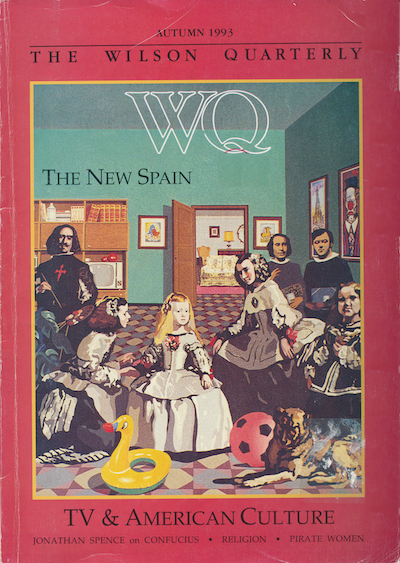
I first encountered Gitlin’s media criticism in an article about television published in the Autumn 1993 issue of The Wilson Quarterly, an essay titled “Flat and Happy.” I appreciated his attention to the sensibilities nourished by our media experiences, a theme I discussed many years ago in my own book, All God’s Children and Blue Suede Shoes: Christians and Popular Culture.
I think that Antón Barba-Kay is exactly right when he asserts (in A Web of Our Own Making: The Nature of Digital Formation) that television “has been continuously preparing us for what the digital is and does to all appearances.” So the observations from decades ago by attentive critics of pre-social media media such as Gitlin are valuable diagnostic tools for us right now.
Here are some excerpts from Gitlin’s article:
“To call television a medium of communications misses much of the point. It is somewhat like calling a family a system of communication. Family therapists do so, but their descriptive power falls short of Tolstoy’s. It might carry us somewhat further to say that television is a medium of cultural power. What happens on, or through, television — the images, topics, and styles that circulate through living rooms — does proceed from headquarters outward to take up a space in the national circuitry. But to speak of television as if it were nothing but a sequence of images is to miss a crucial feature of the machinery, namely how much of it there is and how easily it enters the house. . . .
“In all these households, television is, I suggest, more than an amusement bank, a national bulletin board, a repertory of images, an engine for ideas, a classification index, a faithful pet, or a tranquilizer. It is all of these, in some measure. But television’s largest impact is probably as a school for manners, mores, and styles — for repertoires of speech and feeling, even for the externals and experiences of self-presentation that we call personality. This is not simply because television is powerful but also, and crucially, because other institutions are less so.
“As work, family, and religion lose their capacity to adumbrate how a person is expected to behave, television takes up much of the slack. . . .
“It is reasonable to suspect that, at the least, television teaches people how they should talk, look, and behave — which means, in some measure, that it teaches them how they should think, how they should feel, and how, perchance, they should dream. . . .
“To borrow Joshua Meyrowitz’s terms, . . . the backstage world of ordinary relationships is nastier. From domestic battering to automatic cursing and the rudeness of motorists — note the decline in directional signaling over the last few decades — a harshness has settled into the texture of everyday life. It seems to me that television has furthered these changes — without having, all by itself, devised or caused them.
“I am struck, in particular, by the growth of ‘knowingness,’ a quality of self-conscious savvy that often passes for sophistication. Knowingness is not simply access to or a result of knowledge; knowingness is a state of mind in which any particular knowledge is less important that the feeling that one knows and the pleasure taken in the display of that knowledge. Knowingness is the conviction that it is possible to be in the know; it is the demonstration that one hasn’t been left behind, that one is hip, with it, cool. It is a mastery of techniques by which to reveal that one has left the side show and made it into the big tent. The opposite of knowingness is unabashed provincialism, naiveté, complacent straightforwardness. This provincialism and straightforwardness have been eroded within the American culture of recent decades — with the help of television. . . .
“The content of television is not simply one story after another. In fact, to think of television as nothing more than a sum of stories is like thinking of a lawn as nothing more than a sum of blades. The very significance of the units derives from their membership in the ensemble. As the British critic Raymond Williams has pointed out, one remarkable thing about television is the sheer profusion of stories it delivers. No previous generation of human beings has been exposed to the multitude of narratives we have come to take for granted in our everyday lives. The impact of each one may be negligible, but it hardly follows that the impact of the totality is negligible. Moreover, the profusion of stories changes each component story. The stories exist in multiplicity: their significance bleeds from one story into another.
“Most people watch television, not discrete narrative units. The flow of television is both rapid and interrupted. A story begins with credits. A few minutes of story take place. The story is interrupted for commercials — probably more than one per commercial break. . . . In the wonderful world of television, anything is compatible with anything else. The one continuity is discontinuity. . . .
“The questions then arises: What kind of social education, what type of character formation, occurs when there are so many stories and each one is constantly interrupted, is soon over, and flows immediately into an unrelated story that, in turn, is swallowed up by the next? In an earlier America, even the uneducated could know well, and reflect upon, a small stock of stories — in particular, the Bible and Shakespeare. . . . By contrast, every evening television tells a Scheherezade’s 1,001 Night-worth of stories, and the meaning of any particular show has a shelf life of, usually, minutes. A viewer engages less with the content of one program than masters an attitude of superiority to them all. Rather than learn one subject well, he or she acquires a sophisticated repartee and light banter good for discussing anything and everything that comes up — a style in which, as I noted before, to seem quick and knowing is more important than what one knows. . . .
“Thanks to slick visuals . . . and crisp movement, glibness rules. . . .
“On TV both children and adults speak with an unprecedented glibness. Thanks to the wonders of editing, no one on television is ever at a loss for words or photogenic signs of emotion. . . . Hesitancy, silence, awkwardness are absent from TV’s repertory of behaviors, except in sitcoms or made-for-TV movies where boy meets girl. Yet outside TV, awkwardness and hesitancy often characterize the beginning, and each further development, of interiority, of a person’s internal life. On TV, however, speech is stripped down, designed to move. The one-liner, developed for ads, is the premium style. TV’s common currency consists of slogans and mockery. Situation comedies and morning shows are in particular obsessed with the jokey comeback. The put-down is the universal linkage among television’s cast of live and recorded characters. A free-floating hostility mirrors, and also inspires, the equivalent conversational style among the young who grow up in this habitat.
“As critic Mark Crispin Miller has observed, the knowingly snide attitude is so widespread and automatic that it deserves to be called ‘the hipness unto death.’ The promotion of David Letterman to CBS’s 11:30 P.M. talk-show slot signals the ascendancy of this style. Relentless if superficial self-disclosure is one of the conventions of television today. . . .
“Through this relentless inspection, character is dissected, torn apart. Indeed, character — based upon self-mastery, moral resolve, learning or understanding, and quiet or heroic action — is reduced to personality, impression management, the attractions of the body and mannerism. . . .
“One hardly needs to read Tocqueville to surmise that, regardless of the channel or brand name, the odds are that the rule of the glib and the cute will prevail. The once-over-lightly glibness of American culture prevails not only on television but in the movies and magazines, among sports announcers and talk-show hosts, in the jargons of politics and psychotherapy alike. It is difficult to resist the conclusion that America’s culture of comfort and convenience, of the quick fix and fast relief, of mass-manufactured labels of individuality, has acquired in television a useful technology to reduce the range of colors in the spectrum of life to a bleached center glittering with sequins of drop-dead colors.”
Click on the tags below for listings of related readings or audio features.