By 1976, Wallace Stegner’s career as a writer was well established. He had won the Pulitzer Prize for literature in 1972 (for Angle of Repose), and was to receive the National Book Award in 1977 for The Spectator Bird. But this diary entry from 1976 is evidence of an abiding sense of restlessness:
Undoubtedly there are writers who know what they think, and write their books to air what they think. I, on the contrary, seem generally to be asking questions, maundering around and being amazed by the complexity (beauty, anguish) of the most ordinary people and events. Like Dreiser, I suppose I am going to leave this world knowing less than when I came.
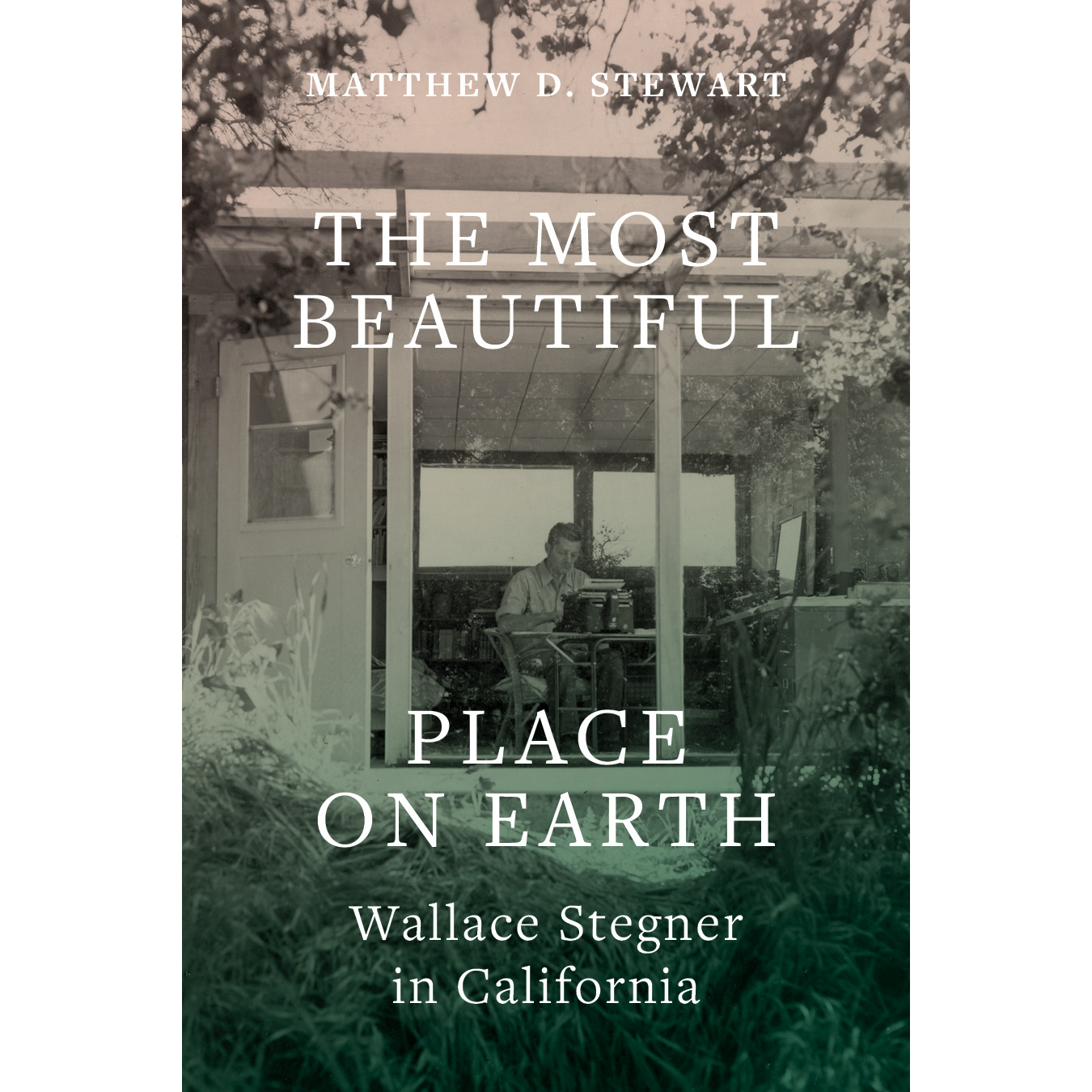
On Volume 157, I talked with Matthew Stewart about his book The Most Beautiful Place on Earth: Wallace Stegner in California (The University of Utah Press, 2022). Stewart’s book discusses Stegner’s novels as reflections on the effects of displacement in modern America.
“Stegner created artistic worlds that had integrity to them and explored a wide range of questions in those worlds, in the attempt to make sense out of the world he actually inhabited. They were moral laboratories of a sort. There is intellectual content to Stegner’s fiction that goes beyond strictly ‘aesthetic’ or ‘political’ categories. While few scholars would defend such divisions in theory, the legacy of the moralistic tales of the Victorians writing in the Genteel Tradition on the one hand, or the agitprop associated with the Popular Front of the 1930s on the other, left American writers with very prominent negative examples of a ‘prescriptive aesthetics,’ or propaganda posing as fiction. At its worst, such work was aesthetically worthless and perhaps not even entertaining, or, for the more politically oriented, simply a useless diversion from more valuable political action. It was a tendency to be avoided at all costs. Further, regardless of theoretical conviction, many readers are simply repulsed by fiction that is overtly ideological and didactic. Nonetheless, Stegner practiced a form of fiction that yields more insight if his novels are considered in the ‘novel of ideas’ category, in which the ‘intellectual’ and ‘aesthetic’ content of a novel are not easily disentangled.
“This is not because an occasional character in a Stegner novel engages in a witty conversation against hasty and destructive suburban development or some other conservation issue. Such remarks are a feature of Stegner’s fiction, but a tendency he studiously avoided as much as possible. Rather it is to emphasize that, for Stegner, the American West would only become a ‘geography of hope,’ in his terms, if its communities managed to enlist the loyalty of generations of stickers, who would build and maintain — and love — cultures that were adapted to the place.
“In the American postwar context, he considered fiction and, to a lesser extent, history and other forms of nonfiction, essential resources for that effort. In Stegner’s vision, fiction was a means of enlightening people to their existing or missing connections with places and other people. In the words of William Bevis, he ‘imagined’ and ‘wrenched’ the ‘conception of western from forms of escape to forms of belonging.’ This attempt was not separate from an aesthetic experience but was in fact part of the way that Stegner believed fiction worked when at its most powerful. It was at least the fiction he found most compelling.
“In sum, Stegner’s fiction should not be reduced to either soft political argument on the one hand or hard ideological fiction on the other; I see his books instead as artifacts that demand an aesthetic and intellectual response, that encourage a form of holistic thinking that is obscured by more one-dimensional modes of thought. Incorporating fiction into intellectual history allows for a mode of inquiry that is not as easily separated into formal and informal categories. Close reading of fiction can point towards ways that ideas are entangled with moral reasoning, sensibility, and emotion, seemingly intangible matters that fiction is uniquely poised to illuminate.”
Related reading and listening
- Modernity’s crisis of place — Craig Bartholomew reflects on the importance of place to our humanity. (58 minutes)
- A sampling of newly published lectures — Ken Myers introduces listeners to four recently released lectures, courtesy of our Partners. The lecturers are Jennifer Frey, Gary Saul Morson, N. T. Wright, and Andrew Kern. (27 minutes)
- Grace and Christian realism — Jennifer Frey explores Thomist elements in Flannery O’Connor’s theology and writing, with a particular emphasis on a Thomist understanding of art. (39 minutes)
- Mystery novels with theological concerns — In these interviews from 1993, mystery author P. D. James speaks about the philosophical and theological issues woven into her novels, and Alan Jacobs discusses James’s novel The Children of Men. (23 minutes)
- Modern fictional “heroes” — FROM VOL. 141 Susanna Lee discusses moral authority in the heroes of hard-boiled crime fiction. (24 minutes)
- Technophiliac obsessions — FROM VOL. 141 Literary and media scholar Grant Wythoff talks about the “father of science fiction,” Hugo Gernsback. (26 minutes)
- Ontology and reality in fiction — Katy Carl discusses Catholic novelist Graham Greene’s skill in portraying the struggle between spiritual belief and doubt. (27 minutes)
- Sacred and Profane Love: Graham Greene and the Catholic Imagination — Katy Carl discusses novelist Graham Greene’s fiction and spiritual struggles in light of the concept of the Catholic imagination. (49 minutes)
- Landscape and living memory — FROM VOL. 44 Gayle Brandow Samuels examines the ways in which trees have served as anchor-points for memory and identity in American culture. (9 minutes)
- City of God, City of Man — Architect Philip Bess discusses how our modern-day confusion and moral illiteracy are worked out visibly in the cities and buildings our architects create. (57 minutes)
- The reciprocity of all things — FROM VOL. 148 Jeffrey Bilbro explores the importance of sustainability through the essays, poetry and fiction of Wendell Berry. (13 minutes)
- What are students for? — FROM VOL. 140 Drawing from Wendell Berry’s works, Jack Baker and Jeffrey Bilbro discuss a vision of higher education that respects a multidimensional notion of place. (23 minutes)
- Georges Bernanos & the Mystery of the Human Person — Translator J. C. Whitehouse praises French novelist Georges Bernanos’s profundity in exploring the depths of the human soul through the vehicle of fiction. (58 minutes)
- A poet’s relationship to time — FROM VOL. 57 Poet Wilmer Mills (1969–2011) discusses how his agricultural and cross-cultural childhood in Brazil shaped his imagination and his relationship with modernity. (11 minutes)
- Flannery at 100 — In honor of Flannery O’Connor’s 100th birthday, we have gathered here an aural feast of interviews with O’Connor scholars and aficionados discussing her life, work, and faith. (3 hours, 28 minutes)
- Gratitude and stewardship as political postures — FROM VOL. 118 Mark Mitchell explores the consequences of four concepts that are sadly missing from most political debates today: creatureliness, gratitude, human scale, and place. (18 minutes)
- An embedded life — Following a move from one state to another, Gilbert Meilaender explores the tension between being simultaneously a sojourner and a body located in place and time. (30 minutes)
- Immersion in a different time — FROM VOL. 17 Literary critic Alan Jacobs considers the author Patrick O’Brian as perhaps the best historical novelist ever. (13 minutes)
- God is in the details — Flannery O’Connor on why stories rely on the particularities of reality
- Stewart, Matthew D. — FROM THE GUEST PAGE: Matthew D. Stewart teaches humanities at The Ambrose School in Meridian, Idaho, and is associate editor for Front Porch Republic.
- Where mortals dwell — FROM VOL. 113Theologian Craig Bartholomew provides a biblically rich critique of the contemporary “crisis of place,” a disorienting condition caused by neglect of the meaning of our embodiment. (21 minutes)
- Bridges with structural flaws — FROM VOL. 4What made The Bridges of Madison County so popular, and so flawed? Alan Jacobs offers some insights. (14 minutes)
- Mars Hill Audio Journal, Volume 157 — FEATURED GUESTS:
Allan C. Carlson, Matthew Stewart, Steven Knepper, Holly Ordway, Norm Klassen, and Norman Wirzba
- Faulkner’s tragic vision — Alan Jacobs describes how William Faulkner’s fiction explored the tragedy of living with a legacy of evil acts. (26 minutes)
- On remembering and recognition — In memory of Frederick Buechner’s life, Ken Myers shares from his 1996 conversation with the acclaimed writer. Also heard are two interviews with novelist Ron Hansen about the craft of writing fiction. (29 minutes)
- Why churches should be more attentive to space — Eric O. Jacobsen discusses New Urbanism with a Christian perspective, imagining how we might organize places in which life may be lived at a human scale and in which real community is nourished. (26 minutes)
- On faithful fiction: Larry Woiwode, Alan Jacobs, & Jay Tolson — This Friday Feature represents three interviews on fiction from Volume 3: Larry Woiwode on what makes good fiction, Alan Jacobs on P. D. James’s The Children of Men, and Jay Tolson on Walker Percy. (29 minutes)
- The wide, wide resonance of local details — Novelist Larry Woiwode on the unbreakable bond between specificity and universality
- Six recent books worthy of note — Ken Myers shares a summary of six recent books that we want our listeners to know about but whose authors we won’t be interviewing. (15 minutes)
- Mars Hill Audio Journal, Volume 141 — FEATURED GUESTS:
Grant Wythoff, Susanna Lee, Gerald R. McDermott, Carlos Eire, Kelly Kapic, and James Matthew Wilson
- Mars Hill Audio Journal, Volume 140 — FEATURED GUESTS:
Matthew Rubery, James A. Herrick, Jack Baker, Jeffrey Bilbro, Timothy Gloege, David Hollinger, and Barrett Fisher
- Mars Hill Audio Journal, Volume 113 — FEATURED GUESTS: Steven Shapin, Arthur Boers, Christine Pohl, Norman Wirzba, Craig Bartholomew, and David I. Smith
- Mars Hill Audio Journal, Volume 100 — FEATURED GUESTS: Jennifer Burns, Christian Smith, Dallas Willard, Peter Kreeft, P. D. James, James Davison Hunter, Paul McHugh, Ted Prescott, Ed Knippers, Martha Bayles, Dominic Aquila, Gilbert Meilaender, Neil Postman, and Alan Jacobs
- Mars Hill Audio Journal, Volume 93 — FEATURED GUESTS: Alan Jacobs, James A. Herrick, Robert C. Roberts, J. Daryl Charles, Allan C. Carlson, and Sheila O’Connor-Ambrose
- Ralph C. Wood: “Rapidly Rises the Morning Tide: An Essay on P. D. James’s The Children of Men” — Ralph C. Wood discusses the way in which the futuristic dystopia of P. D. James‘s novel, The Children of Men, reveals much about the West’s modern spiritual confusion and about the possible sources of hope beyond that chaos. (39 minutes)
- Mars Hill Audio Journal, Volume 60 — FEATURED GUESTS: David Naugle, D. G. Hart, Dermot Quinn, Russell Hittinger, Leon Kass, and James Howard Kunstler
- Mars Hill Audio Journal, Volume 59 — FEATURED GUESTS: Ron Hansen, Bernard Lewis, Alan Jacobs, Adrienne Chaplin, Todd Gitlin, and Quentin Schultze
- Mars Hill Audio Journal, Volume 58 — FEATURED GUESTS: Hubert Dreyfus, Francis Fukuyama, Gordon Preece, Gijs van Hensbergen, Ted Prescott, and Bradley J. Birzer
- Mars Hill Audio Journal, Volume 52 — FEATURED GUESTS: Tom Shippey, Jeffrey Meyers, Ralph McInerny, Daniel Ritchie, Ian Ker, Mark Schwehn, Gilbert Meilaender, and Tiina Nunnally.
- Mars Hill Audio Journal, Volume 48 — FEATURED GUESTS: Jon Butler, Gary Cross, Zygmunt Bauman, Pico Iyer, Richard Stivers, Larry Woiwode, Alan Jacobs, and James Trott
- Mars Hill Audio Journal, Volume 47 — FEATURED GUESTS: Christopher Clausen, Don Eberly, George Weigel, Luci Shaw, Steve Wilkens, David Harvey, John Durham Peters, and Masaaki Suzuki
- Mars Hill Audio Journal, Volume 44 — FEATURED GUESTS: James Davison Hunter, Brian C. Robertson, David Myers, Robert Frank, Gayle Brandow Samuels, Thomas Hine, Thomas Hibbs, and Robin Leaver
- Place, Community, and Memory — Several essayists and a novelist explore the important ways in which we (and the communities we inhabit) are shaped and sustained by the particular places in which we live. (100 minutes)