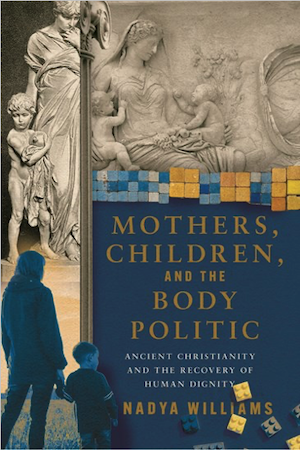
“Too often today, discussions of what it means to respect human life and dignity revolve around just the physical body. Yes, protecting image bearers from abortion, disease, starvation, and war, to name just a few of the threats we have considered over the previous chapters, is an essential starting point.
“It should not, however, be the endpoint. The embedded attacks on children and motherhood I have documented in the first two parts of this book, both in our own society and in the pre-Christian Greco-Roman antiquity, are ultimately attacks not only on human life but on human flourishing. This elusive goal, a desire to return to the conditions of life in Eden, cannot be perfectly achieved on this side of eternity. But we should at least try. This means recognizing that our flourishing does not entail merely the protection of our bodies but also our minds and souls and, last but not least, the environment in which we dwell. We are still connected to the land, even if most of us are not farming.
“Thinking about these dimensions as bound together — the people and the land they inhabit as a connected whole — came naturally to the ancient world, centered as it was on agricultural life. We might note, for instance, the Athenian myth of the birth of the first Athenian spontaneously from the local land. The Athenians were not the only ones to have such a myth of origin. The Thebans had their own version: the earliest Thebans, a race of warriors, sprouted — or, more accurately, sprang up in full armor-from dragon teeth sown in the land.
“Instinctive to such myths was the belief that it was somehow better to be a people who had always dwelt in a particular region than a people who were outsiders moving in. The Spartans were aware of this. Although conquerors of the region they settled, they promoted their own myth of nativity: they were the children of Heracles who returned home to the land of their origin to claim their rightful inheritance.
“Emphasizing these mythologies was also a great way to justify xenophobia in antiquity, but this does not have to be part of the package. People have an instinctive desire to belong, and this means searching for roots. It is no coincidence that now, in this age of urbanization and increased mobility, companies such as Ancestry or 23andMe are doing brisk business in DNA analysis and family history. We want to know: Where are we from? Where do we belong? The where is inextricably connected to the who — who are our people, and whose cousins, however distant, are we?
“Modern America has become a land of uprooted people. For so many, especially of the college-educated class, the expected life trajectory now involves moving away for college and possibly never coming back to live in one’s parents’ home. In many corporate jobs, promotion means yet another uprooting — you move where the job sends you. What are we losing in the process? One answer only grows clearer with each passing year: the potential to flourish more deeply.”
— from Nadya Williams, Mothers, Children, and the Body Politic: Ancient Christianity and the Recovery of Human Dignity (IVP Academic, 2024)
Related reading and listening
- Knowing and living our metaphysical totality — Clyde Kilby on the power of myth to bring together “the slender hints of the knowable”
- Modernity’s crisis of place — Craig Bartholomew reflects on the importance of place to our humanity. (58 minutes)
- The inward eye, cosmic truth, and making well — Andrew Kern takes his listeners along an “interlinear” reading of a portion of St. Augustine’s Confessions that explores the differences between how God makes and how we create. (38 minutes)
- The cost of “killing” God — In this October 2023 lecture, Carl Trueman explores the concept of “desecration” as a frame for understanding the nature of modernity in our time. (42 minutes)
- How music blesses and teaches — FROM VOL. 64 Theologian and musician Jeremy Begbie explores what we learn about time, theology, and the structure of Creation from the experience of music. (28 minutes)
- Cosmic realities in the built world — Christopher and Christine Perrin discuss the implications of architect Christopher Alexander’s (1936–2022) discovery of patterns of building that cohere with the the created cosmos and with ourselves as human creatures. (59 minutes)
- Utopian dreams and cynicism — John Durham Peters discusses the history of the idea of communication, saying that our hopes are too high when we believe that the solution to social discord is just better communication. (49 minutes)
- Man as “both mystic and hobbit” — D. C. Schindler explores how building is a quintessential human activity and an expression of our view of the meaning of reality. (47 minutes)
- Setting the liberal arts free — In addressing the state of liberal arts education in the U.S., Gilbert Meilaender raises some core questions and makes some surprising proposals. (28 minutes)
- Williams, Nadya — FROM THE GUEST PAGE: Nadya Williams, PhD, is a homeschooling mother, books editor, and author.
- Introducing Volume 165 — Ken Myers introduces listeners to Volume 165 of the Journal with short segments from each interview. (32 minutes)
- Mars Hill Audio Journal, Volume 165 — FEATURED GUESTS: Jeffrey Bilbro, Daniel McInerny, Joseph Minich, Carl Elliott, Nadya Williams, and Don W. King
- A Christian understanding of human nature — FROM VOL. 35 Robert C. Roberts and Mark R. Talbot discuss the need for Christian psychologists to draw from Christianity’s deep tradition of understanding human nature. (15 minutes)
- Postmodern culture and the gospel — FROM VOL. 6 Roger Lundin discusses the ethical and theological consequences of our postmodern culture. (9 minutes)
- The recovery of an integrated ecology — In this essay, Michael Hanby unpacks the summons of Laudato si’ to an ecological way of life based on a proper understanding of creation in its fullness and integrity. (57 minutes)
- Politics and the good — FROM VOL. 160 D. C. Schindler argues that political order cannot be disentangled from the social, and that fundamental questions of what humans are and what the good is cannot be bracketed from politics. (30 minutes)
- The profound drama of human sexuality — In this lecture, D. C. Schindler explains the cosmological significance of human sexuality and why it is paradigmatic of the relationship between nature and freedom. (32 minutes)
- A poet’s relationship to time — FROM VOL. 57 Poet Wilmer Mills (1969–2011) discusses how his agricultural and cross-cultural childhood in Brazil shaped his imagination and his relationship with modernity. (11 minutes)
- The downward spiral of all technocracies — Andrew Willard Jones explains the two paths that exist with the development of new technologies: one which leads to an expansion of the humane world and one which exploits and truncates both Creation and humanity. (65 minutes)
- To see people as people — Anthony Bradley argues that a recovery of Christian personalism is needed to counter the dehumanization, polarization, and tribalism of our day. (45 minutes)
- Ethical issues in neurobiological interventions — William Hurlbut explores current neurobiological advancements and the ethics and dangers of biotechnology interventions that go beyond therapy. (62 minutes)
- An impoverished anthropology — FROM VOL. 146 Mark Mitchell asks whether there is anything that truly binds Americans together beyond their commitment to self-creation. (34 minutes)
- St. Thomas the anthropologist — G. K. Chesterton on Aquinas’s complete Science of Man
- An embedded life — Following a move from one state to another, Gilbert Meilaender explores the tension between being simultaneously a sojourner and a body located in place and time. (30 minutes)
- Gratitude, vitalism, and the timid rationalist — In this lecture, Matthew Crawford draws a distinction between an orientation toward receiving life as gift and a timid and cramped rationalism that views man as an object to be synthetically remade. (52 minutes)
- Humans as biological hardware — In this essay, Brad Littlejohn and Clare Morell decry how modern technology tends to hack the human person in pursuit of profit. (55 minutes)
- “The system will be first” — FROM VOL. 27 Robert Kanigel describes the transformation of work due to Frederick Winslow Taylor’s concept of scientific management. (11 minutes)
- What it means to be a person — FROM VOL. 147 Sociologist Craig Gay argues that in order to address the challenges of a technological approach to the world, we need to recover the Christian tradition’s robust theology of personhood. (24 minutes)
- Voluntarily silencing ourselves — FROM VOL. 39 John L. Locke discusses the value of personal communication and how technology is displacing it. (12 minutes)
- Human nature through the eyes of Lucian Freud — FROM VOL. 7 Art critic and sculptor Ted Prescott discusses the work of British realist painter Lucian Freud (notably, the grandson of Sigmund Freud). (8 minutes)
- The gift of meaningful work — In this lecture, D. C. Schindler argues that genuine work is inherently meaningful and facilitates an encounter with reality and therefore, ultimately, with God. (36 minutes)
- “Gender” as ultimate separation — In this November 2018 lecture, Margaret McCarthy explains how the predictions of Pope Paul VI’s Humanae vitae regarding the consequences of separating sex from procreation have proven true. (38 minutes)
- How words are central to the human experience — FROM VOL. 95 Craig Gay reflects on the essential linguistic nature of humanity: how our growth (or decline) in life is tied to words. (18 minutes)
- Bearing well the burdens of the past, present, and future — Louis Markos shows how great literature like the Iliad links us to the human story and strengthens us to live fully and well. (65 minutes)
- The abolition of the fine arts — In this lecture, R. V. Young examines why people are increasingly unable to discriminate between base and fine art, arguing why this issue is of particular concern to Christians. (41 minutes)
- The roots of American disorder — In this reading of an article from 2021 by Michael Hanby, the critique of Marxism in Augusto del Noce’s work is compared with texts from the American Founders. (79 minutes)
- Personhood, limits, and academic vocation — FROM VOL. 39 Marion Montgomery (1934–2002) offers a deep critique of the relationship of the academy to its community in an effort to diagnose how higher education has lost its way. (13 minutes)
- A Christian philosophy of integrated education — FROM VOL. 61 Michael L. Peterson discusses how Christianity could inform society’s understandings of education and human nature. (8 minutes)
- Education for human flourishing — Co-authors Paul Spears and Steven Loomis argue that Christians should foster education that does justice to humans in our fullness of being. (23 minutes)
- Automation and human agency — FROM VOL. 150 Philosopher and mechanic Matthew Crawford laments the losses of human skill that correspond with gains in mechanical automation. (21 minutes)
- Not good to be alone — In a lecture titled “Gender and the Common Good,” Margaret Harper McCarthy argues that the current ideology regarding gender fundamentally separates people from one another and finally even from themselves. (34 minutes)
- Discerning an alternative modernity — In a lecture from 2019, Simon Oliver presents a summary of the cultural consequences of the comprehensiveness of the work of Christ. (28 minutes)
- Mars Hill Audio Journal, Volume 159 — FEATURED GUESTS:
Kirk Farney, Andrew Willard Jones, James L. Nolan, Jr., Andrew Kaethler, Peter Ramey, and Kathryn Wehr
- The Christian humanism of Aleksandr Solzhenitsyn — One of the main themes emphasized by these three guests is that Solzhenitsyn was not principally concerned with politics, but with human nature and purpose, understood in light of the Christian account of reality. (39 minutes)
- With Eastern eyes — Paul Valliere and Vigen Guroian discuss questions of law, politics, and human nature from the Orthodox tradition. (34 minutes)
- Mars Hill Audio Journal, Volume 153 — FEATURED GUESTS:
Charles C. Camosy, O. Carter Snead, Matt Feeney, Margarita A. Mooney, Louis Markos, and Alan Jacobs
- We are not Cybermen — Essayist L. M. Sacasas discusses some of the ideas of Ivan Illich, whose work has influenced Sacasas’s own understanding of the anti-human dynamics of technological society. (21 minutes)
- What is at stake for us in a self-driving future? — Matthew Crawford vividly details the “personal knowledge” acquired in interaction with physical things, their mecho-systems, and the people who care for them. (16 minutes)
- Justice and gender, round 2 — Margaret Harper McCarthy, one of the authors of a brief on gender submitted to the Supreme Court, discusses the philosophical and practical implications of fashionable notions of the meaning of gender. (33 minutes)
- Mars Hill Audio Journal, Volume 147 — FEATURED GUESTS:
R. Jared Staudt, Jason Peters, D. C. Schindler, Craig Gay, Mary Hirschfeld, and Patrick Samway