
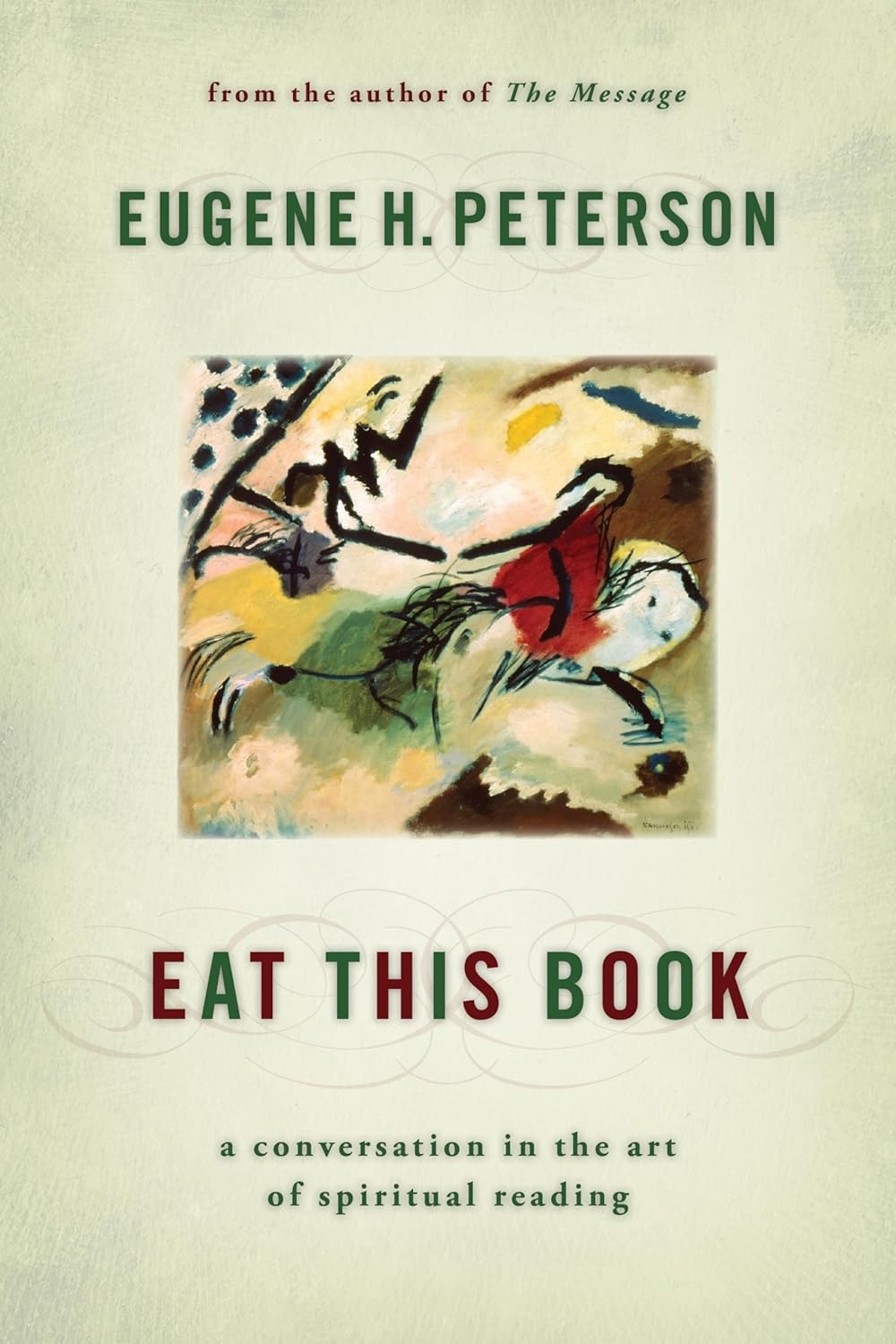
“The Oxford don, Austin Farrar, in his Bampton Lectures [published as The Glass of Vision (1948)], referred to ‘the forbidding discipline of spiritual reading’ that ordinary people have characteristically brought to this text [i.e., the book of Revelation] that forms their souls. Forbidding because it requires that we read with our entire life, not just employing the synapses of our brain. Forbidding because of the endless dodges we devise in avoiding the risk of faith in God. Forbidding because of our restless inventiveness and using whatever knowledge of ‘spirituality’ we acquire to set ourselves up as gods. Forbidding because when we have learned to read and comprehend the words on the page, we find that we have hardly begun. Forbidding because it requires all of us, our muscles and ligaments, our eyes and ears, our obedience and adoration, our imaginations and our prayers. Our ancestors set this ‘forbidding discipline’ (their phrase for us it was lectio divina) as the core curriculum in this most demanding of all schools, the School of the Holy Spirit, established by Jesus when he told his disciples, ‘When the spirit of truth comes, he will guide you into all the truth . . . he will take what is mine and declare it to you’ (John 16:13–15; also 14:16; 15:26; 16:7–8). All writing that comes out of this School anticipates this kind of reading: participatory reading, receiving the words in such a way that they become interior to our lives, the rhythms and images becoming practices of prayer, acts of obedience, ways of love.
“Words spoken or written to us under the metaphor of eating, words to be freely taken in, tasted, chewed, savored, swallowed, and digested, have a very different effect on us from those that come at us from the outside, whether in the form of propaganda or information. Propaganda works another person’s will upon us, attempting to manipulate us to an action or a belief. Insofar as we are moved by it, we become less, the puppet of a puppeteer writer/speaker. There is no dignity, no soul, in a puppet. And information reduces words to the condition of commodities that we can use however we will. Words are removed from their originating context in the moral universe and from personal relationships so that they can be used as tools or weapons. Such commodification of language reduces both those who speak it and those who listen to it also to commodities.
“Reading is an immense gift, but only if the words are assimilated, taken into the soul — eaten, chewed, gnawed, received in unhurried delight. Words of men and women long dead, or separated by miles and/or years, come off the page and enter our lives freshly and precisely, conveying truth and beauty and goodness, words that God’s spirit has used and uses to breathe life into our souls. Our access to reality deepens into past centuries, spreads across continents. But this reading also carries with it subtle dangers. Passionate words of men and women spoken in ecstasy can end up flattened on the page and dissected with an impersonal eye. Wild words wrung out of excruciating suffering can be skinned and stuffed, mounted and labeled as museum specimens. The danger in all reading is that words be twisted into propaganda or reduced to information, mere tools and data. We silence the living voice and reduce words to what we can use for convenience and profit.
“One psalmist mocked his contemporaries for reducing the living God who spoke and listened to them into a gold or silver thing-god that they could use:
Those who make them are like them;
so are all who trust in them. (Ps. 115:8)
“It’s an apt warning for us still as we deal daily with the incredible explosion of information technology and propagandizing techniques. These words need rescuing.”
— From Eugene H. Peterson, Eat This Book: A Conversation in the Art of Spiritual Reading (Eerdman’s, 2006). Eugene Peterson (1932–2018) talked with Ken Myers about this book and four others on spiritual theology in Dancing Lessons: Eugene Peterson on Theology and the Rhythms of Life. That Conversation was released as a Friday Feature shortly after Peterson died in 2018.
This post was originally published on February 19, 2021.
Click on the tags below for listings of related readings or audio features.