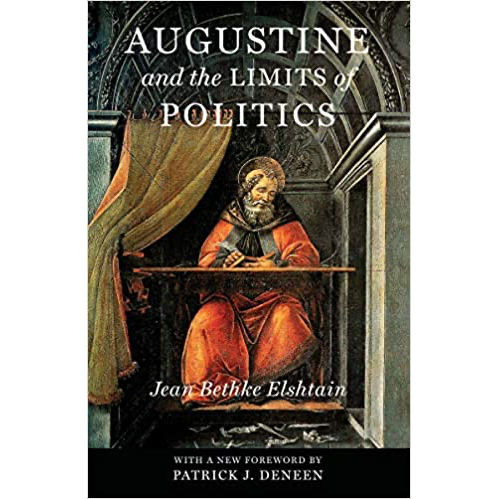
In 1995, Jean Bethke Elshtain gave the Frank M. Covey, Jr., Loyola Lectures in Political Analysis at Loyola University in Chicago. That same year, her five presentations were published by the University of Notre Dame Press under the title Augustine and the Limits of Politics. The first chapter was called “Why Augustine? Why Now?” That was also the title given to an article by Elshtain published in 2003 in the Catholic University Law Review. Below is a passage from this article, which you may download in its entirety here.
“[H]uman beings are inherently social. While created in the image of God, humans are defined by human relationships. The self cannot be free-standing. Social life, however full of ills, must be cherished. Among those social forms, civil life is not simply what sin has brought into the world, but what emerges from our capacity for love, our use of reason, as well as a pervasive lust for domination attendant upon human affairs. Augustine stated, ‘The philosophers hold the view that the life of the wise man should be social; and in this we support them much more heartily.’ Indeed, the City of God, Augustine’s way of characterizing that pilgrim band of Christians during their earthly sojourn in and through a community of reconciliation and fellowship that presaged the heavenly kingdom, could never have had ‘its first start . . . if the life of the saints were not social.’ All human beings are citizens of the earthly kingdom, the City of Man, and even in this fallen condition there is a kind of ‘natural likeness’ that forges a bond between humankind. This bond of peace does not suffice to prevent wars, dissensions, cruelty, and misery of all kinds, but we are nonetheless called to membership based on a naturalistic sociality and basic morality available to all rational creatures. A unity in plurality pushes towards harmony; but the sin of division, with its origins in pride and willfulness, drives us apart.
“Yet, it is love of friendship that lies at the root of what might be called Augustine’s ‘practical philosophy,’ which involves his history, ethics, and social and political theories. Pinioned between alienation and affection, human beings — those ‘cracked pot[s]’ — are caught in the tragedy of alienation but glued by love. Human sociality is innate, and for Augustine, the question is not whether humans should be social or whether they should trust enough to love. Instead, the question is: ‘What shall I love and how shall I love it?’ Augustine’s complex ethical theory understands that political life is one form that human social and ethical life assumes. Humans are frequently contained within society and are continually seeking the consolation of others. For Augustine, society is a species of friendship, and friendship is a moral union in and through which human beings strive for a shared good. Augustine’s central categories, including the categories of war and peace, are in the form of a relation of one sort or another. And the more humans are united at all levels in a bond of peace, the closer they come to achieving the good at which they aim and at which God intends.
“For Augustine, neighborliness and reciprocity emerge from ties that bind, beginning with familial bonds and extending from these particular relations outward; the filaments of affection must not stop at the portal to the domus. Augustine writes:
“‘The aim was that one man should not combine many relationships in his one self, but that those connections should be separated and spread among individuals, and that in this way they should help to bind social life more effectively by involving in their plurality a plurality of persons.’
“The social tie is not ‘confined to a small group’ but extends ‘more widely to . . . a large number with the multiplying links of kinship. The importance of plurality, of the many emerging from a unique one — for God began as a singular form — cannot be underestimated in Augustine’s work. Augustine notably fuses together into a single frame human uniqueness and individuality with sociality and plurality. Bonds of affection tied human beings from the start; bonds of kinship and affection bound them further. These relationships became dispersed, eventually encompassing the entire globe.”
Related reading and listening
- The Bride of Christ — John Cavadini explores the different views of Origen and Augustine as to the nature and mission of the Church, and he calls for a recovery of the identity of the Church as the Bride of Christ. (38 minutes)
- Reason and the love of truth — FROM VOL. 97 James Peters discusses historical understandings of reason and rationality and how they differ from the modern notion of rationality. (21 minutes)
- The inward eye, cosmic truth, and making well — Andrew Kern takes his listeners along an “interlinear” reading of a portion of St. Augustine’s Confessions that explores the differences between how God makes and how we create. (38 minutes)
- Why the Department of War must be a Department of Peace — Daniel M. Bell, Jr. summarizes Augustine’s understanding of justice in warfare
- The “sovereign uselessness of moral reflection” — Calling on the wisdom of St. Augustine, Oliver O’Donovan reminds his listeners that all knowledge participates in the eternal Logos of God and is rooted in love, not disinterested moral judgement.(Lecture 1 of 3; 52 minutes)
- Free for obedience — Glenn W. Olsen on Augustine’s understanding of freedom
- The law of faith and of love — Oliver O’Donovan compares St. Augustine’s interpretation of Psalm 119 with that of others, revealing Augustine’s more nuanced understanding of the complexities of the life of faith that the psalmist explores. (64 minutes)
- The demoralizing effect of pagan Roman religion — Oliver O’Donovan examines St. Augustine’s critique of pagan Roman religion in Book II of his treatise City of God and asks his audience to consider what insights Augustine’s critique has for us today. (Lecture 1 of 3; 51 minutes)
- Etiquette and ethics — In this essay, Judith Martin (a.k.a. Miss Manners) argues that etiquette is “civilization’s first necessity” and an indispensable societal virtue. (21 minutes)
- Recovering the primacy of contemplation — Augusto Del Noce finds in St. Augustine resources to diagnose the fatal flaw in progressivism
- When is a market “free”? — William T. Cavanaugh argues for a richer conception of freedom than the reductionist one promoted by economist Milton Friedman. (44 minutes)
- Only a dying civilization neglects its dead — Historian Dermot Quinn discusses the work of fellow historian Christopher Dawson (1889–1970). (15 minutes)
- Christopher Dawson: Chronicler of Christendom’s Rise and Fall — Dermot Quinn discusses historian Christopher Dawson’s meta-historical perspective and his wisdom about what makes cultures healthy or unhealthy. (54 minutes)
- The light shines in the darkness — Physicist David Park explores the physical, aesthetic, and spiritual aspects of light, considering the phenomenon of light in profound ways, from spiritual meanings embedded in our culture to the challenging questions put forth by great scientists and philosophers. (17 minutes)
- Democratic Authority at Century’s End — Jean Bethke Elshtain summarizes mid-twentieth-century concerns of Hannah Arendt (1906–1975) about the growing suspicion about the very idea of authority. (41 minutes)
- The tasks, conditions, and limits of democratic politics — Excerpts from three interviews with Jean Bethke Elshtain about her concern that democracy might not be able to survive widespread distrust or the dynamics of identity politics. (37 minutes)
- The rise of God as capricious and willful — Jean Bethke Elshtain on the effects of nominalism on the Western understanding of divine (and human) sovereignty
- The problem of a degenerate electorate — Aquinas, Augustine, and Aristotle on good government, as summarized by Reginald Garrigou-Lagrange
- A celebration of introverts — Adam McHugh and Susan Cain explain how an American culture that prizes gregariousness and “selling” oneself ends up marginalizing introverts and the gifts they have to offer, even in the Church. (36 minutes)
- Questioning the “sacred-secular” division — With the stage set by Michael Sandel, Jean Bethke Elshtain, David L. Schindler, and John Milbank, Andrew Willard Jones examines a medieval alternative to the modern liberal paradigm. (61 minutes)
- Mars Hill Audio Journal, Volume 109 — FEATURED GUESTS: Douglas Coupland, Charles Mathewes, William T. Cavanaugh, William Dyrness, Steven Guthrie, and Susannah Clements
- Mars Hill Audio Journal, Volume 97 — FEATURED GUESTS: Mark Noll, Stanley Fish, James Peters, Scott Moore, and Makoto Fujimura
- Mars Hill Audio Journal, Volume 85 — FEATURED GUESTS: C. John Sommerville, Catherine Albanese, Christopher Shannon, Michael G. Lawler, Gilbert Meilaender, and Matthew Dickerson
- Mars Hill Audio Journal, Volume 78 — FEATURED GUESTS: Mark Bauerlein, Elisabeth Lasch-Quinn, Sam Van Eman, Thomas de Zengotita, Eugene McCarraher, and John Witte, Jr.
- Mars Hill Audio Journal, Volume 64 — FEATURED GUESTS: Paul Berman, Jean Bethke Elshtain, Hadley Arkes, Ralph C. Wood, and Jeremy Begbie