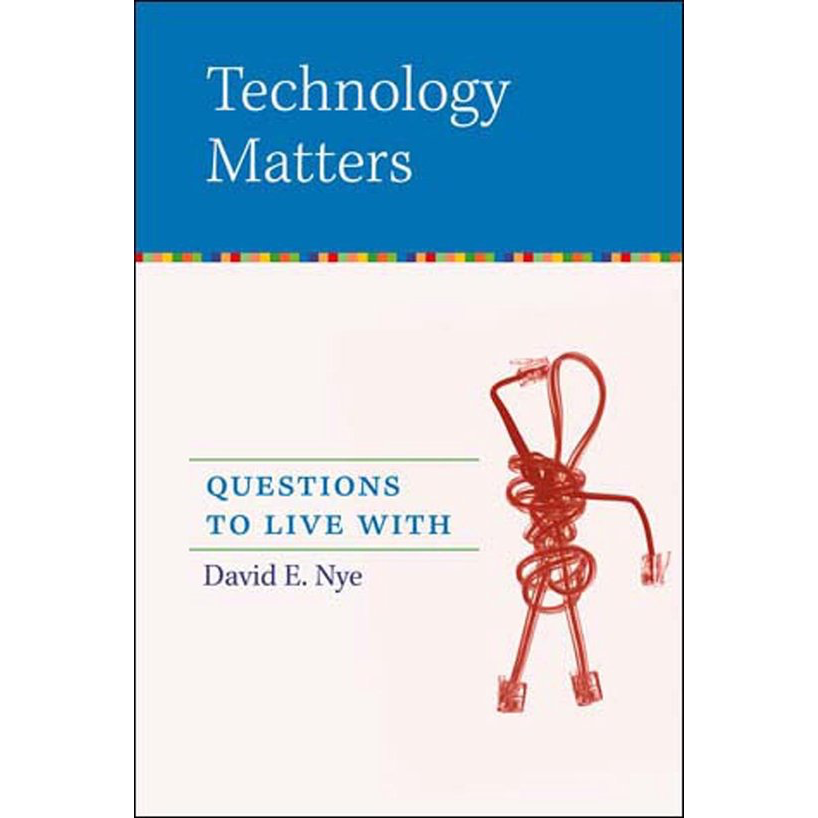
“Are modern men and women so thoroughly adapted to their technological society that they cannot step back from it? Is our acculturation irreversible and inescapable? Many flee the sensory overload of urban life. Some hike into wilderness areas, escaping from all forms of technological communication and immersing themselves in unspoiled surroundings. Some have even attempted to escape from the present by living in and using the artifacts of a physical space reconstructed or preserved from another moment in history. By living in a Stone Age village or a Victorian house, they separate themselves from the world of perceptions they were born into and challenge unexamined assumptions about the ‘natural’ textures, tastes, sounds, and appearances of daily life.
“By the early years of the twentieth century, city dwellers realized that a fundamental rupture had separated them from nature, putting in its place an artificial environment of skyscrapers and of subways that ran day and night on electricity. In 1909, E. M. Forster imagined the ultimate result of substitutions for direct experience in ‘The Machine Stops.’ In this short story, all people live in identical single rooms under the ground. These rooms cater to every desire. At the touch of a button, water, synthetic food, music, or communication is effortlessly and instantaneously available. In this world, the exchange of ideas is far more important than direct experience, and its denizens live alone. They dislike seeing one another in person, and they avoid physical intimacy. Instead, they continually exchange messages over the wires or speak to one another on screens. The sounds and the images are slightly imperfect, but that has long since ceased to bother anyone. ‘The Machine,’ a vast interlinked system powered by electricity, regulates all exchanges of information and filters direct experience. It also restricts direct contact with the surface, where few have ever been and where almost no one desires to go. Indeed, few people want to travel, since everywhere is like anywhere else. Not only is all experience mediated through the machine; the world inside it has become completely naturalized. The inhabitants of this future society disparage immediate experience or physical sensations; they prefer replications of events and refinements of ideas. They value secondhand knowledge more highly than firsthand, and the credibility of an idea increases the more it is refined through reinterpretations. Over several generations, lacking interest in the physical world, the citizens gradually have forgotten how their vast infrastructure works. When it begins to break down, they are unable to make repairs, and they begin to perish en masse. Only a hitherto unsuspected remnant of humanity survives. They have maintained a far less technological existence on the surface. . . .
“‘The Machine Stops’ may now seem a fable about a world in which all people have become isolated nerds addicted to the Internet, but its fundamental theme was not new even in 1909. In the nineteenth century, Thomas Carlyle and others worried that machines would rob people of an organic relationship with nature. But concern intensified in the twentieth century. What are the psychological effects of living within a technological society that wraps humanity in a cocoon of machines and conveniences? In Max Frisch’s 1957 novel Homo Faber, a diary entry by the engineer narrator records a conversation with his ex-wife: ‘Discussion with Hanna — about technology (according to Hanna) as the knack of so arranging the world that we don’t have to experience it. The technologist’s mania for putting the Creation to a use, because he can’t tolerate it as a partner, can’t do anything with it; technology as the knack of eliminating the world as resistance, for example, of diluting it by speed, so that we don’t have to experience it. (I don’t know what Hanna means by this.) The technologist’s worldlessness.’ The passage communicates both Hanna’s critique and her former husband’s failure to understand her. She is an expert on ancient Greek society, and the contrast between classical and modern civilization informs her observations. He has worked in Latin America and Mexico, installing electric power stations, which help to ‘eliminate the world as resistance.’ Electric light eliminates the night, air conditioning eliminates climate, and electric devices replace physical labor (such as pumping water or grinding wheat into flour). As Hanna complains, the result of these and many other technologies is that no one directly experiences the world.
“Like Hanna, philosophers have tended to emphasize not particular machines but rather whole systems that foster technocratic sensibilities. Martin Heidegger argued that in the modern world technology provides a pre-theoretical ‘horizoning of experience.’ As technological rationality becomes dominant, people begin to perceive all of nature as a ‘standing reserve’ of raw materials awaiting use. The transformation of this standing reserve for our comforts becomes ‘natural.’ A child born since 1950 finds it ‘natural’ to use electric lights, to watch television, to ride in an automobile, and to use satellite-based communications. That child’s grandparents regarded such things as remarkable innovations that had disrupted the ‘normal.’ In contrast, the child unquestioningly accepts these technical mediations of experience as the pre-theoretical ‘horizon’ of perception.
“Some recent philosophers of technology argue that ‘as devices replaced practices, disenchantment set in.’ As the technological domain encroaches on or mediates all experience, it overtakes and delegitimizes both traditional society and older perceptions of the world. In place of the familiar cycles of everyday life in a more direct relationship with nature, ‘technological character is concentrated in its liberating powers to be anything, that is, to be new, to never repeat itself.’ But this is only an apparent liberation that comes at a cost. The penetration of technology into all aspects of being means that ‘our new character is grounded in human-technology symbiosis,’ and that ‘prior to reflection, technology transforms character.’ The transformation imposes itself on each child, redefining every generation’s social construction of ‘normal experience.’”
— from David E. Nye, Technology Matters: Questions to Live With (MIT Press, 2006)
Related reading and listening
- The destructive perils of speech without a real partner — Josef Pieper and Marc Barnes on how chatbots pervert the nature of conversation
- Machines and misanthropy — Nicholas Carr on how technology has transformed our understanding of progress (and people)
- Alienation and autoamputation: the price of power — Nicholas Carr on the numbing effect of technology
- Disengagement from the world — Nicholas Carr encourages us to consider how automation technologies impact our ability to engage with the world and whether — like a good tool — they present a more inviting world or close us off from that world. (30 minutes)
- Life more abundantly — Jeanne Schindler advocates for a return to an understanding and prioritizing of sensory experience — real engagement with the real world — as foundational to learning and living. (35 minutes)
- Technophiliac obsessions — FROM VOL. 141 Literary and media scholar Grant Wythoff talks about the “father of science fiction,” Hugo Gernsback. (26 minutes)
- Utopian dreams and cynicism — John Durham Peters discusses the history of the idea of communication, saying that our hopes are too high when we believe that the solution to social discord is just better communication. (49 minutes)
- What adolescence misses — FROM VOL. 94 Mark Bauerlein talks about the ways of learning and living practiced by contemporary youth, how they impact the acquisition and use of knowledge and form intellectual habits, and what this means for the future of our society. (16 minutes)
- Helping boys become virtuous men — Teacher and chaplain Mark Perkins describes forms of formation that take the body seriously 50 minutes
- The temptations of talismanic technologies — Jeffrey Bilbro on the persistence of techno-utopianism
- Living in a tool-i-fied world — Joseph Minich on how the ubiquity of technology makes atheism entirely plausible
- In the Image of Our Devices — Nicholas Carr considers how automation technologies impact our ability to engage with the world. (66 minutes)
- The recovery of an integrated ecology — In this essay, Michael Hanby unpacks the summons of Laudato si’ to an ecological way of life based on a proper understanding of creation in its fullness and integrity. (57 minutes)
- The downward spiral of all technocracies — Andrew Willard Jones explains the two paths that exist with the development of new technologies: one which leads to an expansion of the humane world and one which exploits and truncates both Creation and humanity. (65 minutes)
- How social media truncates relationships — In this lecture, Felicia Wu Song explains how social media industrializes and monetizes our relationships, forming us in modes of relationships and identity that are detrimental to ourselves and to society. (41 minutes)
- In technology, we live and move and have our knowing — George Parkin Grant on technology’s establishment of a framework for thinking about technology
- On the Degeneration of Attentiveness — Critic Nicholas Carr talks about how technology-driven trends affect our cultural and personal lives. (56 minutes)
- Gratitude, vitalism, and the timid rationalist — In this lecture, Matthew Crawford draws a distinction between an orientation toward receiving life as gift and a timid and cramped rationalism that views man as an object to be synthetically remade. (52 minutes)
- Humans as biological hardware — In this essay, Brad Littlejohn and Clare Morell decry how modern technology tends to hack the human person in pursuit of profit. (55 minutes)
- “The system will be first” — FROM VOL. 27 Robert Kanigel describes the transformation of work due to Frederick Winslow Taylor’s concept of scientific management. (11 minutes)
- Choices about the uses of technology — This Feature presents interviews with David Nye and Brian Brock related to how we evaluate adoption of new technology and how technology influences our thinking. (31 minutes)
- What it means to be a person — FROM VOL. 147 Sociologist Craig Gay argues that in order to address the challenges of a technological approach to the world, we need to recover the Christian tradition’s robust theology of personhood. (24 minutes)
- The problem with dynamism without direction — Paulina Borsook on the biological paradigm of technolibertarianism’s love of spontaneous dynamism, whatever the costs
- The libertarian spawning-ground of tech bros — Paulina Borsook on high tech’s long-standing animosity toward government and regulation
- Tech bros and public power — Paulina Borsook discusses the “bizarrely narcissistic” and ultra-libertarian culture of Silicon Valley. (22 minutes)
- Voluntarily silencing ourselves — FROM VOL. 39 John L. Locke discusses the value of personal communication and how technology is displacing it. (12 minutes)
- Souls in cyberspace — FROM VOL. 25 Douglas Groothuis examines the worldview and mythology behind the creation and marketing of the Internet. (13 minutes)
- Life in a frictionless, synthetic world — FROM VOL. 17 Mark Slouka explores the worldview of techno-visionaries who aim to create a new era of human evolution. (11 minutes)
- The digital revolution and community — FROM VOL. 7 Ken Myers talks with Jane Metcalfe, the founder of WIRED Magazine, about technology and community. (8 minutes)
- Metaphysical impulses beneath techno-utopianism — FROM VOL. 38 Erik Davis describes his research on how humans’ fascination with technology is permeated with “mythic energy” and gnostic aspirations. (11 minutes)
- Post-Christian America and the “unlimited technological future” — George Parkin Grant on technology and the Puritan legacy of “unflinching wills”
- Education that counters alienation — In this lecture, Jeanne Schindler explores how digital technologies warp not only education but our experience of being human. (30 minutes)
- What is lost with labor-saving devices — Romano Guardini on what is lost when cultural pursuits eclipse natural order
- Paradoxical attitudes toward plastic — Jeffrey Meikle traces the technological, economic, and cultural development of plastic and relates it to the American value of authenticity. (15 minutes)
- Technology and the kingdom of God — FROM VOL. 63 Albert Borgmann (1937–2023) believes Christians have an obligation to discuss and discern the kind of world that technology creates and encourages. (12 minutes)
- The gift of meaningful work — In this lecture, D. C. Schindler argues that genuine work is inherently meaningful and facilitates an encounter with reality and therefore, ultimately, with God. (36 minutes)
- Diverting language from its richest possibilities — FROM VOL. 75 Steve Talbott discusses the rich capacities of language and how technology diminishes them. (18 minutes)
- The recovery of true authority for societal flourishing — Michael Hanby addresses a confusion at the heart of our current cultural crisis: a conflation of the concepts of authority and power. (52 minutes)
- Automation and human agency — FROM VOL. 150 Philosopher and mechanic Matthew Crawford laments the losses of human skill that correspond with gains in mechanical automation. (21 minutes)
- A fearful darkness in mind, heart, and spirit — Roberta Bayer draws on the work of George Parkin Grant (1918–1988) to argue that our “culture of death” must be countered with an understanding of reality based in love, redemptive suffering, and a recognition of limitations to individual control. (33 minutes)
- Questioning “conservatives” — John Lukacs asserts that believers in unending technological ‘progress’ can’t really be conservatives.
- Seeking control, in white magic and The Green Book — Alan Jacobs on C. S. Lewis’s critique of the modern pursuit of god-like control
- Life, liberty, and the defense of dignity — In a 2003 interview, Leon Kass discussed his book Life, Liberty, and the Defense of Dignity: The Challenge for Bioethics. The unifying theme in the book’s essays is the threat of dehumanization in one form or another. (36 minutes)
- The surrender of culture to technology — FROM VOL. 6Neal Postman discuses the ways in which how we think about the world has been influenced by communications technology, even in its earliest forms. (11 minutes)
- A.I., power, control, & knowledge — Ken Myers shares some paragraphs from Langdon Winner‘s seminal book, Autonomous Technology: Technics-out-of-Control as a Theme in Political Thought (1977) and from Roger Shattuck‘s Forbidden Knowledge: From Prometheus to Pornography (1996). An interview with Shattuck is also presented. (31 minutes)
- Technology and social imaginaries — In this interview from 1999, cultural historian David Nye insists that societies have choices about how they use technologies, but that once choices are made and established, a definite momentum is established. (19 minutes)
- Living into focus — As our lives are increasingly shaped by technologically defined ways of living, Arthur Boers discusses how we might choose focal practices that counter distraction and isolation. (32 minutes)
- Albert Borgmann, R.I.P. — Albert Borgmann argues that, despite its promise to the contrary, technology fails to provide meaning, significance, and coherence to our lives. (47 minutes)
- Embedded values and dreams — Felicia Wu Song on why our technologies are not neutral tools
- Mars Hill Audio Journal, Volume 154 — FEATURED GUESTS:
Felicia Wu Song, Michael Ward, Norman Wirzba, Carl Trueman, D. C. Schindler, and Kerry McCarthy