“Almost thirty years ago Professor Phelps Brown, in his presidential address to the Royal Economic Society, talked about ‘The Underdevelopment of Economics.’ He complained about ‘the smallness of the contribution’ made by the most conspicuous developments of economics to the solution of pressing problems such as inflation, environmental protection, overseas development, urbanization, and the quality of life.
“Schumacher believed that the preoccupation of economists with logical, mathematical and econometric subtleties had led to the almost total neglect of crucial determining factors. If economics was to play any meaningful part in solving the most pressing problems facing humanity and the planet it would have to look beyond the purely economic to the wider questions of life which give economics its purpose, In other words, to become truly relevant, economics must look beyond itself: the ‘how’ of economics needs to be reconciled with the ‘why’ of human existence. Economics needs to become meta-economics. Nowhere has this bedrock reality been discussed more lucidly and potently than in Schumacher’s Small Is Beautiful. . . .
“Schumacher divided meta-economics into three distinct areas. In the first place, economics needs a metaphysical critique of itself, an examination of its intrinsic purpose. Secondly, there is a need on the part of economics to recognize that the physical factors of life are essentially qualitative as well as quantitative. Finally, economics needs to study man in his wholeness and not consider him only as ‘economic man,’ since homo economicus is an abstraction devoid of essential humanity.
“The fundamental error of modern economics is its mechanistic approach. It has evolved ever more intransigently in a merely quantitative direction, erecting econometric models based on mathematical theory which assume that the actions of people are essentially the same as the behavior of atoms. Yet are the ‘facts’ of economics in their essential nature the same as the facts of mathematics or physics? Are human beings, the dramatis personae of economics, similar to atoms in their essential nature? If so, does this not strip humanity of its freedom, its responsibility, its creativeness, its purpose, its meaning? In essence, does it not strip humanity of its humanity? For Schumacher, such questions were at the heart of meta-economics: ‘If economists continue to refuse to face such fundamental metaphysical — or, if you prefer the term, philosophical — questions, I cannot see that they can have any idea of what they are really teaching and what is the relationship of their teaching to truth.’
“Failure to address metaphysical questions has led to many of the central errors of conventional economics. The preoccupation with the physical as opposed to the metaphysical, the quantitative as opposed to the qualitative, has many practical ramifications. For example, the economic obsession with the quantitative has led to price eclipsing value, since price is quantitative whereas value is qualitative. Price is measurable mechanically whereas value can only be evaluated by making value judgments based on philosophical concepts. Since conventional economics shuns these meta-economic concepts, it speaks of ‘value’ only in terms of the market — and ‘market value’ is merely another way of saying ‘price.’ Therefore, intrinsic value does not exist for conventional economics.
“The consequences of this lack of distinction between price and value are far-reaching. As discussed in previous chapters, it has led to a failure to differentiate between primary and secondary goods, or between renewable and nonrenewable goods. It has led to the purely quantitative pricing of the economy in terms of gross national product, ‘which adds everything together, whether it is good or bad, healthy or unhealthy, life-sustaining or life-destroying.’
“Similarly, it has fuelled the idea of the ‘free market.’ Since the market is measured only in terms of price it is assumed that the consumer makes only price-induced judgments. In theory at least, the ideal consumer is a bargain-hunter who is concerned with nothing but price. Consumers do not care whether the goods they are buying are home produced or imported, renewable or non-renewable, organic or chemical, natural or genetically modified, cruelly or humanely produced. Consumers who make any of these value judgments prior to making a purchase are not behaving according to the econometric price mechanism that governs economic theory. They are not behaving as homo economicus should. They have stepped out of line by bringing into the equation value as opposed to price, quality as opposed to quantity, and metaphysics as opposed to physics. They are behaving not as predictable atoms, but as free-willed human beings. By making choices according to supraeconomic standards, people confound the expectations of economic forecasts.
“Clearly, economics needs to be alive to its disciplinary limitations, resisting the academic specialization that isolates it from its traditional roots in ethics and a metaphysical conception of man. It needs to acknowledge the eternally radical statement that ‘Man shall not live by bread alone. . . .’ and to recognize that life is not just a science but an art. In short, if economics is to have any useful or meaningful role, it needs to have a meta-economic ‘soul.’”
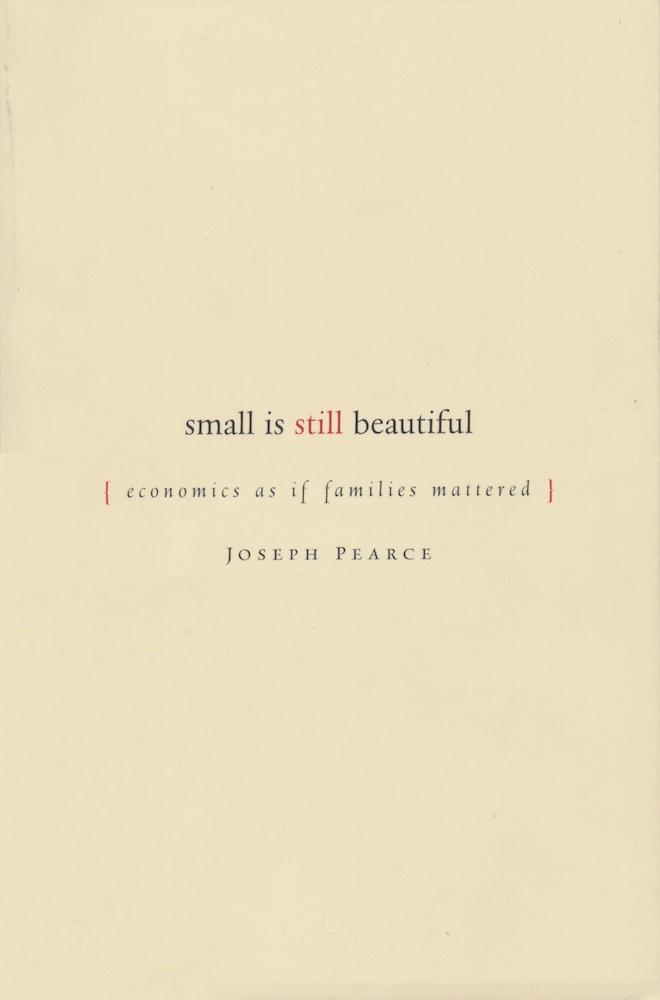
— from Joseph Pearce, Small Is Still Beautiful: Economics As If Families Mattered (ISI Books, 2006)
Related reading and listening
- Volume 106 excerpts — Hear excerpts of interviews with Adam Briggle, John C. Médaille, Christopher Page, Christian Smith, Herman Daly, and Thomas Hibbs (33 minutes)
- Economics rightly understood — Herman E. Daly on how modern economics has little to do with oikonomia
- Economics is about right relationships — John C. Médaille. on the situatedness of economics in human life
- Volume 102 excerpts — Hear excerpts from interviews with Daniel M. Bell Jr., Lew Daly, Adam K. Webb, Stratford Caldecott, James Matthew Wilson, and Thomas Hibbs. (30 minutes)
- The reclaiming of authentic liberalism — John Médaille examines the Christian roots of liberalism and how liberalism might be recovered from the heresy of secularism. (51 minutes)
- Ethics hidden in economics — FROM VOL. 134 William Cavanaugh explains why Christians should think about economics theologically, not just as a science or an ethical discipline. (25 minutes)
- Money, status, and satisfaction — FROM VOL. 44 David Myers and Robert Frank discuss the tenuous relationship between wealth and happiness. (22 minutes)
- Economics and personhood — FROM VOL. 147 Mary Hirschfeld argues that modern economics makes some fundamental assumptions about personhood, material goods, and God that prevent the development of a truly human understanding of economic life. (20 minutes)
- Cultures of chance, cultures of control — Historian Jackson Lears explains how gambling springs from a longing for an experience of “unbidden beneficence,” a repudiation of the idea of control that marks modernity. (49 minutes)
- Milton Friedman meets Augustine — We present an interview from our archives with theologian William Cavanaugh, in which he examines the free market, consumerism, globalization, and scarcity, all parsed within an unabashedly theological framework. (37 minutes)
- Distributist & sustainable economics — Two interview from 2010: John C. Médaille summarizes how distributist economics differs from both capitalism and socialism. Then Herman Daly discusses the danger of economic theory abstracted from the actual stuff of Creation. (44 minutes)
- The idolatry of giantism — E. F. Schumacher on why scale matters
- The obligation of prodigality — Daniel Bell on the hedonistic logic of the “new capitalism”
- Post-liberalism of an earlier generation — Allan C. Carlson discusses an anthology of articles from Free America, a magazine published between 1937 and 1947 whose writers believed that political democracy could only survive if coupled with decentralized economic democracy. (26 minutes)
- Mars Hill Audio Journal, Volume 147 — FEATURED GUESTS:
R. Jared Staudt, Jason Peters, D. C. Schindler, Craig Gay, Mary Hirschfeld, and Patrick Samway
- Loving your neighbor during a pandemic — Brad Littlejohn reflects on how best to ask and answer some of the questions raised by our current disease-ravaged circumstances, particularly questions related to Christian freedom and love of neighbor. (29 minutes)
- The nature of freedom reconsidered — In anticipation of this Fall’s Areopagus Lecture entitled “‘For Freedom Set Free’: Retrieving Genuine Religious Liberty,” we present selections from interviews with three MARS HILL AUDIO guests who have raised questions about the modern understanding of freedom. (27 minutes)
- Man, myth, and Middle-earth — Tom Shippey and Joseph Pearce discuss the “author of the century,” J. R. R. Tolkien, and assert the power of myth to convey deep truth. (26 minutes)
- Further up and further in: understanding Narnia — Joseph Pearce explains how fairy stories can open our eyes to the depths of reality if we read them with the virtue of humility. (15 minutes)
- Mars Hill Audio Journal, Volume 134 — FEATURED GUESTS:
Chris Armstrong, Grevel Lindop, Michael Martin, William T. Cavanaugh, Philip Turner, and Gisela Kreglinger
- Doing business: selfishly or generously? — David L. Schindler on Adam Smith’s big mistake
- Mars Hill Audio Journal, Volume 115 — FEATURED GUESTS: Arlie Russell Hochschild, Andrew Davison, Adrian Pabst, Gary Colledge, Linda Lewis, and Thomas Bergler
- Mars Hill Audio Journal, Volume 106 — FEATURED GUESTS: Adam Briggle, John C. Médaille, Christopher Page, Christian Smith, Herman Daly, and Thomas Hibbs
- Mars Hill Audio Journal, Volume 102 — FEATURED GUESTS: Daniel M. Bell, Jr., Lew Daly, Adam K. Webb, Stratford Caldecott, James Matthew Wilson, and Thomas Hibbs
- Mars Hill Audio Journal, Volume 100 — FEATURED GUESTS: Jennifer Burns, Christian Smith, Dallas Willard, Peter Kreeft, P. D. James, James Davison Hunter, Paul McHugh, Ted Prescott, Ed Knippers, Martha Bayles, Dominic Aquila, Gilbert Meilaender, Neil Postman, and Alan Jacobs
- Before and after economics — Mark Mitchell: “The ideology of economics is a way of seeing the world. It forces reality into a preconceived structure and subsequently deigns to rule this truncated world with all the authority of science.”
- Mars Hill Audio Journal, Volume 95 — FEATURED GUESTS: Stewart Davenport, William T. Cavanaugh, J. Matthew Bonzo, Michael R. Stevens, Craig Gay, Eugene Peterson, and Barry Hankins
- A devilish temptation — Wendell Berry explains how the modern Western ideal of the sovereign self enshrines a story of the abandonment of restrictions and restraints in the name of human freedom.
- Mars Hill Audio Journal, Volume 71 — FEATURED GUESTS: Peter Augustine Lawler, David Koyzis, Roger Lundin, Craig Gay, Steven Rhoads, and R. Larry Todd
- Re-imagining economic obedience: lessons from Wendell Berry — The order of Creation, says Wendell Berry, is closer to that of a drama than that of a market. That quality should inform how we imagine economic life to be well-ordered.
- Mars Hill Audio Journal, Volume 53 — FEATURED GUESTS: Lawrence Adams, Dana Gioia, Elmer M. Colyer, R. A. Herrera, Margaret Visser, and Joseph Pearce
- Maker of Middle-earth — Tom Shippey, Joseph Pearce, and Ralph Wood examine J. R. R. Tolkien and his mythological Lord of the Rings trilogy to explore what makes Tolkien’s work resonant and a vessel for truth. (86 minutes)
Click on the tags below for listings of related readings or audio features.