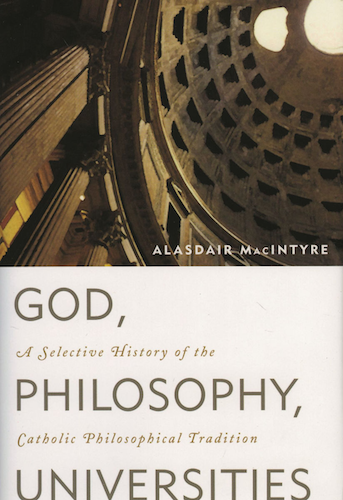
Alasdair MacIntyre of Notre Dame joins the chorus of observers who decry the fragmentation and bankruptcy of the modern university education system, in “The End of Education: The Fragmentation of the American University” in Commonweal; and asks if Catholic universities should do better. According to MacIntyre, the specialization and compartmentalization of faculties and academic disciplines, accompanied by the resulting marketplace mechanism of “individual student choice” as the form of curriculum structure, yields an incompletely, inadequately and superficially educated public — whether graduates from secular or Catholic universities. This “should matter to anyone who thinks it important what conceptions of human nature and the human condition students have arrived at by the time they enter the adult workplace — and therefore to any Catholic. For each of the academic disciplines teaches us something significant about some aspect of human nature and the human condition,” and should interact and integrate. MacIntyre then proposes a solution in the time-honored manner of indicating there “are questions that need to be answered if we are to understand who we are here and now.” From three sets of great questions — who are we materially? who are we historically and culturally? and, who are we to other cultures? — MacIntyre indicates that a “tripartite curriculum emerges” which emphasizes scientific, historical and linguistic studies.
Yet these distinct strands must interact and integrate, not stray into specialized cubbyholes. To avoid such superficiality, MacIntyre notes Cardinal Newman’s view that “it is theology that is the integrative and unifying discipline needed by any university, secular, Protestant, or Catholic. And it is in the light afforded by the Catholic faith and more especially by Catholic doctrines concerning human nature and the human condition” that “[t]heology can become an education in how to ask such questions” as are at the foundation of liberal education. The resources exist, only the will to reform is lacking. MacIntyre ends by addressing the expected question of economic and technological demand for professional specialization as a goal for education, by suggesting a 4-year program, the first 3 of which engages in a rigorous, liberal, tripartite, question-asking curriculum, with the fourth year reserved for a professional apprenticeship in preparation for the workplace. “We do not have to sacrifice training in research in order to provide our students with a liberal education, just as we do not have to fragment and deform so much of our students’ education, as we do now.”
George Marsden explores the culture of suspicion in academia toward Christian scholarship and argues for its inclusion as intellectually viable and coherent with regard to reality. (11 minutes)
A living tradition — In this lecture, James Matthew Wilson explores the nature of tradition as a “condition of possibility” that situates both reason and poetry. (49 minutes)
Moral reasoning and human flourishing — Tim McIntosh describes moral philosopher Alasdair MacIntyre’s intellectual conversion to a synthesis of Aristotelian ethics and Christianity, best embodied in Thomism. (44 minutes)
Life more abundantly — Jeanne Schindler advocates for a return to an understanding and prioritizing of sensory experience — real engagement with the real world — as foundational to learning and living. (35 minutes)
Alert to the magic in the world — Junius Johnson discusses the importance of teaching stories, particularly fairy stories, in classical education. (25 minutes)
University or “utiliversity”? — In this essay, Reinhard Hütter examines in depth John Henry Newman’s The Idea of a University and argues that its insights and prescriptions are urgently relevant to the current status of higher education. (87 minutes)
The “scandal” of theology in the university — Edward T. Oakes, S.J. explains why John Henry Newman’s eloquent defense of the nature of university education, The Idea of a University, continues to inspire, challenge, and even frustrate its sympathizers. (24 minutes)
Setting the liberal arts free — In addressing the state of liberal arts education in the U.S., Gilbert Meilaender raises some core questions and makes some surprising proposals. (28 minutes)
Tim Clydesdale discusses the experience of freshmen year at college, suggesting that by that time students have been effectively inoculated against a love of knowledge. (21 minutes)
Helping boys become virtuous men — Teacher and chaplain Mark Perkins describes forms of formation that take the body seriously 50 minutes
Drawing from Wendell Berry’s works, Jack Baker and Jeffrey Bilbro discuss a vision of higher education that respects a multidimensional notion of place. (23 minutes)
Perry L. Glanzer and Nathan F. Alleman discuss the fragmentation of modern higher education and why we need theology to unify universities. 26 minutes)
A life well lived — In this essay, Stanley Hauerwas explains the breadth and depth of Alasdair MacIntyre’s thought, the goal of which was to help people to act intelligibly and live morally worthy lives. (40 minutes)
Historian John Fea discusses how American and Protestant individualism continues to influence our orientation toward the past. (22 minutes)
Education that counters alienation — In this lecture, Jeanne Schindler explores how digital technologies warp not only education but our experience of being human. (30 minutes)
Education vs. conditioning — Education necessarily involves metaphysical and theological preconditions, and Michael Hanby argues that our current education crisis is a result of society rejecting these preconditions. (41 minutes)
Knowing by heart — D. C. Schindler reflects on Plato’s idea of “conversion” in education, assuming the symbol of the heart as the center of man. (39 minutes)
Education as a pilgrimage and a mystery — In this lecture, James Matthew Wilson gives a compelling argument for understanding the role of a literary or poetic education as an immersion of the whole being in truth and beauty. (43 minutes)
Submission to mathematical truth — In this lecture, Carlo Lancellotti argues that integration of the moral, cognitive, and aesthetic aspects of mathematics is needed in a robust liberal arts mathematics curriculum. (25 minutes)
Marion Montgomery (1934–2002) offers a deep critique of the relationship of the academy to its community in an effort to diagnose how higher education has lost its way. (13 minutes)
James K. A. Smith explains how education always involves the formation of affections and how the form of Christian education should imitate patterns of formation evident in historic Christian liturgy. (15 minutes)
Michael L. Peterson discusses how Christianity could inform society’s understandings of education and human nature. (8 minutes)
Education for human flourishing — Co-authors Paul Spears and Steven Loomis argue that Christians should foster education that does justice to humans in our fullness of being. (23 minutes)
Professor C. John Sommerville describes the increasingly marginal influence of universities in our society, and why they seem to be of no substantive relevance to people outside the school. (13 minutes)
In tracing Christianity’s relationship to the academy, Arthur F. Holmes points to Augustine as one of the first to embrace higher learning, believing God’s ordered creation to be open to study by the rational mind of man. (9 minutes)
In praise of a hierarchy of taste — In a lecture at a CiRCE Institute conference, Ken Myers presented a rebuttal to the notion that encouraging the aesthetic appreciation of “higher things” is elitist and undemocratic. (58 minutes)
Historian Christopher Shannon discusses how American academic historical writing presents a grand narrative of progressivism, which it defends by subscribing to an orthodoxy of objective Reason. (21 minutes)
On wonder, wisdom, worship, and work — Classical educator Ravi Jain dives deeply into the nature, purpose, and interconnectedness of the liberal, common, and fine arts. (43 minutes)
Orienting reason and passions — In an essay titled “The Abolition of Mania” (Modern Age, Spring 2022), Michael Ward applies C. S. Lewis’s insights to the polarization that afflicts modern societies. (16 minutes)
The loss of hierarchy and humility in the academy — In interviews from 1999, literature professors Alvin Kernan and Marion Montgomery discuss how culture of the academy — its hyper-democratic posture and its loathing of limits — derails the pursuit of truth. (25 minutes)
Mars Hill Audio Journal, Volume 160 — FEATURED GUESTS:
Jessica Hooten Wilson, Kyle Hughes, Gil Bailie, D. C. Schindler, Paul Tyson, and Holly Ordway
An outrageous idea? — In the late 1990s, George M. Marsden and James Tunstead Burtchaell both wrote books examining the claim that it was far-fetched even to imagine that scholarly work could be an expression of Christian claims about reality. (25 minutes)
Teaching for wonderfulness — Stratford Caldecott on why education is about how we become more human, and therefore more free