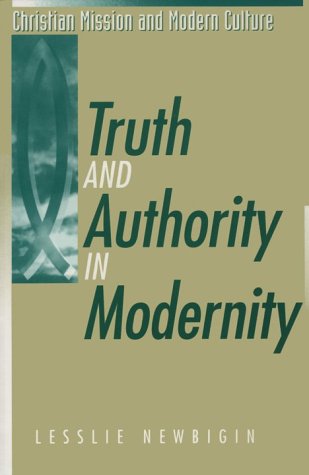
“If the reality that we seek to explore, and of which we are a part, is the work of a personal Creator, then authority resides in this one who is the Author. If, on the other hand, this reality is the result of processes within itself — if, for example, it is the outcome of a struggle for existence in which the strongest survives the rest then authority is simply one way of describing superior strength. Power and authority are one and the same. The Christian tradition maintains, of course, that the former is the case, that authority resides in the One who is the Author of all being. And because personal being can be known only insofar as the person chooses to reveal herself or himself, and cannot be known by the methods that are appropriate to the investigation of impersonal matters and processes, then authority, in this view, must rest on divine revelation. Modernity has declined to accept this authority. . . .
“For the purpose of this volume I am assuming that in speaking of ‘modernity’ we are speaking about the way of thinking that came to dominance in the intellectual leadership of Europe — though with roots running far back into the past — a way of thinking that rejected appeals to revelation and tradition as sources of authority except insofar as they could justify themselves before the bar of individual reason and conscience. Reliable, and therefore authoritative, knowledge of truth is not, in the view of modernity, to be found in faith in alleged revelation, but by observation of the facts and rigorously critical reflection on them. Typical of modernity is John Locke’s definition of faith: ‘a persuasion of our own minds short of knowledge’ (cited by Polanyi [Personal Knowledge] 1958, 266). This may be contrasted with the famous slogan of Augustine: credo ut intelligam; I believe in order that I may know. Here faith is understood not as an alternative to knowledge but as the pathway to knowledge. We do not come to know anything except by believing something. We have to begin by believing the evidence of our senses, the veracity of our teachers, and the validity of the tradition into which we are seeking apprenticeship. All of these things may have to be questioned at some stage. But we can question them only on the basis of things that we have come to know as the result of this kind of apprenticeship. We do not begin to acquire any kind of knowledge by laying down in advance the conditions upon which we will accept any evidence. We have to begin with an openness to a reality greater than ourselves in relation to which we are not judges but pupils. . . .
“What are we to make of this demand for a proof of the existence of God that assumes that there are grounds more trustworthy than those given in God’s own self-revelation? If God really exists, is there not something ridiculous about one of God’s creatures taking a stance that, in effect, says to God: ‘I can demonstrate your existence without relying on what you tell me about yourself.’ . . .
“It is now clear that Descartes’ method, which has dominated subsequent European thought, has in it the seeds of its own destruction. The corollary of that method was the famous ‘critical principle.’ Reliable knowledge is that which can be achieved by starting from indubitable certainties and building on them arguments that have the clarity and indubitability of mathematics. Reliable knowledge, for which the word science is henceforth used, has mathematics as its working language. What falls outside the scope of this certain knowledge is to be doubted.”
— from Lesslie Newbigin, Truth and Authority in Modernity (Trinity Press, 1996)
Related reading and listening
- Christian culture and the myth of the secular — Ken Myers draws on T. S. Eliot to argue that Western civilization has broken down, not into a multiplicity of cultures, but into a “post-culture.” (47 minutes)
- Modernity’s crisis of place — Craig Bartholomew reflects on the importance of place to our humanity. (58 minutes)
- The epistemology of love — In this lecture, N. T. Wright examines the epistemology of love and how it counters the reductionism of Enlightenment and Epicurean ways of knowing. (63 minutes)
- The cost of “killing” God — In this October 2023 lecture, Carl Trueman explores the concept of “desecration” as a frame for understanding the nature of modernity in our time. (42 minutes)
- Silence at the end of history — Alan Jacobs examines several literary imaginings of “the last days” and argues that such narration is profoundly inadequate and perhaps even presumptuous. (51 minutes)
- Cultural superiority and Medieval romance literature — FROM VOL. 164 Tiffany Schubert argues that Jane Austen’s novels subtly incorporate some medieval literary conventions in ways that enable modern readers to experience a sense of wonder, romance, and the benevolence of Providence. (30 minutes)
- A flood of images — Oliver O’Donovan describes the distinctive character of publicity in modernity, which drowns us in a flood of ever-changing representations that do not serve the common good. (37 minutes)
- Publicity and representative images in society — Oliver O’Donovan describes the nature of publicity as the force that mediates our communication with one another, creating common interests and then rapidly subsuming them into newer ones.(Lecture 3 of 3; 57 minutes)
- Beyond a reasonable doubt — From a 1980 interview with Ken Myers, Mortimer J. Adler discusses his argument that belief in the existence of God is rational. (14 minutes)
- Mordor versus the Shire — In this lecture, Heidi White explains how the modern project is a diabolical inversion of Christendom and calls for Christians to build lives and a culture that can counter it. (53 minutes)
- Christian belief as real knowledge — Dallas Willard on the modern divorce between faith and knowledge
- How the Church promotes the cause of freedom — Oliver O’Donovan: “We discover we are free when we are commanded by that authority which commands us according to the law of our being, disclosing the secrets of the heart.”
- Power to the people — Nathan O. Hatch on the DIY spirit of early American Christianity
- “Only a real world can save us” — Oliver O’Donovan explores how the “religion” of modernity lacks a coherent world in which one may participate with full human agency and moral purpose. (Lecture 3 of 3; 61 minutes)
- Antagonism or fruitfulness? — FROM VOL. 108 Jean Porter describes how natural law justifies legal and moral authority within the life of the human person. (17 minutes)
- Governments officially committed to ignorance — In this lecture, D. C. Schindler explains why authority, properly understood, is essential to genuinely human life. (39 minutes)
- A poet’s relationship to time — FROM VOL. 57 Poet Wilmer Mills (1969–2011) discusses how his agricultural and cross-cultural childhood in Brazil shaped his imagination and his relationship with modernity. (11 minutes)
- Dickinson and modern malaise — FROM VOL. 36 Roger Lundin explains how Emily Dickinson’s understanding of love, nature, religion, and mortality are modern in content. (11 minutes)
- Excluding cranks and dabblers — Drusilla Scott on Michael Polanyi’s insistence that the “community of science” required authority
- Steward of knowledge vs. autonomous knower — FROM VOL. 66 Esther Lightcap Meek challenges the modernist view of knowledge, which prefers the figure of the autonomous knower to the figure of a steward of knowledge acquired in part from others. (15 minutes)
- Wonder, being, skepticism, and reason — FROM VOL. 135 Matthew Levering talks about the long and rich tradition of reasoning about God. (23 minutes)
- Modernity and the shaping of America — FROM VOL. 48 Historian Jon Butler explains how aspects of modernity were already present and at work in colonial American life prior to 1776. (12 minutes)
- Submission to mathematical truth — In this lecture, Carlo Lancellotti argues that integration of the moral, cognitive, and aesthetic aspects of mathematics is needed in a robust liberal arts mathematics curriculum. (25 minutes)
- When philosophy loses its way — FROM VOL. 52 Ralph McInerny (1929–2010) speaks about themes from his 1999 Gifford Lectures, which relate how natural theology came to be regarded as pointless, resulting in a philosophical dead end.(24 minutes)
- The need for robust Christian intellectual life — In this lecture, Robert Benne surveys the contemporary landscape in which Christian scholars attempt to integrate their faith and their intellectual life. (43 minutes)
- Mars Hill Audio Journal, Volume 163 — FEATURED GUESTS: Andrew Youngblood, R. J. Snell, Nicholas Denysenko, Nigel Biggar, Robert McNamara, and David Cayley
- From shadows to the light of reality — FROM VOL. 153 Louis Markos argues that Plato needs to be recognized for his unique and serendipitous role in preparing the world for Christ. (24 minutes)
- The Decline of Formal Speech and Why It Matters — John McWhorter examines the reasons behind the decline in articulate speech and writing in the late 20th century, and the implications of this change across many areas of culture. (55 minutes)
- The recovery of true authority for societal flourishing — Michael Hanby addresses a confusion at the heart of our current cultural crisis: a conflation of the concepts of authority and power. (52 minutes)
- Science’s need for philosophy and revelation — D. Stephen Long explores a consistent theme in the work of theologian Hans Urs von Balthasar: the relationship between Christianity, modernity, and secularity. (46 minutes)
- Augusto Del Noce’s critique of modernity — FROM VOL. 128 Physicist and mathematician Carlo Lancellotti discusses the life and work of twentieth-century Italian philosopher, Augusto Del Noce. (25 minutes)
- Unmasking claims of “secular neutrality” — Lesslie Newbigin on the Church’s prophetic duty concerning public life
- The kingdom of God has public consequences — Lesslie Newbigin on the subversiveness of the Church’s message to the world
- Mars Hill Audio Journal, Volume 162 — FEATURED GUESTS: Mark Noll, R. Jared Staudt, Paul Weston, William C. Hackett, Hans Boersma, and David Paul Baird
- The integration of theoretical and mythic intelligence — FROM VOL. 156 William C. Hackett discusses the relationships between philosophy and theology, and of both to the meaning embedded in myth. (29 minutes)
- The Gospel as the foundation of dialogue — FROM VOL. 83 Professor Paul Weston discusses theologian Lesslie Newbigin’s time in India and how it influenced his thought and work. (17 minutes)
- A fearful darkness in mind, heart, and spirit — Roberta Bayer draws on the work of George Parkin Grant (1918–1988) to argue that our “culture of death” must be countered with an understanding of reality based in love, redemptive suffering, and a recognition of limitations to individual control. (33 minutes)
- St. Irenaeus against the Gnostics — In this reading of an essay by theologian Khaled Anatolios, St. Irenaeus is remembered for his synthesis of faith and reason. (52 minutes)
- When is civil disobedience necessary? — Douglas Farrow examines the relation between “the kings of the earth” and the law of Christ, particularly when governmental law is exercised without reference to natural or divine law. (49 minutes)
- Freedom as conformity to reality — W. Bradford Littlejohn summarizes the definitions of liberty offered by Richard Bauckham and Oliver O’Donovan
- Renewal of authentic political authority — Brad Littlejohn builds a case for the idea that authority makes free action possible, illustrating how that occurs within the forms of political and epistemic authority, properly understood and wisely practiced. (45 minutes)
- Cleansing sea breezes — Thomas C. Oden argues that rather than being conformed to contemporary ideological trends, we should be informed by 2000 years of the Church’s wisdom. And Darrell Amundsen corrects some false claims about the early Church’s views on suicide. (27 minutes)
- Divorcing the spirit of the age — Thomas C. Oden on overcoming the theological faddism of the late twentieth century
- Orienting reason and passions — In an essay titled “The Abolition of Mania” (Modern Age, Spring 2022), Michael Ward applies C. S. Lewis’s insights to the polarization that afflicts modern societies. (16 minutes)
- Lessons from Leviticus — The book of Leviticus may be assumed to be irrelevant for charting a way through the challenges of modernity. Theologian Peter J. Leithart disagrees. (22 minutes)
- The Symbol of Authority — In the second of two lectures given by D. C. Schindler, he explores the nature of authority with reference to the transcendental dance of Truth, Goodness, and Beauty. (60 minutes)
- The Authority of the Symbol — In this lecture presented at the CiRCE Institute national conference, D. C. Schindler presents a metaphysical description of what symbols are. (54 Minutes)
- Resituating discussion of “science” and “religion” — Peter Harrison argues that modern Western culture’s partitioning of ‘science’ and ‘religion’ into distinct spheres is a novel categorical conception in history. (58 minutes)
- Sources of wisdom (and of doubt) — Roger Lundin shares what he has appreciated about Mars Hill Audio conversations, and he discusses what makes Christian belief so implausible to non-believers. (32 minutes)
- Rehabilitating authority — Authority, argues David Koyzis, is an aspect of the image of God, exercised to fulfill human vocations. (30 minutes)