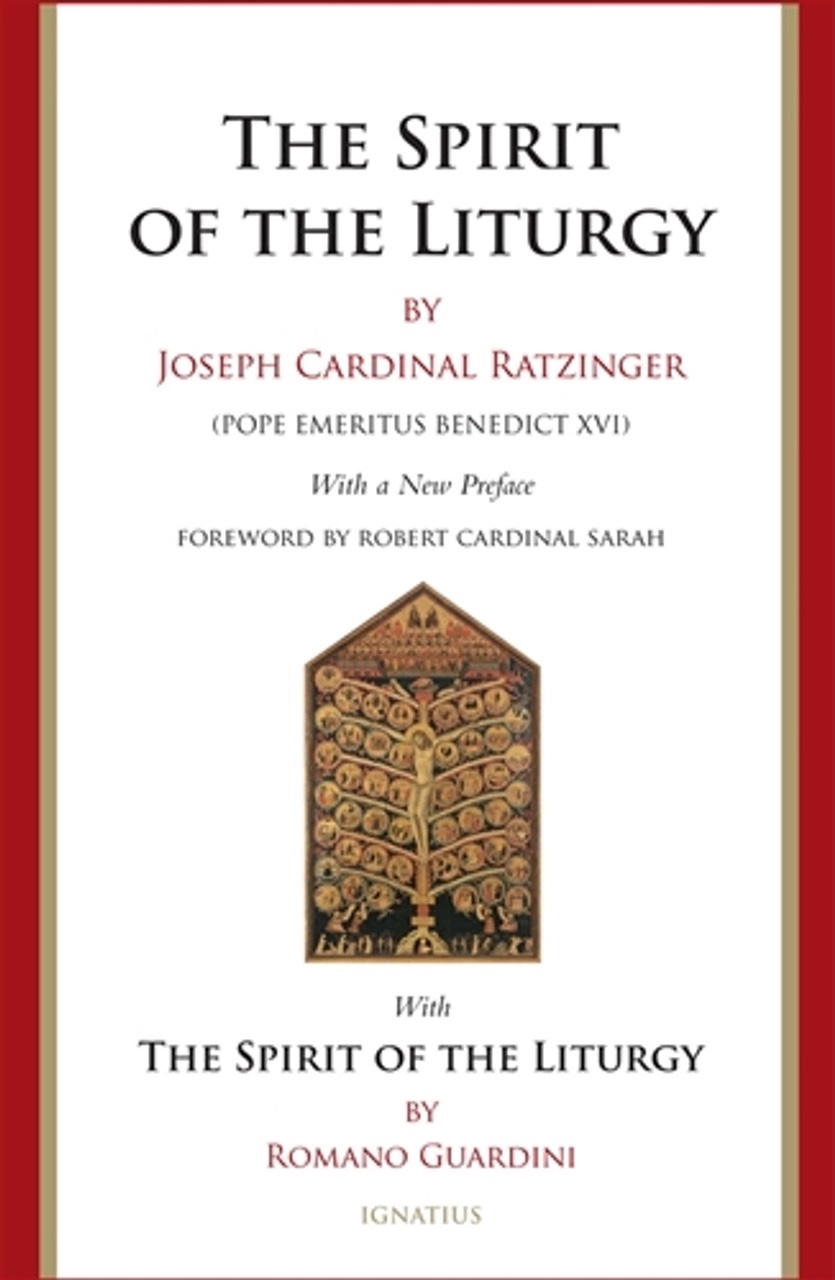
“‘The glory of God is the living man, but the life of man is the vision of God’, says St. Irenaeus (cf. Adv. Haer. 4, 20, 7). . . . Ultimately, it is the very life of man, man himself as living righteously, that is the true worship of God, but life only becomes real life when it receives its form from looking toward God. Cult exists in order to communicate this vision and to give life in such a way that glory is given to God. . . .
“[O]n Sinai the people receive not only instructions about worship, but also an all-embracing rule of law and life. Only thus can it become a people. A people without a common rule of law cannot live. It destroys itself in anarchy, which is a parody of freedom, its exaltation to the point of abolition. When every man lives without law, every man lives without freedom. . . . In the ordering of the covenant on Sinai, the three aspects of worship, law, and ethics are inseparably interwoven. This is the greatness of the Sinai covenant but also its limitation, as is shown in the transition from Israel to the Church of the Gentiles, where the interweaving was to unravel, to make room for a diversity of legal forms and political structures. In the modern age this necessary unravelling has led finally to the total secularization of the law and the exclusion of any God-ward perspective from the fashioning of the law. But we must not forget that there is an essential connection between the three orders of worship, law, and ethics. Law without a foundation in morality becomes injustice. When morality and law do not originate in a God-ward perspective, they degrade man, because they rob him of his highest measure and his highest capacity, deprive him of any vision of the infinite and eternal. This seeming liberation subjects him to the dictatorship of the ruling majority, to shifting human standards, which inevitably end up doing him violence. . . . When human affairs are so ordered that there is no recognition of God, there is a belittling of man. That is why, in the final analysis, worship and law cannot be completely separated from each other. God has a right to a response from man, to man himself, and where that right of God totally disappears, the order of law among men is dissolved, because there is no cornerstone to keep the whole structure together.”
— from Joseph Cardinal Ratzinger, The Spirit of the Liturgy (Ignatius Press, 2000)
Related reading and listening
- The establishment of nonbelief — FROM VOL. 10 George Marsden explains how and why American universities became places where religious concerns are excluded. (10 minutes)
- Ten, seven, and the rhythm of God’s love — Joseph Cardinal Ratzinger on the meaningfulness of numbers in Creation and Scripture
- Lex Rex, or Vox Populi Lex, or Rex Lex? — Law professor Li-ann Thio on the theological roots of belief in the rule of law
- Gratitude, vitalism, and the timid rationalist — In this lecture, Matthew Crawford draws a distinction between an orientation toward receiving life as gift and a timid and cramped rationalism that views man as an object to be synthetically remade. (52 minutes)
- Privacy and a right to kill — FROM VOL. 60 Russell Hittinger explains the legal history behind the “right to privacy” and how it was used in landmark cases involving abortion and physician-assisted suicide. (33 minutes)
- A metaphysics of realism, relationality, and personalism — John Milbank gives a survey and critique of the efforts of 20th and 21st century theologians to articulate a Trinitarian ontology that reflects reality and counters secularization. (61 minutes)
- Torrential winds of doctrine — Joseph Cardinal Ratzinger on the “dictatorship of relativism”
- The formation of affections — FROM VOL. 101 James K. A. Smith explains how education always involves the formation of affections and how the form of Christian education should imitate patterns of formation evident in historic Christian liturgy. (15 minutes)
- Congregational singing in Martin Luther’s time — FROM VOL. 137 Liturgical scholar Robin Leaver clarifies some misconceptions about Martin Luther’s commitment to congregational singing. (10 minutes)
- Insisting that political leaders are incapable of obeying Christ — Oliver O’Donovan on the unintended consequences of the First Amendment to the U.S. Constitution.
- An unwitting agent for the secularization of America — Mark Noll, Nathan Hatch, and George Marsden explain how a prominent Christian Founding Father added momentum to the secularization of America
- When is civil disobedience necessary? — Douglas Farrow examines the relation between “the kings of the earth” and the law of Christ, particularly when governmental law is exercised without reference to natural or divine law. (49 minutes)
- The gift of objective reality — Moral philosopher Oliver O’Donovan makes an argument for the consistency of the idea of law when it is conceived in a theological context. (40 minutes)
- The dance of law and freedom — Calvin Stapert on the experience of joyous order in Bach’s music
- Christology and human relationality — Joseph Ratzinger on how the longing for eternity expressed in human love is an analogue of Trinitarian love
- An outrageous idea? — In the late 1990s, George M. Marsden and James Tunstead Burtchaell both wrote books examining the claim that it was far-fetched even to imagine that scholarly work could be an expression of Christian claims about reality. (25 minutes)
- Mars Hill Audio Journal, Volume 159 — FEATURED GUESTS:
Kirk Farney, Andrew Willard Jones, James L. Nolan, Jr., Andrew Kaethler, Peter Ramey, and Kathryn Wehr
- Culture in trinitarian perspective — An article by theologian Tracey Rowland titled “Joseph Ratzinger’s Trinitarian Theology of Culture” summarizes the ramifications of Ratzinger’s confidence that a recognition of the Trinity is the foundation of any reliable and faithful account of the relationship between faith and culture. (65 minutes)
- A remedy for relativism — Geoffrey Wainwright analyzes Joseph Cardinal Ratzinger’s thought on how the crisis of relativism in the West manifests in society and the arts, showing how Ratzinger grounded his response in a deep theology of worship and liturgy. (78 minutes)
- Once there was no “secular” — Carlos Eire on the metaphysical assumptions championed in the sixteenth century
- Is irrational freedom truly freedom? — Joseph Cardinal Ratzinger argues that freedom must be understood in the context of interplay of reason and the will
- Is religious belief really true? — Joseph Cardinal Ratzinger asks if Christian faith is just lovely subjective consolation, a kind of make-believe world side by side with the real world
- With Eastern eyes — Paul Valliere and Vigen Guroian discuss questions of law, politics, and human nature from the Orthodox tradition. (34 minutes)
- Aspects of our un-Christening — In this Friday Feature — presented courtesy of Biola University — Carlo Lancellotti talks with Aaron Kheriaty about the central ideas in Augusto Del Noce’s writings. (43 minutes)
- Unreason destroys freedom — Joseph Cardinal Ratzinger on the relationship between freedom and truth
- Marva Dawn on spiritual formation and being Church — This Feature presents an interview with Marva Dawn from Volume 38 of the Journal, during which she talks about concerns discussed in two of her books, related to the spiritual formation of children and a more holistic understanding of sex and intimacy. (23 minutes)
- The scantily clad public square — Reinhard Hütter on the necessity of the virtue of religion
- The impact of the rise of non-liturgical worship — Peter J. Leithart reviews Lori Branch’s book Rituals of Spontaneity, in which Branch argues that an “ideology of spontaneity” has led to the modern rise of non-liturgical forms of worship. (29 minutes)
- The first virtue of citizenship: Taking the law seriously — Oliver O’Donovan reflects on how the reality of the Kingship of Christ must be affirmed as a present reality
- The religion of the Logos — Joseph Cardinal Ratzinger on acknowledging the Source of rationality
- The meaning of “secularism” and its antidote — Alexander Schmemann on the grand modern heresy
- Justice and gender, round 2 — Margaret Harper McCarthy, one of the authors of a brief on gender submitted to the Supreme Court, discusses the philosophical and practical implications of fashionable notions of the meaning of gender. (33 minutes)
- On the meaning of gender and the truth of human nature — Margaret Harper McCarthy, one of the authors of a brief on gender submitted to the Supreme Court, discusses the philosophical and practical implications of fashionable notions of the meaning of gender. (29 minutes)
- David Martin on what happened in the 1960s — David Martin talks about how the cultural shifts of the 1960s were the fruition of previous changes in the 1890s and 1930s. (17 minutes)
- The missional mandate of truth — Joseph Ratzinger on the partnership of faith and reason in the coherence of love and truth
- A liturgically ordered (and Christ-formed) cosmos — David L. Schindler on how the renewing of our minds requires the recognition of love in the order of Creation
- Is religion just moralistic therapy after all? — Alexander Schmemann on the secularization of religion
- From darkness [sic] into light [sic] — David Bentley Hart on the ignorant myth that banishes the transcendent from modern public spaces
- No such thing as pure objectivity — Joseph Cardinal Ratzinger on lessons for faith from physics
- A God with nothing to do — Joseph Cardinal Ratzinger on the loss of belief in the public presence of God
- The witness of goodness and beauty to truth — Joseph Cardinal Ratzinger on the apologetic necessity of holiness and great art
- Religion for Sundays only — Walter Kasper on how secularization did not eliminate religion, but made it but one sector of modern life along with many others.
- Mars Hill Audio Journal, Volume 114 — FEATURED GUESTS: Susan Cain, Brad S. Gregory, David Sehat, Augustine Thompson, O.P., Gerald R. McDermott, and Marilyn Chandler McEntyre
- Mars Hill Audio Journal, Volume 108 — FEATURED GUESTS: Thomas Albert Howard, Jean Porter, Peter Augustine Lawler, Hans Boersma, Felicia Wu Song, and Elias Aboujaoude
- Mars Hill Audio Journal, Volume 103 — FEATURED GUESTS: Steven D. Smith, David Thomson, Adam McHugh, Glenn C. Arbery, Eric Miller, and Eric Metaxas
- Mars Hill Audio Journal, Volume 99 — FEATURED GUESTS: Marilyn Chandler McEntyre, Paul A. Rahe, James L. Nolan, Jr., Andrew J. Cherlin, Dale Keuhne, and Alison Milbank
- Mars Hill Audio Journal, Volume 91 — FEATURED GUESTS: John Witte, Jr., Hugh Brogan, Daniel Ritchie, Daniel Walker Howe, George McKenna, and Patrick Deneen
- Mars Hill Audio Journal, Volume 90 — FEATURED GUESTS: J. Mark Bertrand, Michael P. Schutt, Michael Ward, Dana Gioia, Makoto Fujimura, Gregory Edward Reynolds, Catherine Prescott, and Eugene Peterson
- Mars Hill Audio Journal, Volume 87 — FEATURED GUESTS: John Witte, Jr., Steven Keillor, Philip Bess, Scott Cairns, and Anthony Esolen
- Mars Hill Audio Journal, Volume 84 — FEATURED GUESTS: Harry L. Lewis, Nicholas Wolterstorff, Brendan Sweetman, James Turner Johnson, David Martin, and Edward Ericson, Jr.