We were created as beings intended to inhabit time well. We are so eager to defend the fact of Creation to skeptics and atheists that we often forget the instructive quality of the rhythm of Creation. God who is beyond time somehow takes time to create all things. And then a day of rest is established. Christian faith is thus not simply historical; it is also concerned with honoring the meaning of our temporality. Impatience is a deeply disordering vice, displaying at root a frustration with a God who uses time to accomplish his purposes, who has chosen not to do everything right away.
While there is nothing new about impatience, I think it’s fair to say that no human culture has so institutionalized restlessness and a quest for immediacy as has our own. We expect that people will respond to our demands without delay and circumstances will be altered (whether a website loading or traffic abating or a meal being prepared) in the blink of an eye. More significantly, we expect to be able to adjust our own feelings quickly, to move from an emotional 0–60 in 3 seconds. The idea that any joys — whether sublime or mundane — might require disciplines of cultivation is increasingly foreign to our accelerated culture.
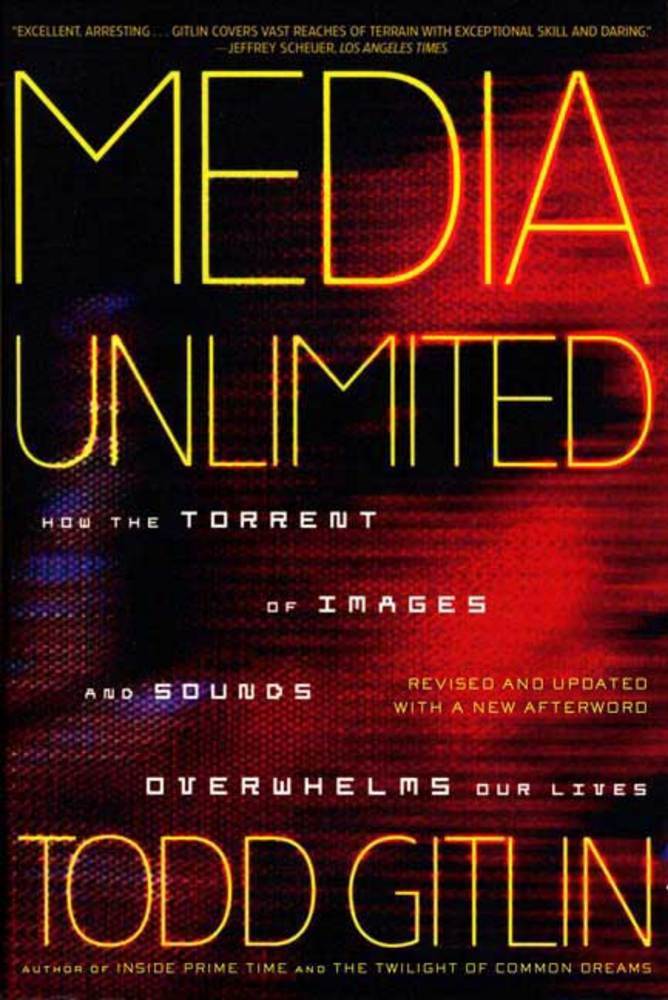
In his 2001 book Media Unlimited: How the Torrent of Images and Sounds Overwhelms Our Lives (Henry Holt & Co.), Todd Gitlin argues that our experience with omnipresent media creates in us what he describes as a new way of having emotions. We expect experiences to have an intense emotional impact immediately, but we want to be able to abandon these feelings just as quickly. Frenetic Java animations on a web page, fast-cutting 15-second commercials, 90-second news reports skimming the surface of hugely complicated stories: all are crafted to offer us a daisy-chain of disposable epiphanies. For commercial reasons, no mass-mediated experience can afford to make us turn off the set or turn from the screen to reflect on what we have seen or heard. We have to want to come back for more. Sensational intensity rather than contemplative depth is the ideal.
Gitlin situates this sensibility in a time long before TV or the Internet: in the Romantic reaction to Enlightenment rationalism, a reaction that established human feeling (and willing) as more fundamental and reliable than reason. Romanticism “urges us to heed the inner voice of feeling. Real life takes place in deep feeling, authentic feeling, feeling that must be protected from social impositions, feeling that was born free and longs to go native. The idea spreads that the individual is, above all, his or her feelings.”
But the demands of work, sustaining relationships, and participating in social life require some tempering or management of emotions. So, as Gitlin puts it, “Romanticism must be domesticated, made to fit into the niches of life. . . . Emotions must refresh, not drain or disrupt. They must be disposable and, if not free, at least low-cost.” The goal is a “society of nonstop popular culture that induces limited-liability feelings on demand — feelings that do not bind and sensations that feel like, or pass for, feelings.”
Gitlin’s thoughtful analysis exposes the way in which modern media don’t so much deliver information as they shape and intensify desires — and not just desires for things (the final goal of advertising) but the desire for love, acceptance, pleasure, security, power, happiness, even the desire for desire itself, or the desire for experiences that stoke desire. The restlessness sustained by mass media is a product as much of its form as its content, and the most powerful formal device the media uses to generate this restlessness is the sense of speed. “Speed on top of speed,” writes Todd Gitlin: “there is the swirling dynamic within a shot, and then the edit between one shot and the next. Montage is as relentless as the camera is restless. But in many instances, the camera movement and the quickcut editing conceals the fact that the images themselves are not that visually interesting. . . . Pictorially, they often lack interest. In other words, the pleasure of beholding these freestanding images speeding by is not strictly visual but amounts to a different sort of pleasure, the kind Mark Crispin Miller calls ‘subvisual’ — visceral pleasure at the disorientation that results from a sequence of bursts, pleasure at immersion in a wild procession of fragments.” I think that “lust of the eyes” is an apt description of this condition.
Gitlin’s politics and theology are far from my own, but I know of few books as insightful in analyzing the causes and effects of media saturation. If his diagnosis is correct, churches that re-tool their worship services to accommodate these sensational expectations are simply adding momentum to a severe cultural and personal disorder, which is an odd way to love your neighbors or make disciples.
This essay first appeared in the “Contours of Culture” column (Touchstone, November/December 2009)
This post was originally published on 2/19/13.
Related reading and listening
- To be at home in the world — D. C. Schindler examines how rituals enable us to experience time in a meaningful way — how they actually make time habitable for us. (41 minutes)
- How music blesses and teaches — FROM VOL. 64 Theologian and musician Jeremy Begbie explores what we learn about time, theology, and the structure of Creation from the experience of music. (28 minutes)
- A flood of images — Oliver O’Donovan describes the distinctive character of publicity in modernity, which drowns us in a flood of ever-changing representations that do not serve the common good. (37 minutes)
- “Earth-shaking” and “heart-breaking” beauty — FROM VOL. 151 Junius Johnson warns that the pursuit of beauty is both perilous and an experience that points to the desire for God. (25 minutes)
- Media as agencies of order — Media theorist John Durham Peters wants us to reexamine the purposes of media and how fundamental media are. (59 minutes)
- Thinking Together — Alan Jacobs discusses some principles he’s compiled to help us think well (and charitably) in our cultural context, and he warns us to be attentive to the ways technology displaces previously fixed communities. (53 minutes)
- The amplification of distraction — FROM VOL. 152 Jeffrey Bilbro advocates a Christian posture toward our contemporary digital media ecosystem that addresses its disorienting and disintegrating effects. (23 minutes)
- When time loses its shape — Dorothy Bass explains how practicing a Christian way of living each day, week, and year helps to reorient us to time in ways that honor creation, our communities, and our embodied lives. (22 minutes)
- A poet’s relationship to time — FROM VOL. 57 Poet Wilmer Mills (1969–2011) discusses how his agricultural and cross-cultural childhood in Brazil shaped his imagination and his relationship with modernity. (11 minutes)
- Impact of “infotainment” on community — Neil Gabler and C. John Sommerville discuss how the mentalities conveyed by our experience with communications media work against the nurturing of community. (36 minutes)
- Defined by what we buy — FROM VOL. 48 Gary Cross argues that Americans are uniquely susceptible to the temptation to define ourselves by what we buy. (10 minutes)
- Sensory overload — FROM VOL. 59 Todd Gitlin discusses the effects of media saturation on our mental and emotional lives. (14 minutes)
- The formation of affections — FROM VOL. 101 James K. A. Smith explains how education always involves the formation of affections and how the form of Christian education should imitate patterns of formation evident in historic Christian liturgy. (15 minutes)
- Infrastructures of addiction — Christopher Lasch on the subversive effects of the expectation of novelty
- Mars Hill Audio Journal, Volume 159 — FEATURED GUESTS:
Kirk Farney, Andrew Willard Jones, James L. Nolan, Jr., Andrew Kaethler, Peter Ramey, and Kathryn Wehr
- Music, passion, and politics — In this interview from 2001, Carson Holloway discusses his book All Shook Up: Music, Passion, and Politics, which summarizes the dramatic chasm between the classical and modern views of political ends and of musical means. (45 minutes)
- What makes our desires and action intelligible — David Bentley Hart on why we must believe that human beings are by nature inclined to the super-natural
- Mars Hill Audio Journal, Volume 152 — FEATURED GUESTS:
Elisabeth Lasch-Quinn, Jeffrey Bilbro, Zena Hitz, James L. Nolan, Jr., Bishop Robert Barron, and Jason Blakely
- Desire desires desire — Zygmunt Bauman on being a consumer in a consumer society
- The nature of freedom reconsidered — In anticipation of this Fall’s Areopagus Lecture entitled “‘For Freedom Set Free’: Retrieving Genuine Religious Liberty,” we present selections from interviews with three MARS HILL AUDIO guests who have raised questions about the modern understanding of freedom. (27 minutes)
- Mediated: Thomas de Zengotita on Postmodernity and the Flattered Self — Thomas de Zengotita describes how communication media contribute to the widespread sense of entitlement and of identity as an autonomous chooser. The postmodern self is what Zengotita calls “the flattered self,” increasingly believing itself to be the center of the universe. (59 minutes)
- Mars Hill Audio Journal, Volume 142 — FEATURED GUESTS:
Stanley Hauerwas, Perry L. Glanzer, Nathan F. Alleman, Jeffrey Bishop, Alan Jacobs, D. C. Schindler, and Marianne Wright
- Mars Hill Audio Journal, Volume 141 — FEATURED GUESTS:
Grant Wythoff, Susanna Lee, Gerald R. McDermott, Carlos Eire, Kelly Kapic, and James Matthew Wilson
- Martin Luther, Printing, and the Making of the Reformation — Historian Andrew Pettegree (Brand Luther: 1517, Printing, and the Making of the Reformation) describes how Luther’s facility for writing in German and his intuitive business sense spread ideas and transformed the distribution model of the printing industry. (55 minutes)
- Mars Hill Audio Journal, Volume 131 — FEATURED GUESTS:
John Durham Peters, Paul Heintzman, Richard Lints, Peter Harrison, Francis J. Beckwith, David L. Schindler, and Nicholas J. Healy, Jr.
- The burden of creating meaning — George Parkin Grant on the insatiability of the modern will
- Mars Hill Audio Journal, Volume 118 — FEATURED GUESTS: Gilbert Meilaender, Ron Highfield, Mark Mitchell, Daniel M. Bell, Jr., Helen Rhee, and Peter Brown
- Mars Hill Audio Journal, Volume 109 — FEATURED GUESTS: Douglas Coupland, Charles Mathewes, William T. Cavanaugh, William Dyrness, Steven Guthrie, and Susannah Clements
- Mars Hill Audio Journal, Volume 90 — FEATURED GUESTS: J. Mark Bertrand, Michael P. Schutt, Michael Ward, Dana Gioia, Makoto Fujimura, Gregory Edward Reynolds, Catherine Prescott, and Eugene Peterson
- Mars Hill Audio Journal, Volume 78 — FEATURED GUESTS: Mark Bauerlein, Elisabeth Lasch-Quinn, Sam Van Eman, Thomas de Zengotita, Eugene McCarraher, and John Witte, Jr.
- Mars Hill Audio Journal, Volume 68 — FEATURED GUESTS: Murray Milner, Jr., Steven C. Vryhof, Douglas J. Schuurman, Robert Gagnon, Richard Stivers, and Quentin Schultze
- Mars Hill Audio Journal, Volume 66 — FEATURED GUESTS: Leon Kass, Nigel Cameron, Susan Wise Bauer, Esther Lightcap Meek, John Shelton Lawrence, and Ralph Wood
- Mars Hill Audio Journal, Volume 64 — FEATURED GUESTS: Paul Berman, Jean Bethke Elshtain, Hadley Arkes, Ralph C. Wood, and Jeremy Begbie
- Mars Hill Audio Journal, Volume 59 — FEATURED GUESTS: Ron Hansen, Bernard Lewis, Alan Jacobs, Adrienne Chaplin, Todd Gitlin, and Quentin Schultze
- Mars Hill Audio Journal, Volume 57 — FEATURED GUESTS: John Hare, Clifford Putney, Andrei S. Markovits, Wilmer Mills, Steve Bruce, Colleen Carroll, Michael Budde, and Robert Brimlow
- Mars Hill Audio Journal, Volume 44 — FEATURED GUESTS: James Davison Hunter, Brian C. Robertson, David Myers, Robert Frank, Gayle Brandow Samuels, Thomas Hine, Thomas Hibbs, and Robin Leaver
- Mars Hill Audio Journal, Volume 42 — FEATURED GUESTS: Michael Kammen, Philip Fisher, John Horgan, William Dembski, Steven Garber, Dorothy Bass, Paul Vitz, J. Budziszewski, and David Aikman